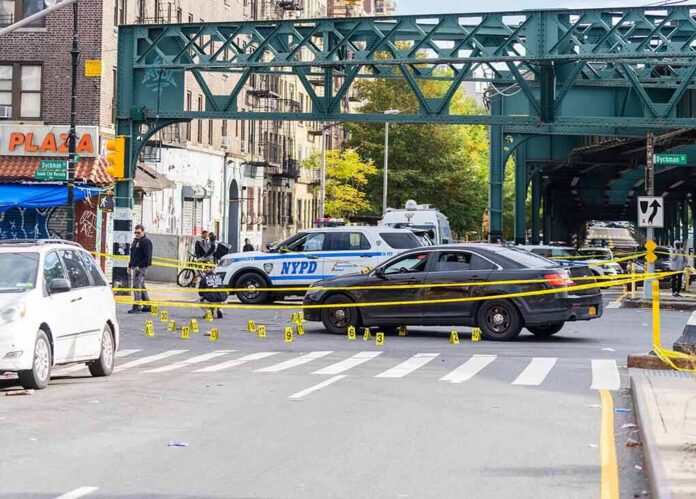
When a runner is murdered on a familiar public path, the shock travels far beyond one neighborhood—because it collides with two truths at once: the rarity of stranger-on-stranger homicide and the profound fear it triggers. The Brooklyn case of Katie Suarez sits precisely at that intersection: a lethal attack during an ordinary jog, an arrest days later, and a charging decision that now moves from headlines into the exacting machinery of criminal law.
At a Glance
- A 28-year-old runner, Katie Suarez, was stabbed along the Shore Parkway Greenway and died several days later.
- NYPD arrested and charged 27-year-old Sayed Mohassib with second-degree murder, tampering with physical evidence, and weapon possession.
- Police-linked reporting describes alleged statements by Mohassib about carrying a knife, blacking out, and later being covered in blood.
- Authorities have characterized the attack as apparently random; prosecutors now shoulder the burden of proving identity and intent in court.
What Happened: The Fatal Attack and the Charges
On an October evening along the Shore Parkway Greenway by the Belt Parkway waterfront in Brooklyn, Katie Suarez was stabbed at least twice in the neck while out for a run. She was transported for emergency treatment and died several days later. The facts of the assault and fatal causal chain—attack, medical intervention, death—are consistent across independent reports and law-enforcement accounts. Within days, detectives arrested Bath Beach resident Sayed Mohassib and prosecutors charged him with second-degree murder, tampering with physical evidence, and criminal possession of a weapon. Those are the central, uncontested pillars of the case as it stands publicly.
Police told reporters they developed evidence placing Mohassib at or near the scene. Outlets also attributed to law-enforcement sources a set of alleged statements by Mohassib: that he had been walking the path with a knife, blacked out, and later awoke covered in blood. Separately, sources suggested the weapon’s path might have included disposal into the garbage and movement through a Staten Island landfill, which would align with the paired charges of weapon possession and evidence tampering. These details come through police and police-sourced reporting, not courtroom transcripts, but they shape the initial investigative narrative now proceeding into litigation.
How Cases Like This Move from Shock to Law
From a legal perspective, the state’s task divides cleanly into identity, causation, and intent. Identity connects a specific defendant to a specific criminal act; causation links that act to the victim’s death; intent, for New York’s primary murder theory, requires that the perpetrator acted with the conscious objective to cause death. Second-degree murder under New York Penal Law § 125.25(1) is the classic intentional-homicide charge: the prosecution must prove beyond a reasonable doubt that the defendant intended to kill and did kill another person.
In many homicides, intent is inferred from conduct and circumstances—weapon choice, wound pattern, targeting of vital anatomy, repetition of blows, statements before or after the event. Two deep, penetrating neck wounds inflicted with a knife will ordinarily be argued as strongly probative of an intent to kill, particularly if accompanied by flight, concealment, or weapon disposal. Tampering with physical evidence—if proven—can function as both a separate crime and circumstantial evidence of consciousness of guilt. Those are familiar contours in violent-crime prosecutions, and they are why the charging package here is not unusual for a fatal stabbing.
The Reported Statements and What They Mean
Alleged defendant statements can be as decisive as DNA, or as fraught as any hearsay, depending on the facts: who heard them, when they were made, whether Miranda warnings were given and waived, and whether the statements are internally consistent and corroborated. The reporting here attributes to unnamed law-enforcement sources a version in which Mohassib said he had a knife, blacked out, and later found himself covered in blood. If that account is accurate and admissible, prosecutors will likely argue that the statement links the defendant to possession of the weapon and to the aftermath of the attack; the defense, by contrast, could point to the claimed blackout to undermine proof of intentional mental state. Courts do not treat “blackout” as a magic wand—it is a claim to be weighed against physical and digital evidence, medical history, and the coherence of the timeline.
In practice, prosecutors seek independent corroboration for critical admissions—location data, surveillance, trace evidence on clothing, recovery of a weapon consistent with the wounds—to satisfy both legal standards and common-sense juror expectations. The public reporting has referenced evidence “placing” the suspect at the scene and a believed disposal route for the knife; if those strands are borne out through forensics or documented retrievals, they can knit statements and physical proof into a single narrative of guilt.
Why “Random” Feels Different—and How Often It Actually Occurs
Stranger-on-stranger murders command outsized public attention because they threaten the ordinary routines we rely on—commutes, runs, errands—without the mediating logic of disputes, domestic histories, or criminal entanglements. Yet in the United States, the best syntheses of homicide clearance data suggest strangers account for a minority of killings—on the order of roughly one in ten during recent pre-pandemic years. That base rate matters: it explains why cases like Suarez’s reverberate so powerfully even as they remain statistically uncommon in the broader landscape of lethal violence.
Media dynamics amplify the effect. For decades, researchers have documented that news coverage disproportionately features vivid violent crimes and stranger-danger narratives relative to their share of overall offending. The result is a perceptual tilt: many people feel at greater ambient risk than their local crime patterns would justify, particularly after a highly salient attack in a familiar public place. Understanding this asymmetry is not a plea to minimize tragedy; it is a reminder that policy responses should be guided by evidence and risk patterns, not by the emotional gravity of the most shocking events.
Brooklyn Jogger Dies and a Man Is Charged With Murder in Her Stabbing – The New York Times https://t.co/Trnz4GGQpS
— @Gabriele Sar (@Gabenewsinfo) November 8, 2026
From Waterfront Path to Courtroom: What to Watch
As the case transitions from arrest to adjudication, three evidentiary arenas will likely define its trajectory. First, forensic linkage: whether blood, DNA, trace material, or wound morphology connects the recovered or hypothesized weapon to both the victim and the defendant in a manner consistent with the timeline. Second, the integrity and admissibility of any statements: recordings, Miranda forms, and corroboration will determine how much weight jurors can place on the reported blackout account. Third, digital and locational scaffolding: device location data, transit or plate-reader hits, and surveillance in the wider perimeter can stitch together presence, movement, and post-crime behavior in ways that either reinforce or erode reasonable doubt.
Meanwhile, the public frame—a runner killed on a dimly lit waterfront path many residents use daily—will continue to spur practical questions that run parallel to the prosecution: lighting, visibility corridors, emergency call access, and patrol patterns along linear parks and greenways. These are the everyday risk mitigations that, multiplied over time, lower the odds of opportunistic violence without reshaping a city’s identity as a place to live, work, and yes, run.
One Brief Caveat
Murder is a charge, not yet a conviction; the presumption of innocence applies until a jury returns a verdict or the defendant enters a plea.
Sources:
foxnews.com, nytimes.com, nydailynews.com, abcnews.com, nbcnews.com, fox5ny.com