

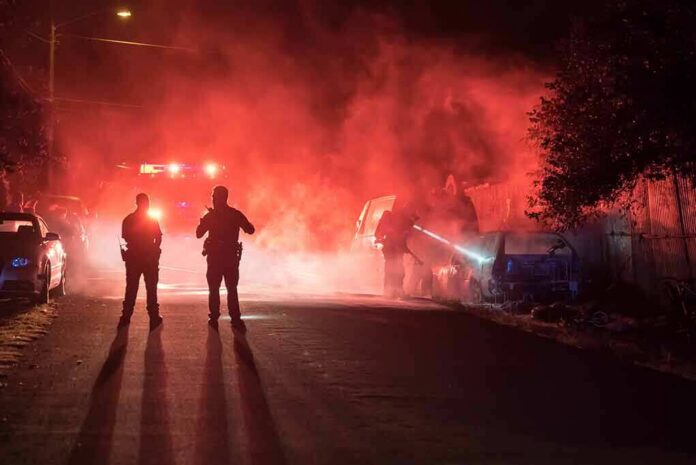
When a house fire yields two people shot to death and, hours later, police confront the suspected killer barricaded on a city bus, you are seeing multiple disciplines—homicide, arson, transit security, crisis negotiation—collide in one compressed timeline. That convergence is the point: modern urban policing is as much about managing fast-moving, multi-scene crises as it is about solving the crimes that triggered them.
At a Glance
- Firefighters discovered two women with apparent gunshot wounds inside a burning home; both were later pronounced dead at a hospital.
- Police then encountered an armed man who refused to leave a SEPTA Route 18 bus at the Fox Chase loop after the last passenger was dropped off.
- Authorities publicly linked the barricaded man to the double homicide investigation the same day.
- The bus standoff ended when the suspect suffered a self-inflicted gunshot wound and later died at a hospital.
What Happened and Why It Matters
Shortly before dawn, Philadelphia firefighters responded to a house fire on the 8200 block of Williams Avenue, where they found two women with gunshot wounds; both were transported and pronounced dead at Einstein Hospital. Within hours, attention shifted across the city to the Fox Chase transit loop, where a SEPTA Route 18 driver reported a male passenger who refused to exit at the end of the line. When police arrived, the man displayed a gun; the operator evacuated safely, and the scene escalated into a barricade on a city bus. Investigators publicly connected that armed passenger to the double homicide under investigation, tying together the fire scene in Northwest Philadelphia and the bus standoff in the Northeast.
The episode ended the way too many barricade scenarios do: the suspect shot himself on the bus and later died at a hospital, according to local reporting citing police and official sources. The arc is stark but regrettably familiar—an apparent domestic setting, the presence of a firearm, multiple fatalities, and a suicidal end to a prolonged negotiation window. Incidents like this are not statistical outliers in one important respect: across U.S. data, homicides and suicides frequently involve firearms, and many lethal encounters unfold in private residences rather than public spaces.
The Timeline Across Two Scenes
Fire call first, homicide discovery second: responders entered the Williams Avenue home and located two female victims with head wounds consistent with gunshots; they were removed and later pronounced dead. That same morning, a Route 18 bus operator reached the end-of-line loop at Fox Chase. After the last passenger should have departed, one man remained and refused to exit. According to contemporaneous accounts, the passenger told the driver to summon police; when officers arrived, the man produced a firearm, and the driver exited unharmed as the situation hardened into a barricade.
Police shut roads, staged negotiators, and held the perimeter through the morning and afternoon. During the standoff, officials said the man on the bus was connected to the double homicide from the Williams Avenue fire scene—a rare but decisive on-record linkage between two distant but same-day events. Hours later, the man sustained a self-inflicted gunshot wound and was transported to a hospital, where he died, ending any prospect of charging or trial in the case.
Identification, Family Ties, and On-Scene Reporting
Multiple local outlets cited relatives who identified the man as a family member of the women found at the house. Family members named the victims as Sadie Turner and Gabby Turner and described the barricaded suspect as their son and brother, respectively, underscoring the domestic context in which the violence began. While names and relationships surfaced through relatives in the first wave of coverage, the essential operational facts—two fatal shootings discovered during a fire response, an armed barricade on a SEPTA bus, and a self-inflicted gunshot ending the standoff—were carried by official statements and consistent multi-outlet reporting.
Across independent local reporting, the sequence remained stable: a residential fire and discovery of two women shot, the Route 18 bus barricade initiated after an end-of-line stop, public attribution connecting the armed man to the double homicide investigation, and a self-inflicted gunshot concluding the standoff. These are not the flourishes of a headline; they are the bones of the case that guided how police staged, contained, and ultimately closed a two-scene crisis.
How Crises Like This Are Managed
Transit systems plan for the improbable: an armed subject isolated in a vehicle at the end of the line. End-of-line loops are both a risk and an advantage—risk because an operator is briefly alone with remaining passengers; advantage because the geography is contained, ingress and egress are known, and responders can stage heavy assets, negotiators, and shields with less risk to bystanders. Once the operator exited and police established a perimeter, command priorities would have been clear: contain, communicate, and buy time while investigators established the suspect’s connection to the earlier shootings and assessed the presence of additional weapons or explosives.
Philadelphia has decades of experience with complex barricades and multi-agency coordination. Modern doctrine emphasizes negotiation and time over dynamic entry when there is no ongoing harm to others inside the barricade. In the bus setting, structural confines and lines of fire complicate tactical resolution; the agency’s bias toward a negotiated surrender is not only humane but risk-aware. Most barricades end without injury; the hardest variable to control is a subject’s intent to self-harm, which can outpace even the best-run containment.
The Broader Pattern: Firearms, Homes, and Lethal Outcomes
Cases that begin in a home and end in suicide are tragically consistent with a broad body of research: access to firearms increases the risk of both homicide and suicide for household members, often by multiples that persist even after accounting for other factors. Public-health surveillance shows that a majority of U.S. homicides and over half of suicides in recent years have involved firearms, and many of those events occur in residential settings rather than public ones. This is not a claim about motive in any one case; it is a structural observation about risk. When a lethal encounter begins at home, it is more likely to be rapid, final, and insulated from external interruption.
That pattern has implications for prevention. Domestic relationships—parents and adult children, siblings, intimate partners—can be both protective and combustible. Where there are warning behaviors, access to a firearm can transform a brief loss of control into irreversible tragedy. Crisis intervention orders, clinician-and-family pathways to temporary removal of firearms, and reentry planning for recently released individuals with known volatility are not abstractions; they are the levers that shift probabilities in the moments that matter most.
What This Means for Cities and Transit Agencies
For cities, the operational lesson is redundant but urgent: cross-train fire, police, EMS, and transit security to treat seemingly discrete calls—kitchen fire here, end-of-line dispute there—as potentially connected until they are not. That means information-sharing protocols that move faster than rumor; it also means equipping frontline operators with clear decision trees for disengagement when a passenger signals danger. The Fox Chase loop episode illustrated both: a bus operator who created time and space by exiting, and a citywide command spine that could connect a Residential A to a Transit B in near-real time.
For readers, the human lesson is uncomfortable but essential. Most lethal violence does not announce itself in advance with gangland stylings or Hollywood spectacle. It flashes in ordinary places—kitchens, bedrooms, end-of-line bus bays—where proximity and a trigger are enough. Aligning public-health risk reduction with police crisis management is not a slogan; it is the only practical way to compress the odds of a morning like this into something closer to zero.
Sources:
nypost.com, rnbphilly.com, metrophiladelphia.com, 6abc.com, audacy.com, fox29.com