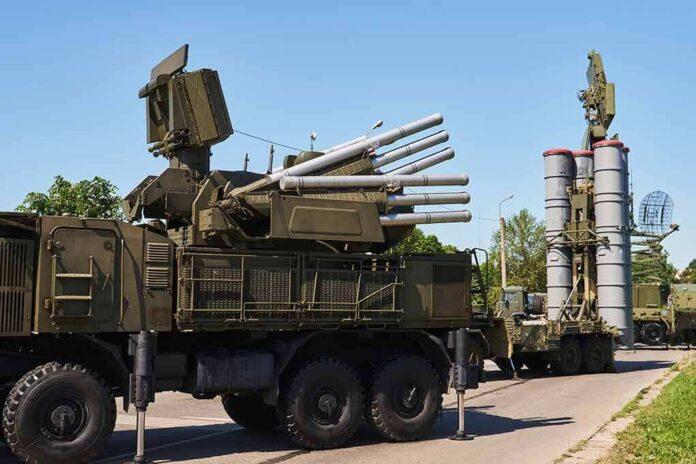
When Beijing moved to ban most sales and even marketing of retired military equipment, it did more than shut down a niche collector’s market; it codified a security-first doctrine that treats surplus hardware, online commerce, and even imitation gear as potential vectors for leaks, fraud, and reputational damage to the People’s Liberation Army.
At a Glance
- China’s Central Military Commission and state regulators jointly issued a nationwide ban on the sale of most retired or scrapped military equipment, citing risks to military secrecy and public safety.
- The notice also prohibits production, modification, assembly, and commercial promotion of imitation or reconstructed gear that could be mistaken for genuine military equipment.
- The policy carves out a narrow exception for “dual-use” dismantled parts sold through a designated state-owned asset management group under official catalogs.
- The move fits a long-running pattern in China: multi-agency security regulations used to tighten control over defense-adjacent markets and protect the institutional image of the armed forces.
A Multi-Agency Ban With a Clear Security Logic
The core of the new policy is straightforward and unusually explicit: China has decided that the commercial trade in retired or scrapped military equipment is too risky to leave to the market. In a joint notice published by the State Administration for Market Regulation and key departments under the Central Military Commission (CMC), authorities state that “any entity or individual” is now strictly prohibited from selling retired or scrapped military equipment. The definition of such equipment is broad, covering hardware that has been formally withdrawn from service and designated for disposal as scrap, including weapons, ammunition, devices, associated components, and specialized materials.
The notice explains why this seemingly narrow slice of commerce attracted high-level attention. In recent years, vendors have openly sold retired military items and associated “sensitive information” both online and offline, which officials say has caused “adverse effects” and created “security risks.” Those risks are framed in three dimensions: protection of state and military interests, elimination of public-safety hazards, and safeguarding the “good image” of the people’s army. The message is that surplus kit, when allowed to circulate in largely unregulated markets, can undermine secrecy, invite accidents, and erode the symbolic authority of the armed forces.
What Exactly Is Prohibited: Beyond Simple Resale
The notice goes well beyond banning simple resale of genuine surplus equipment. It closes off an entire ecosystem of quasi-military products and promotions that had sprung up around retired gear. First, it forbids any entity or individual from producing, modifying, or using dismantled retired equipment to “assemble or reassemble” items that could be viewed by the public as military equipment. In other words, one cannot legally take scrap parts from decommissioned vehicles or weapons, rebuild them, and sell or display them in a way that resembles operational kit. This covers outright reconstructions, cosmetic rebuilds, and potentially even some museum-style restorations if they rely on retired parts without military approval.
Second, the notice bans the sale of imitation gear that could be mistaken for real military equipment, even if no original parts are used. That sweeps in replicas designed for training, film and television production, or enthusiast markets—any product that, to an ordinary observer, looks like authentic PLA equipment. Third, the prohibition extends to commercial marketing: no unit or individual may engage in advertising, promotional events, or other marketing activities for retired military equipment or imitation products that could be perceived as such. This is notable because it treats the mere promotion of military-adjacent goods as a security issue, not just their physical circulation.
The Exception That Proves the Rule: State-Managed Dual-Use Sales
Despite its sweeping language, the policy does include a narrow but important exception. Retired military equipment is not entirely barred from civilian economic life; it can enter commercial channels under tightly controlled conditions. The notice allows sales of dismantled parts that have been formally listed in public catalogs issued by China Rongtong Asset Management Group, a state-owned enterprise designated to manage retired and scrapped military assets. These parts must be classified as “dual-use,” meaning they have legitimate civilian applications—industrial components, materials, or sub-systems that no longer carry operational military significance.
Additionally, equipment that has been specifically approved by the military for sale may be traded outside the forbidden category. Together, these carve-outs underscore the policy’s underlying calculus: the state is not opposed to extracting economic value from retired hardware, but insists that the process be channeled through an official asset-management regime that can vet items for security risk and control how they are described and marketed. Commercial value is permitted only where it does not conflict with secrecy, safety, or symbolic control.
Why Retired Equipment Became a Security Priority
To understand why Beijing is intervening at this level of detail, it helps to see retired equipment not as inert scrap, but as a data-rich artifact and a powerful symbol. Modern military hardware embodies design secrets, materials science choices, and configuration data that adversaries can exploit, even when the equipment is no longer cutting-edge. A decommissioned radar array or armored vehicle, for instance, can reveal how a system is integrated, what frequencies or armor compositions were used, or how logistics and maintenance are organized. Allowing such items to circulate unregulated, especially across online platforms, increases the risk that foreign buyers, intelligence services, or technically savvy hobbyists could acquire and analyze them.
The information risk is not limited to the hardware itself. Sellers frequently share detailed descriptions, photographs, serial numbers, and provenance in their listings, turning commerce sites into informal technical archives. Chinese authorities explicitly reference “sensitive information” associated with retired equipment as part of the problem, suggesting that what worried them was as much the metadata and visual documentation as the physical objects. At the same time, public-safety concerns are real: surplus ammunition, pyrotechnics, or partially demilitarized weapons can cause accidents if handled by untrained civilians or repurposed without proper safeguards. The combination of technical leakage and safety incidents is enough, in a system that prioritizes security, to justify a blanket prohibition.
Image Management and Control of the Military Brand
The inclusion of the PLA’s “good image” among the policy’s stated aims is not rhetorical padding; it points to a broader concern with how the military appears in domestic commerce and culture. When civilians outfit vehicles to resemble armored personnel carriers, sell replica uniforms, or market themed products using near-authentic gear, they blur the boundary between the professional armed forces and amusement, cosplay, or private security theatrics. From the state’s perspective, that can trivialize the military brand, invite impersonation, or facilitate fraud by actors posing as soldiers or officials.
By outlawing the assembly and sale of imitation equipment “sufficient to make the public regard it as military equipment,” the notice draws a bright line around the visual and symbolic identity of the PLA. Only the state and its approved institutions are to display or use such imagery. This is consistent with earlier Chinese efforts to crack down on illegal use of police insignia, unauthorized uniforms, and fake military documents, all framed as necessary to prevent scams and protect the dignity of state organs. In that sense, the retired-equipment ban is as much about narrative control as about hardware.
Several Chinese entities, including the Ministry of Public Security and the Central Military Commission, have announced a ban on the sale of retired military equipment to prevent its unauthorized circulation and strengthen oversight of defense assets.#China pic.twitter.com/1VDSSMq9lY
— 生态中国 (@EcologicalChina) July 29, 2026
A Familiar Regulatory Pattern in Security-First China
This joint notice slots into a well-established pattern of Chinese regulation at the intersection of markets and security. In sectors ranging from cybersecurity to rare-earth exports and unmanned aerial vehicles, Beijing has repeatedly identified commercial activities as possible channels for information leakage, safety incidents, or reputational harm, and responded with centralized rules issued by multiple agencies in concert. The structure here is textbook: a claim of risk based on recent problematic practices, a coordinated directive from military and civilian regulators, and a promise of stepped-up supervision and enforcement.
The notice calls on “relevant functional departments” to strengthen routine inspections of markets and advertising activities involving retired equipment, emphasizing inter-agency cooperation and ongoing oversight rather than one-off campaigns. Violations that endanger public safety or military secrecy are to be handled “seriously” under existing laws, and where conduct constitutes a crime, authorities pledge criminal prosecution. What remains opaque—typical for such Chinese regulations—is the detail of the underlying incidents that triggered the move: officials do not disclose specific cases, volumes of trade, or identified foreign buyers. The public sees the policy response, but not the forensic narrative behind it.
International Echoes and External Implications
Although the notice is domestic in scope, it resonates with concerns expressed in other countries about Chinese military and quasi-military commerce. The United States, for example, has its own prohibitions on acquiring certain items from “Communist Chinese Military Companies” when those items are on the U.S. Munitions List or sensitive export-control categories, reflecting a mirror-image fear of foreign defense supply chains intersecting with Chinese military-linked firms. Globally, governments are increasingly attentive to how surplus military hardware, training equipment, and dual-use components move through markets and across borders.
For foreign companies and collectors involved in Chinese surplus or replica markets, the implications of Beijing’s ban are direct. Any business model that relied on buying retired PLA gear, assembling replica vehicles, or using military-equipment imagery in commercial promotion now faces legal risk inside China. Even where trade occurred via cross-border e-commerce platforms, enforcement pressure can be applied to Chinese sellers, logistics providers, and payment channels. Over time, one should expect a tightening supply of authentic surplus PLA items in global collector markets and a more cautious environment for China-based firms involved in defense-adjacent goods.
What to Watch Next: Enforcement and Scope Creep
The text of the notice is clear; the real test lies in enforcement. Chinese regulators have at their disposal administrative fines, business-license revocations, and criminal charges for serious cases, but in practice implementation can be uneven across regions and platforms. A key signal will be how aggressively market supervision bureaus and public security organs move against online marketplaces, social media sellers, and small manufacturers that skirt the rules by marketing “decorative” items that resemble military gear. If early enforcement is visible and well publicized, it will likely have a strong deterrent effect.
Another question is whether the logic of this ban will extend further into related domains, such as civilian shooting clubs, paramilitary-style training services, or film and television prop houses that rely on realistic equipment. The language about items that could be “regarded by the public as military equipment” is broad enough to justify future expansions. For now, the policy is tightly framed as protecting secrecy, safety, and image around retired PLA hardware, but in a security-first regulatory environment, clear doctrines often seed wider controls over time.
Sources:
theepochtimes.com, money.udn.com, finance.sina.com.cn, news.china.com, acquisition.gov