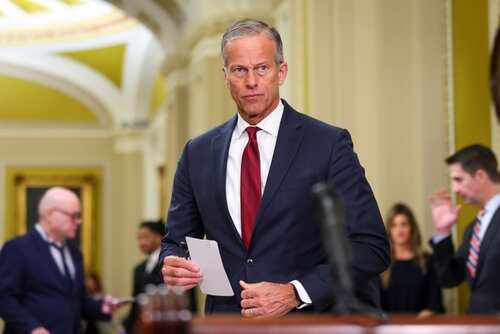
Senate Majority Leader John Thune has signaled that recess appointments may be on the table to break the logjam of President Trump’s stalled nominees—an option that underscores the deepening standoff in Congress and could reshape the balance of power in Washington.
Quick Take
- Senate Majority Leader Thune considers recess appointments to address backlog of Trump nominees
- The House, led by Speaker Johnson, blocks Senate recess using pro forma sessions
- The Supreme Court’s Noel Canning decision significantly restricts the president’s recess appointment power
- Gridlock highlights rising partisan tensions and constitutional maneuvering
Thune Weighs Constitutional Leverage Amid Nominee Gridlock
Senate Majority Leader John Thune (R-S.D.) has openly discussed deploying recess appointments to clear the mounting backlog of President Trump’s executive and judicial nominees. Such appointments, rooted in Article II of the U.S. Constitution, allow a president to temporarily fill vacancies when the Senate is in recess, but only under strict circumstances established by the Supreme Court. Thune’s comments—“everything is on the table”—reflect mounting frustration among conservatives over procedural roadblocks that have left critical government positions unfilled and the Trump agenda stalled.
Procedurally, the Senate cannot enter a recess of at least 10 days, as required for valid recess appointments, without House agreement. Speaker Mike Johnson (R-La.) has employed pro forma sessions every three days, a tactic designed to block the formal recess needed to trigger the president’s appointment power. This maneuver echoes similar strategies used in past administrations and follows the strict legal boundaries set by the Supreme Court’s 2014 decision in NLRB v. Noel Canning, which clarified that pro forma sessions are a lawful means for Congress to prevent recess appointments.
John Thune: Recess appointments on table as Senate faces backlog of nominees https://t.co/FWmNVcIubG
— The Hill (@thehill) July 31, 2025
Legal Limits: Supreme Court and Congressional Procedure
The Supreme Court’s ruling in Noel Canning established that recess appointments are only valid if the Senate has been in recess for at least 10 days, and that pro forma sessions—brief meetings often with no business conducted—are sufficient to prevent a qualifying recess. This precedent has greatly curtailed the president’s unilateral power to fill vacancies and made the House and Senate’s cooperation essential for any recess appointments to occur. The Congressional Research Service confirms that Congress can effectively block recess appointments by holding these brief, regular sessions, a fact that both parties have leveraged in recent years to maintain checks and balances within government.
Thune’s openness to recess appointments signals a willingness to use every available constitutional tool to advance the Trump administration’s priorities, but the legal and procedural hurdles remain formidable. The current standoff not only delays the staffing of crucial executive and judicial posts but also raises questions about the long-term impact on the Senate’s advice-and-consent role—a foundational aspect of American governance.
Partisan Tensions and the Stakes for Governance
The backlog of Trump nominees has fueled frustration among conservatives who see prolonged vacancies as a threat to effective governance and the implementation of the president’s policies. Critics of the current process argue that the use of pro forma sessions to block nominees is less about legitimate scrutiny and more about partisan gamesmanship that undermines the will of the voters. Legal scholars, however, caution that overuse or abuse of recess appointments could erode the Senate’s constitutional prerogatives and further politicize the appointment process.
The broader context includes increasing gridlock in the Senate over appointments, a trend that has accelerated in recent decades and has affected administrations of both parties. The Trump administration’s challenges echo earlier episodes, including President Obama’s failed recess appointments, which were ultimately struck down by the courts. The difference now lies in the heightened polarization and the willingness of congressional leaders to use every available procedural weapon to advance—or block—the president’s agenda.
What’s Next: Constitutional Balance or Continued Stalemate?
With no immediate resolution in sight, the standoff over recess appointments encapsulates the ongoing struggle between the executive and legislative branches for control over federal appointments. The stakes are significant: unfilled positions can hamper the functioning of government agencies and delay the implementation of key policies, from border security to economic management. While some on the right see recess appointments as a necessary countermeasure to Senate obstruction, others warn that resorting to this tactic could set a troubling precedent for future administrations of either party.
Ultimately, the outcome of this confrontation will likely shape not only the Trump administration’s ability to govern but also the enduring balance of power between Congress and the presidency. The watchwords now are vigilance and accountability as the constitutional process plays out in a climate of heightened partisanship and public scrutiny.
Sources:
Library of Congress: Recess Appointments FAQ
Citizens for Responsibility and Ethics in Washington: Abuse of recess appointments
Arnold & Porter: What Are Recess Appointments, and Will President-Elect Trump Bring Them Back?