

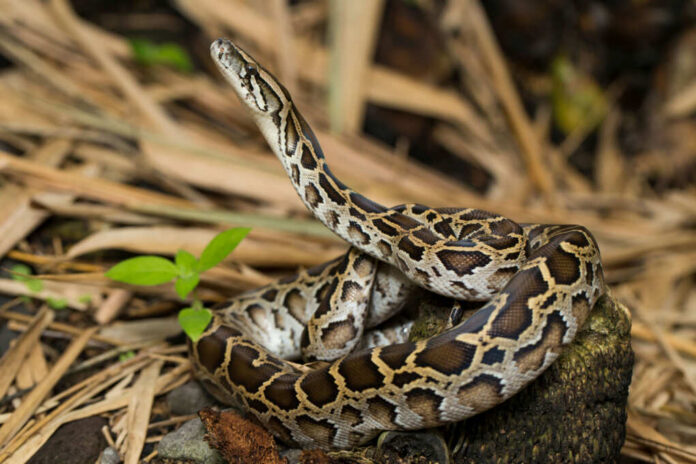
A snake that looks like two different species at once is forcing scientists to admit that “trust your eyes” can be the fastest way to get nature completely wrong.
Quick Take
- Researchers formally described a new venomous pit viper in central Myanmar: the Ayeyarwady pit viper (Trimeresurus ayeyarwadyensis).
- The snake’s coloring varies so much that it initially looked like a hybrid of two neighboring pit vipers—but genomic work confirmed it is a distinct species.
- The find underscores how modern DNA tools are reshaping species identification when outward appearance is misleading.
- Scientists mapped the species’ known range to the Ayeyarwady River basin, an area where geography may help isolate populations.
A “Hybrid-Looking” Viper Turns Out to Be Its Own Species
Researchers studying Asian pit vipers in Myanmar encountered a population that didn’t fit cleanly into known categories. Some individuals were dark green with blotches resembling the southern mangrove pit viper, while others appeared bright green and largely unmarked like the northern redtail pit viper. That kind of split presentation often triggers a simple explanation—hybridization—but the team used genomic techniques and concluded the animals represented a distinct species now named the Ayeyarwady pit viper.
The new species was formally described in January 2024 in the open-access journal ZooKeys, with herpetologist Dr. Chan Kin Onn as the lead figure highlighted in coverage. Chan’s background spans major museum and university research programs, and the work involved international collaboration. While public attention often focuses on the “new species” headline, the deeper story is about scientific method: careful field observations, a plausible first hypothesis, then genetic testing that overturns what appearance alone seemed to suggest.
Why the Trimeresurus Genus Keeps Tripping Up Visual ID
Asian pit vipers in the genus Trimeresurus are notoriously difficult to classify because some species look nearly identical while others vary widely within a single species. In this case, the two “look-alike” neighbors create a mental trap for both experts and amateurs: one is typically uniformly green, and the other often carries blotches and broader color variation. The Ayeyarwady pit viper breaks those assumptions by showing wide variation inside one lineage, blurring the borders that field guides rely on.
That matters beyond academic trivia because misidentification ripples into everything from biodiversity surveys to public health guidance in regions with venomous snakes. The research described no human bite incidents tied to the new species in the reporting available, and it did not announce any immediate conservation action. Still, accurate naming is the first step for any later decisions—where a snake lives, how common it is, and what resources should be devoted to studying it. Without solid taxonomy, governments and NGOs can’t reliably measure what’s at risk.
What Genomics Clarified—and What It Still Can’t Prove
Genomic analysis helped settle the central question: the snakes were not simply hybrids of the northern and southern pit vipers but a separate species. Coverage also relayed a cautious scientific inference: the team suspects the lineage may have exchanged genes with neighboring species sometime in the past. That kind of introgression can complicate evolutionary histories and may contribute to confusing appearances. However, the reporting frames this as a hypothesis rather than a proven cause-and-effect explanation for the snake’s variable look.
Geography, Range Mapping, and the Limits of What We Know
The Ayeyarwady pit viper’s reported distribution sits in central Myanmar along the Ayeyarwady River basin, bounded by river systems that help define where populations are found. River deltas and connected waterways can act as natural corridors or barriers, shaping how animals spread and how isolated they become. The available coverage does not describe ongoing field work or updated population estimates beyond the initial description, so readers should treat the known range as a snapshot based on collected specimens and surveys rather than a final map.
“Baffling” new snake species in Myanmar looks like multiple species at once https://t.co/nfKJduZUoh
— Drew Grimaldi (@Grimillionaire) April 22, 2026
For Americans watching science and institutions more broadly, there’s a familiar lesson here that cuts across politics: large systems often run on shortcuts until evidence forces a reset. In biology, “it looks like X” can be wrong; in public policy, “it sounds like it will work” can be wrong too. The best guardrail is transparency—clear methods, open data when possible, and humility about what’s confirmed versus what’s inferred. In this case, the most solid takeaway is straightforward: DNA evidence backed up the claim of a new species, while the gene-exchange idea remains tentative.
Sources:
“Baffling” New Species of Snake Discovered in Myanmar
“Baffling” New Species of Snake Discovered in Myanmar
Same and Different: A New Species of Pit Viper from Myanmar
Deadly new snake species described!