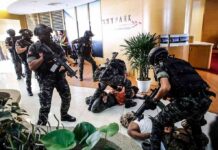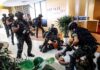

New DOJ surveillance footage shows just how close an armed suspect allegedly came to breaching a Secret Service checkpoint to reach President Trump at a high-profile Washington dinner.
Quick Take
- Federal prosecutors say Cole Tomas Allen, 31, tried to force his way through security at the Washington Hilton during the White House Correspondents’ Association Dinner on April 25, 2026.
- Authorities allege Allen carried a 12-gauge pump-action shotgun and a .38-caliber pistol, and that a Secret Service officer was shot in the chest but survived due to a ballistic vest.
- DOJ says Allen’s travel, hotel booking, weapons purchases, and a pre-attack email point to premeditation; he has been charged with attempting to assassinate the president.
- The case is reigniting concerns—across left and right—about political violence, elite institutions, and whether federal systems are capable of protecting the public and holding offenders fully accountable.
Footage release puts a violent security breach on the record
Federal prosecutors released surveillance footage tied to the April 25 incident at the Washington Hilton, where the annual White House Correspondents’ Association Dinner was being held. Investigators allege Cole Tomas Allen rushed a magnetometer checkpoint on the hotel’s Terrace Level around 8:40 p.m. while armed. Authorities say gunfire followed and a U.S. Secret Service officer was struck in the chest, surviving because of a ballistic vest. Allen was arrested shortly afterward.
The public release matters because it moves the story from rumor and cable-news framing into a piece of evidence people can see and evaluate. In an environment where many Americans distrust both legacy media and federal agencies, visual documentation tends to carry more weight than press statements alone. It also underscores a grim reality: even at an event with heavy protection—packed with political and media VIPs—security can be tested in seconds by a determined attacker.
Prosecutors outline a timeline that suggests planning, not spontaneity
DOJ filings describe a series of steps that, taken together, prosecutors argue show intent. Allen allegedly purchased a .38-caliber pistol in October 2023 and a 12-gauge pump-action shotgun in August 2025. Authorities say he reserved a Washington Hilton room on April 6, 2026 for April 24–26, then arrived in Washington by train on April 24 after traveling via Chicago from near Los Angeles. Prosecutors also reference a pre-attack email sent shortly before the incident.
From a public-safety standpoint, the timeline highlights how threats can develop long before a single checkpoint encounter. The weapons purchases span years, while the travel and lodging details suggest deliberate positioning ahead of the dinner. At the same time, the publicly available information is still limited about motive beyond what authorities describe in the email and the alleged behavior at the checkpoint. More detail could emerge through additional charges, court filings, and any defense response.
Official statements emphasize an assassination charge and a national-security lens
Federal officials have characterized the case as an attempted assassination rather than a generic shooting or disruption. DOJ announced Allen was charged with attempting to assassinate the president, and officials have highlighted the setting: a symbolic, high-visibility dinner that routinely gathers senior government figures and influential media. The government’s framing is significant because it sets the stakes for prosecution, detention arguments, and resource allocation, including how investigators coordinate between DOJ, FBI, and the Secret Service.
For many conservatives, the core issue is straightforward: a sitting president was allegedly targeted in a way that could have turned catastrophic, and the system must respond with clarity and force. For many liberals, the urgent concern is also straightforward: political violence is escalating and threatens democratic stability. Where distrust of “the deep state” and elite institutions enters is in the shared fear that political incentives—protecting reputations, narratives, or careers—can overshadow transparency and consistent enforcement.
What the incident signals about politics, institutions, and the year ahead
The attempted breach lands in a country already exhausted by polarization and by the sense that government is failing ordinary people. Republicans control Washington in 2026, while Democrats continue aggressive opposition; that broader fight often spills into rhetoric that paints opponents as existential threats. When that atmosphere collides with a real-world attack allegation, Americans on both sides tend to ask the same question: can institutions still keep order without turning every crisis into a messaging opportunity?
Justice Dept releases footage of Trump shooting suspect#worldnews #borneobulletin #topheadlines #headlines #JusticeDept #releases #footage #Trump #shootingsuspecthttps://t.co/qf6KR467Ug
— Borneo Bulletin (@borneo_bulletin) May 1, 2026
Practically, the case is likely to push tighter security protocols for major events and renewed debate over how agencies detect and disrupt threats earlier, including through travel and weapons-purchase indicators that are already lawful but potentially concerning in context. The available reporting also leaves key gaps—such as a fuller account of how Allen got to the checkpoint with the weapons and what additional evidence exists beyond the email. Those answers will likely come through court proceedings, not social-media speculation.
Sources:
Prosecutors release video of armed man storming correspondents’ dinner
Trump updates: Suspect arrested after shooting at correspondents’ dinner