
Household resilience fails first on basics: water, food, medications, light, and information. The 72-hour benchmark isn’t hype; it’s the minimum buffer that lets emergency services focus on life-threatening cases while your home rides out the initial shock without panic.
The Short Version
- Public agencies in the United States and abroad advise households to be self-sufficient for at least three days; water is the binding constraint, at roughly one gallon per person per day.
- After major disasters, responders may not reach every neighborhood quickly due to demand and access; roads and utilities can be impassable or offline. A 72-hour kit bridges that gap.
- Past surveys showed low kit assembly; more recent national data indicate improvement, but preparedness is uneven across items and actions.
- The fix is pragmatic, not apocalyptic: build a basic kit around water, calories, medications, sanitation, light, and communications, then maintain it like insurance.
Why 72 hours remains the operational threshold
The three-day standard exists because logistics do. When a storm, quake, or grid failure hits, local capacity is instantly oversubscribed. Clearing downed lines and trees, triaging medical calls, restoring substations, and opening access corridors all take time; even when personnel are available, physical constraints slow everything. County-level guidance in the United States is explicit that emergency services may be unavailable for up to 72 hours due to overwhelming demand or blocked roads. A household that can meet its own needs for those first three days reduces both personal risk and pressure on limited response assets.
Water dictates the tempo. Public guidance converges on a simple, actionable number: one gallon per person per day for drinking and sanitation. It is intentionally conservative—enough for hydration and minimal hygiene under average conditions—and it scales cleanly to families, roommates, and visiting relatives. The rest of the kit—nonperishable food, first aid, lighting, a radio, medications, sanitation supplies—aggregates around that core. The point is continuity of routine, not comfort: adequate fluids, calories, and information keep problems small and recoverable.
What the data actually say about American households
Surveys have long captured a gap between belief and behavior. A widely cited 2015 poll reported that 72% of respondents had made no effort to assemble an emergency supply kit, even as 86% agreed such a kit improves survival odds; many expected emergency services to help them, while others cited time constraints, avoidance, or uncertainty about what to do. Those barriers—optimism bias, competing priorities, and ambiguity—are durable features of human behavior.
The picture has evolved. FEMA’s 2024 National Household Survey found that 69% of respondents had assembled emergency supplies, and among those, 88% said their supplies would last more than three days—a marked improvement over the earlier narrative. Another nationally representative analysis of 16,725 households found that 68.9% met at least half of recommended preparedness items, with stronger performance on supplies than on action-based preparations like practicing plans. In short, preparedness is better than a decade ago but still uneven, with actions lagging behind acquisition.
How a 72-hour kit functions when systems fail
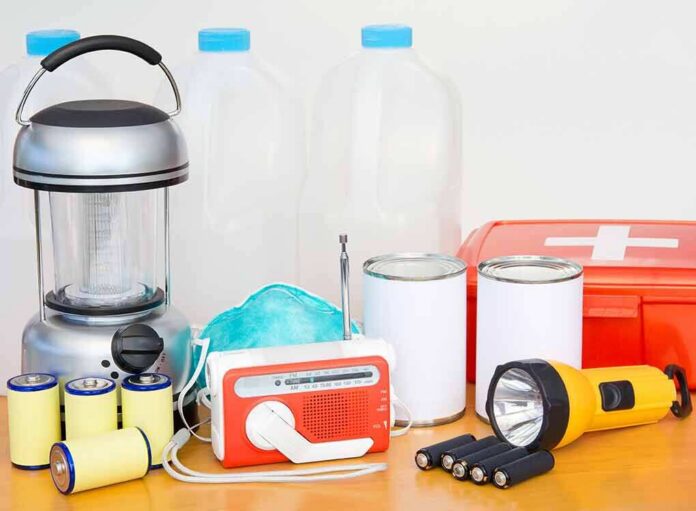
A credible kit is a system, not a tote of gadgets. Mechanically, it covers six domains:
Water: Store a minimum of one gallon per person per day, more in hot climates, for infants, and for medical needs. Containerize safely, label dates, and rotate. Add point-of-use treatment (filters, disinfectants) as redundancy.
Calories: Choose shelf-stable, no-cook or easy-cook foods your household actually eats—canned proteins, beans, soups, nut butters, bars—enough for three days, preferably a week. Calorie density matters more than novelty.
Medications and first aid: Maintain at least three days of prescription meds, with a pathway to extend to 30 days where possible. Stock common over-the-counter items and a first-aid kit sized to your household’s skill level.
Light and power: Flashlights and headlamps with spare batteries, plus a power bank to keep a phone alive. If you keep a small generator, know how to run it safely outdoors.
Information: A battery, solar, or hand-crank AM/FM/NOAA radio outruns cell congestion and power loss. Communications are a safety multiplier.
Sanitation and comfort: Hygiene items, trash bags, wet wipes, hand sanitizer, toilet paper, and basic tools (manual can opener) preserve dignity and reduce secondary risks. Add copies of key documents and a small reserve of cash.
Why people underprepare—and how to get past it
Most households are not constrained by knowledge alone; they are constrained by friction. The Chapman survey’s top barriers—expectations of external help, lack of time, avoidance, and uncertainty—map to practical solutions: simplify the task, sequence it, and normalize maintenance. Set an achievable floor (three days), break purchases into weekly increments, and tie maintenance to recurring reminders, like daylight-saving clock changes. The principle is the same one applied to retirement savings and flu shots: routine beats willpower.
Institutional messaging is not perfectly uniform—some countries recommend a week or more—but the signal to households is consistent: several days of self-sufficiency turns foreseeable disruption into inconvenience rather than crisis. Differences in duration reflect geography, hazard profiles, and civil-defense doctrine; they do not invalidate the U.S. three-day minimum. What matters is aligning supplies with your actual risks: heat waves strain water and power; winter storms elevate heat and carbon-monoxide safety; evacuation corridors change the value of “go bags” versus in-place stores.
What would you do if the power went out and you could not get online? Preparing can help you find your way, stay in touch and look after your household.
Visit: https://t.co/bKCvw8GQHo#Technology #Preparedness #Plan #Emergency pic.twitter.com/L4U3GrgQED
— Jenny Do Nascimento (@jdonascimento) November 15, 2026
What to do this month if you’re starting from zero
First, solve water. Acquire and fill containers to meet the one-gallon-per-person-per-day standard for three days; add a treatment method. Then build calories: three days of foods you already eat, requiring little or no cooking. Third, light and information: two flashlights, a headlamp, spare batteries, and an AM/FM/NOAA radio. Fourth, medications: consolidate lists, request refills early, and stage a three-day reserve. Fifth, sanitation: trash bags, wipes, toilet paper, hand sanitizer, and a plan for waste if water service fails. Finally, put a paper contact list with essential numbers in the kit and set a calendar reminder to check everything in six months.
The bottom line
Whether “most Americans” could last 72 hours is the wrong question to organize your life around. The right one is whether your own household can stay fed, hydrated, medicated, lit, and informed for three days without outside help. That is the threshold that keeps emergencies from cascading. Build to it, maintain it, and you will have done the single most effective thing a household can do to turn bad days into survivable ones. The rest—skills, extended reserves, neighbors you know by name—can build from there.
Sources:
unifiedfireut.gov, smccd.edu, blogs.chapman.edu, waynecountymi.gov, fema.gov, jamanetwork.com