A single, sudden fall can turn a routine afternoon into an emergency—especially at 77. Ric Flair’s hospitalization after a fall in Tampa is a clear example of how quickly head and facial injuries escalate, how emergency responders handle them, and why older adults face disproportionate risk.
At a Glance
- Ric Flair, 77, was transported by ambulance after a fall outside a Tampa restaurant; responders treated head and facial bleeding at the scene.
- Photographs showed medics tending to Flair on the ground and loading him onto a stretcher, consistent with a significant facial laceration and concern for concussion.
- Earlier that day, Flair publicly said he was dealing with a blood clot and had restricted travel—context, not proof of cause.
- Falls are a leading cause of traumatic brain injury hospitalizations, particularly in older adults; the mechanism described fits a high-frequency injury pattern.
What Happened: A Restaurant Visit, A Fall, An Ambulance Transport
Published reports place Ric Flair at Wagamama in Tampa on the day of the incident. After leaving personal items at the bar, he reportedly walked across the street, fell, and sustained a head and facial injury that bled heavily—enough to prompt an on-scene medical response and ambulance transport. This sequence is consistent across multiple outlets and supported by photographs described by independent publications, which showed emergency personnel treating Flair where he fell and loading him onto a stretcher. The injury profile—laceration near the eye, visible bleeding—matches the kind of high-vascular facial trauma common in ground-level falls, which can look dramatic even when the underlying structural damage is limited.
While some reports raised the possibility of a concussion, none cited a physician diagnosis at the time. That distinction matters medically but not operationally; field clinicians treat what they can see—bleeding, altered mentation if present, and any red flags that would accelerate transport. Head strike plus age plus visible bleeding is more than enough to warrant prompt evaluation, including imaging if indicated, once at the hospital.
The Medical Context: Why Falls At This Age Are So Dangerous
Among older adults, a fall is not a trivial event. The Centers for Disease Control and Prevention attributes nearly half of traumatic brain injury hospitalizations to falls, and older adults are more likely than younger groups to be hospitalized or die from TBI. Separate CDC data show more than one in four older adults experience a fall each year, with millions of emergency department visits tied to these incidents. The physics are unforgiving: a ground-level fall with head impact can transmit enough force to cause a concussion, intracranial bleeding, or complex facial lacerations. The vascular nature of the scalp and periocular tissues means even superficial cuts can bleed profusely. That is why the images described—medics at street level, controlling bleeding, preparing a stretcher—fit a textbook response to an age-associated, high-risk mechanism of injury.
Concussions in older adults also present differently. Symptoms—confusion, memory changes, headache, nausea, “feeling off”—may evolve over hours. Older brains are more susceptible to shearing forces and delayed bleeds, and comorbid medications such as antiplatelets or anticoagulants can magnify risk. Clinicians triage accordingly: stabilize, evaluate airway and neurological status, control bleeding, and expedite transport for imaging if the presentation suggests it. None of this requires exotic causation; a misstep, curb edge, or uneven pavement can be enough.
The Blood Clot Note: Relevant Background, Not Proof of Cause
Hours before the fall, Flair publicly said he was dealing with a blood clot in his leg, limiting his travel to three to four hours and prompting event cancellations. That disclosure is medically significant background—it can inform clinician thinking about mobility limits, vascular status, and medications—but it is not, by itself, a causal explanation for a fall. Blood clots in the leg (deep vein thromboses) chiefly raise concern for pain, swelling, and the risk of pulmonary embolism. They can affect gait or comfort, and some treatments (like blood thinners) can increase bleeding severity if trauma occurs, but none of that substitutes for an actual clinical determination of what precipitated a specific fall. The appropriate reading is straightforward: the clot is part of the health context, not the event’s established cause.
What is established is the sequence and the injuries visible at the scene: a restaurant visit, a fall outdoors, facial and head bleeding, and ambulance transport with medics photographed intervening. That is enough to understand why this became an urgent matter, and why clinicians would take it seriously regardless of any underlying conditions.
Inside the Emergency Response: What Medics Likely Did And Why
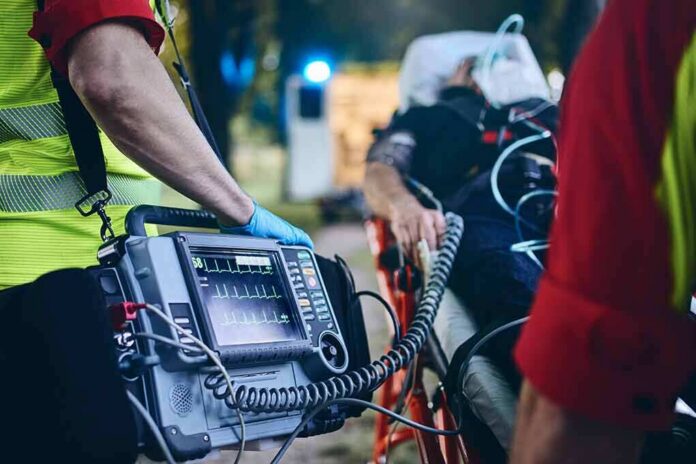
In a fall with head strike in an older adult, paramedics prioritize airway, breathing, and circulation, then neurological assessment using tools like the Glasgow Coma Scale. They control obvious bleeding, protect the cervical spine if mechanism or exam suggests risk, and check for anticoagulant use, as that can change thresholds for imaging and observation. Facial lacerations near the eye trigger careful inspection for orbital involvement, corneal injury, and vision changes; copious irrigation and pressure dressings are common to manage bleeding while preserving ocular integrity. Transport decisions hinge on the possibility of intracranial injury and the patient’s age—both factors that typically lower the threshold for hospital evaluation.
The described scene—extensive bleeding and stretcher transport—tracks with that playbook. Even if the patient appears alert, clinicians know intracranial complications can be delayed in older adults. Hospital care then proceeds to imaging (often CT head), wound management, and observation or admission if any concerning findings emerge.
Why This Fits a Broader Pattern—and Why It Still Matters
This incident is not an outlier; it matches the epidemiology. Falls are the dominant cause of TBI hospitalizations, and their prevalence in older adults makes them a leading driver of emergency transports nationwide. What varies case to case is the outcome—anything from sutures and discharge to neurosurgical intervention. Public figures bring attention to the issue, but the mechanism is the same on any sidewalk. For families, the practical takeaway is unglamorous but life-preserving: assess footwear and ground surfaces, mind medications that affect balance or bleeding, and treat any head strike with prompt medical evaluation.
Flair’s status as a household name gives this story oxygen; the clinical logic is universal. A conspicuous facial laceration and concern for concussion after a fall at 77 demand care. The reporting describes exactly that, including the moment medics took over and the ambulance doors closed. One brief caveat: early reports referenced a possible concussion without a formal diagnosis, a common and sensible caution while clinical teams complete imaging and observation.
WWE legend Ric Flair, 77, was taken by ambulance to a hospital on Friday, October 23, after reportedly falling near Wagamama restaurant in Tampa, Florida. According to TMZ, Flair left his phone and drink at the bar and walked across the street before suddenly falling, suffering…
— Raphousetv (RHTV) (@raphousetv2) October 23, 2026
The Bottom Line
Ric Flair fell outside a Tampa restaurant and was taken to the hospital after sustaining a head and facial injury with significant bleeding. The timeline and scene are consistent across outlets, with photographs described of medics treating and transporting him. Earlier that day, he had publicly discussed a blood clot and travel limits—a meaningful health detail but not a proven cause of the fall. Clinically, this is the archetype of an older-adult fall that warrants rapid evaluation because the stakes are high and the signs—head impact, bleeding—are unambiguous. The medical facts of falls do not spare icons. They apply to all of us.
Sources:
washingtontimes.com, wthr.com, tmz.com, f4wonline.com, cdc.gov