

When a clandestine sea crossing fails, the first facts that harden are the ones radioed in distress: a mayday, a position, a headcount of the living—and a number still missing. Everything else, including the most sensational details, is secondary to that arithmetic.
The Short Version
- A mayday call about a waterlogged vessel 140 miles west of Ensenada triggered a U.S.–Mexico air-and-sea rescue.
- Sixteen people were pulled from the Pacific; authorities continued searching for 11 others believed missing.
- Survivors included Mexican nationals, according to Mexico’s consulate; injuries consistent with shark bites were reported among some rescued.
- The case aligns with a recurring Pacific smuggling corridor where overloaded boats, opaque manifests, and cross-border jurisdiction complicate outcomes.
What Happened: A Rescue Built Around a Distress Call
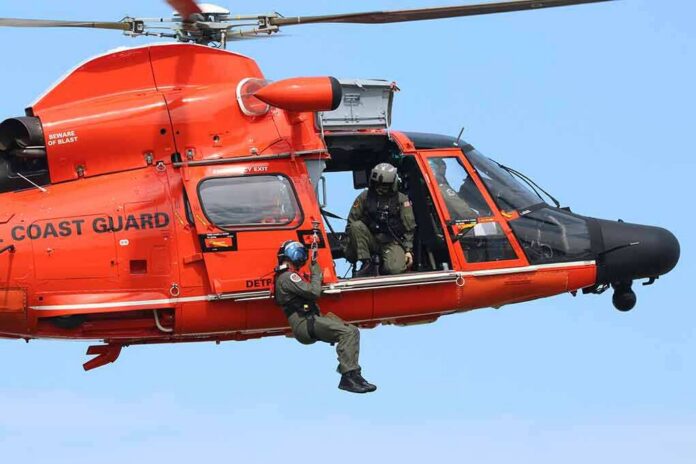
In the predawn hours, watchstanders took a mayday from a vessel reported to be filling with water far offshore in the Pacific, roughly 140 miles west of Ensenada, Baja California. The response that followed—U.S. Coast Guard aircraft and cutters, with support from U.S. Navy and Mexican Navy assets—was the standard playbook for a long-range search-and-rescue case: fix the last known position, fan out in search patterns matched to drift models, and collect survivors as quickly as sea state and daylight allow. By the end of the initial operation, rescuers had pulled 16 people from the water and continued searching for 11 more believed missing, a total consistent with accounts that the boat carried 27 people when it capsized.
The nationality of those rescued was not speculation; Mexico’s consulate in San Diego told reporters the survivors were Mexican nationals, an attribution that normally reflects hospital or consular intake with identities verified against government records. Several survivors were treated for injuries described by authorities as consistent with shark bites—wound patterns that emergency physicians in coastal regions are trained to recognize—though nothing in the public reporting ties sharks to the vessel’s capsizing or confirms their involvement with those unaccounted for.
How These Cases Unfold at Sea
Maritime rescues hinge on time, location, and numbers. A mayday provides the first two; the third is far more fluid. In irregular crossings, there is rarely a passenger manifest, and survivor counts are initially stitched together from radio traffic, on-scene interviews, and medical triage. Search planners then apply drift models that factor wind, current, and sea surface temperature to determine likely survivor positions over time. In the Pacific approaches to Southern California and northern Baja, distances are large, response times are long, and nighttime capsizes are unforgiving; hypothermia, fatigue, dehydration, and predation risks rise with every hour in the water. Even with robust air coverage, the ocean’s scale means that searches can end with survivors rescued, debris recovered, and a residual group listed as missing rather than confirmed deceased.
When injuries consistent with shark bites surface in medical reports, they change triage and trauma care but rarely the causation of the casualty itself. Marine biologists and forensic clinicians can differentiate bite patterns from propeller strikes or impact lacerations, but that analysis typically comes later. The immediate operational priority remains constant: fix survivors’ locations, stabilize them medically, and keep searching along the expanding drift arc for the missing.
Why This Route Is Repeatedly Deadly
This episode is not an outlier; it reflects a known smuggling corridor along the Pacific coast. Over the past several years, small, fast pangas and other unsuitable craft have been used to move people northward, often well offshore to evade patrols. Accidents recur: fatalities off San Diego in 2023, deaths after a panga overturned north of the border in 2025, and convictions tied to overloaded vessels in prior years. The pattern is structural—overcrowded, underpowered boats operating at night, in ocean swells, with limited safety gear and no redundancy. When trouble starts—an engine failure, a following sea that swamps the stern, a misjudged turn in a trough—capsizes are abrupt and violent. Passengers without lifejackets, or with counterfeit or ill-fitting ones, are at acute risk of drowning before rescuers can arrive.
Quantifying the human toll is harder. The International Organization for Migration has documented that deaths and disappearances among migrants are consistently undercounted, including in the Americas; irregular journeys lack paperwork, bodies are not always recovered, and incidents far from shore often leave only survivor testimony and rescue logs. Between 2014 and 2018 alone, IOM recorded at least 2,959 migration-related deaths in the Americas, a minimum estimate given systemic data gaps.
The Numbers That Matter—and the Ones That Don’t
In the first reporting cycle after a mass rescue, two numbers matter most: how many were saved, and how many remain unaccounted for. Here, those figures—16 rescued, 11 missing—anchor the public understanding of the case and align across outlets citing official rescue information. Details that draw disproportionate attention in headlines, such as suspected shark bites, are clinically relevant but not dispositive of the event’s cause or the fate of those missing. The claim of a 27-person total reflects survivor and responder accounts; in the absence of a formal manifest, such composites are routine in maritime migration incidents and are treated operationally as the working headcount for search planning.
Jurisdiction can complicate both the rescue and the public record. Occurring well off Mexico’s coast with U.S. and Mexican forces engaged, a case like this is managed through established bilateral coordination but documented across multiple agencies, each with its own reporting cadence. Final determinations—cause of casualty, definitive death counts, identification of organizers—often take longer than public attention permits, which is why responsible reporting stays tethered to the hard early data: mayday received, position searched, survivors recovered, missing still sought.
Lessons That Persist Beyond One Tragedy
Three points travel well from case to case. First, offshore smuggling routes turn small-vessel mishaps into mass-casualty events because they occur far from immediate help; that time-distance penalty is immutable. Second, the absence of a manifest is not a bureaucratic footnote—it directly shapes how long and how widely rescuers must search, and how confidently authorities can later speak about the final toll. Third, sensational details can obscure the lifeline of facts that rescue professionals use to allocate assets and save lives; the integrity of that core arithmetic—how many, where, when—matters more than any single dramatic element.
Sources:
ibtimes.co.uk, geo.tv, cbc.ca, marinelink.com