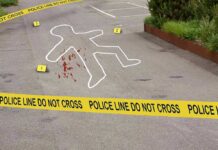


When a homicide unfolds in the lee of a custody fight, the most reliable through-line is not ideology or internet spin but proximity, opportunity, and the paper trail: who was there, what they allegedly did, and what prosecutors can actually prove.
At a Glance
- Arrests occurred within minutes near the Dublin Sports Grounds; reporting describes a firearm recovered from one suspect and witnesses placing both at the scene.
- Prosecutors allege the elderly in-laws took turns firing during a supervised child visit; charges include murder, conspiracy, and child endangerment.
- The defense denies premeditation and frames the shooting as a fear-driven reaction in the context of a fraught custody dispute.
- The strongest evidence in public view concerns presence, timing, and arrest circumstances; motive and full forensic linkage remain to be litigated.
What the public record reliably establishes so far
Across the most detailed accounts, several core facts converge. Jonathan McKinsey, a New York Times engineering director, was shot multiple times in the parking lot of the Dublin Sports Grounds and died at the scene. The suspects—identified as his in-laws, both in their late seventies—were detained close in time and space to the gunfire. Local reporting, sourcing police, states they were stopped within minutes and that officers recovered a gun from Shili (also rendered She Li) Chen; multiple outlets quote witnesses who place both at or leaving the scene immediately after the shooting. In subsequent coverage of unsealed filings, prosecutors assert that the pair appeared during McKinsey’s scheduled visit with his children and took turns shooting him. These are consequential anchors: presence, apprehension window, and a stated prosecutorial theory of joint action.
The charging posture is equally clear. Beyond murder, the docket includes conspiracy and firearms-related counts, along with child endangerment tied to the alleged circumstances of the shooting. That portfolio is not decoration; conspiracy signals the state’s intent to prove agreement and coordinated conduct, not mere coincidental proximity. The homicide did not occur in a vacuum: the parties were enmeshed in a live custody litigation that, according to reporting, was set to resume days later, and the encounter was during a supervised visit—facts that help explain why all three elements (alleged perpetrators, victim, and children) intersected in a municipal parking lot that day.
Where the state’s case is strongest—and where it is not yet public
Proximity evidence—being on scene, arrested within minutes, and associated with a recovered firearm—often carries outsized weight in a homicide prosecution because it ties actors to the event window before narratives have time to drift. Here, media-summarized affidavits further allege a shared use of the gun, which, if borne out by ballistics, prints, DNA, or gunshot residue, would reinforce a theory of concerted action. But the granular forensics that would clinch sequence, weapon linkage to wounds, and which hands fired which shots have not been published in full; neither have the autopsy and trajectory analyses that translate chaotic eyewitness impressions into a physicist’s map of what actually happened.
Witness accounts reported so far are indirect—filtered through outlets rather than on-the-record transcripts—and not perfectly harmonized. One thread describes the pair calmly walking away; another has them departing in a black Honda Civic. Such discrepancies are common early; surveillance video, license-plate-reader hits, and officer narratives usually settle them. Until discovery is aired in court, those details sit in suspension without undermining the bedrock facts already supported by the arrests, charging instruments, and the victim’s death at the scene.
The defense framing: fear, spontaneity, and the custody backdrop
Defense counsel has advanced a straightforward counter: no premeditation, no plan, an elderly couple acting out of fear for grandchildren after seeing something alarming during the supervised visit. Counsel also says the pair began carrying firearms months earlier due to alleged threats from McKinsey, including a threat to hire a hitman, and points to public court filings he characterizes as documenting volatility and danger in the family system. As a matter of criminal law, this is an appeal to negate intent and, if facts eventually support it, to build a narrative toward imperfect self-defense or heat-of-passion mitigation rather than outright justification.
At this stage, however, the defense case in the public square is attorney-sourced rather than evidence-sourced. No independent release of corroborating messages, threat reports, or third-party documentation has been surfaced in the coverage to date. That does not make it false; it makes it untested. Meanwhile, the state’s allegation that the defendants arrived at a supervised exchange with firearms and alternated shots, if paired with forensics, is structurally consistent with premeditation and conspiracy theories of liability. A jury will ultimately translate these rival stories—spontaneous fear versus coordinated shooting—into findings on intent and culpability when the factual spine is fully in view.
How custody disputes intersect with lethal risk
Step back from the particulars and a pattern emerges that researchers of family violence have documented for years: the period around separation, active custody litigation, and contested access to children is a high-risk window for escalation. A synthesis of post-separation abuse research links family-court involvement to a large share of family homicides in multi-victim events; other work catalogues how relationship breakdown, legal stressors, and control dynamics can concentrate risk even as outside observers assume the system is “handling it”. None of that proves who shot whom on a given Saturday afternoon. It does explain why supervised exchanges at public parks—intended as harm-reduction—sometimes become the locus of exactly the harm they are designed to prevent.
This case has additional accelerants. The victim’s transgender identity and competing abuse allegations ensure the story is read through culture-war prisms, which are poor guides to evidence. Social-media amplification and early headlines tend to alchemize allegations into assumed narratives of guilt or innocence; a substantial literature on pretrial publicity shows how volume and framing can shape lay judgments long before a judge rules on admissibility or a jury hears expert testimony. For anyone trying to understand what happened—and for any court trying to seat an impartial jury—resisting that gravitational pull is not optional; it is the work.
A shocking legal battle has emerged surrounding the death of a former New York Times executive. A lawyer claims the transgender executive threatened his mother-in-law with a hitman before she and her husband allegedly killed him. 🎥 Watch the full video for more details pic.twitter.com/8wkw3qU77q
— FrontPageDetectives (@FP_Detectives) October 21, 2026
What will matter next: evidence with adjudicative weight
The decisive materials are the ones still largely withheld from public view but routine in discovery: the unsealed complaints and affidavits in their entirety; 911 recordings and dispatch logs that fix time and movement; security video and license-plate-reader data to trace arrival and departure; and, above all, the forensics that marry bullets, casings, and wounds to specific weapons and handlers. Gunshot residue, latent prints and touch DNA on the firearm(s), ownership and purchase histories, and cell-site records can either substantiate a coordinated plan or move the needle toward a chaotic, fear-driven confrontation. The coroner’s report—wound paths, stippling, distances—will arbitrate between close-quarters struggle and standoff execution theories.
If the state’s alternating-shots allegation survives evidentiary scrutiny and pairs cleanly with recovered weapons and biological trace, the conspiracy scaffolding holds. If, instead, the evidentiary record shows a single shooter, indeterminate handling, or a precipitating event consistent with a sudden fight at a supervised exchange, the jury’s calculus on intent and degree will look different. Both scenarios are contemplated in the current posture, which is why seasoned observers resist overconfidence before the reports are in.
How to read contested, high-profile homicides without losing the plot
Three practical heuristics apply. First, treat earliest, specific facts with the most persistence—time, place, arrest proximity, and physical recoveries—because those change least as narratives evolve. Second, distinguish allegations whose proof rests on laboratory work or documents yet to be filed from those already tied to a chain of custody; patience here is not virtue signaling, it is epistemology. Third, discount rhetoric that leans on identity templates to smuggle in conclusions; what matters in a courtroom is mens rea and actus reus anchored to admissible proof, not what any camp infers from who the players are.
Sources:
nypost.com, abc7news.com, iheart.com, latimes.com, union-bulletin.com, fox5ny.com, marca.com, sundayguardianlive.com