

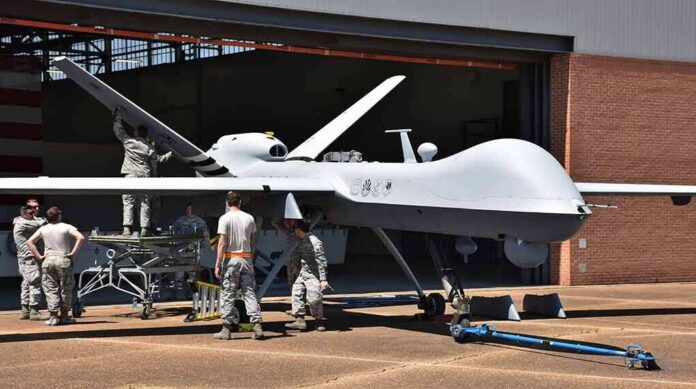
When Iran publicizes “battlefield trophies” from downed or captured MQ-9 Reaper drones, it is doing more than gloating; it is executing a calibrated information operation that leverages a real vulnerability in high-value unmanned systems to signal deterrence, project technical competence, and shape perceptions across the region and beyond.
At a Glance
- Iranian state media and IRGC channels have repeatedly released video and imagery claiming shootdowns or recoveries of U.S. MQ-9 Reaper drones; this is a coordinated narrative, not an isolated boast.
- The messaging deliberately blurs distinctions between shootdown, wreckage recovery, and intact capture—three different outcomes with very different military meanings.
- The Reaper is a valuable, comparatively fragile platform in high-threat air defense environments; losses—real or perceived—carry outsized political and psychological weight.
- Iran’s “trophy” showcases serve strategic goals: bolstering domestic morale, signaling deterrence to adversaries, and advertising competence to allies and partners.
Iran’s Claims: A Coordinated, Repeating Script
Iran’s state-linked outlets have asserted that the Islamic Revolutionary Guard Corps (IRGC) shot down U.S. MQ-9 Reaper drones and released videos presented as the moment of interception, alongside images of debris or display halls featuring recovered airframes. Tasnim News framed one such incident as an IRGC air-defense interception over Bushehr Province, distributing footage as proof. The same narrative was echoed across aligned social accounts and syndicating outlets, producing a synchronized wave: a dramatic interception clip, a tour of wreckage, and declarative captions describing a U.S. asset destroyed over southern Iran or in the Strait of Hormuz. In this ecosystem, virality is the point; the consistency across channels is the tell.
The repeating pattern matters. First, it establishes perceived momentum—if audiences encounter “another downed MQ‑9” every few weeks, the cumulative impression is attritional and demoralizing. Second, iteration normalizes escalatory claims: single events invite skepticism; a drumbeat of similar stories encourages acceptance. Third, repetition exploits a structural asymmetry—verification of air incidents takes time, while video releases are immediate and emotionally vivid. In the attention market, first movers usually win, and Iran behaves like a first mover by design.
What Counts as a “Trophy” and Why the Distinction Matters
Not all “drone down” stories are created equal. A shootdown implies successful detection, tracking, and engagement—competence in layered air defense. Wreckage recovery might follow a shootdown; it could also follow a malfunction or a forced landing. “Intact capture” is different again, suggesting electronic warfare effects such as datalink disruption, satellite navigation spoofing, or remote takeover, followed by ground seizure. Iranian outlets and amplifiers often compress these outcomes into a single, triumphant headline—intercepted, destroyed, displayed—papering over the technical and strategic gulf between burning debris and a recoverable, analyzable airframe.
The distinction is not pedantry. Intact capture—if true—yields intelligence on sensors, waveforms, and mission profiles; wreckage offers fragments of that value; a shootdown without recovery is mostly about signaling and attrition. When the same campaign claims multiple categories interchangeably, the audience should parse each assertion separately: what exactly is shown, where, and with what corroboration?
Mechanism: How a Reaper Gets Vulnerable
The MQ‑9 is optimized for persistence, payload, and multi-sensor reconnaissance-strike missions; it is not a stealth aircraft or a suppression-of-enemy-air-defenses (SEAD) platform. In permissive airspace, it is formidable. In contested zones bristling with radar-guided missiles, optical trackers, and man-portable air-defense systems (MANPADS), it is at risk—more so at lower altitudes and predictable orbits. The IRGC’s layered approach blends fixed-site radars, mobile launchers, and point-defense systems near critical terrain such as the Strait of Hormuz choke points. In that envelope, a large, slow UAV can be detected and engaged, especially if adversaries amass sensors and shooters along narrow air corridors. These are textbook conditions for a headline-grabbing intercept.
Electronic warfare introduces additional vectors. If communications links or navigation inputs are degraded, a Reaper can be forced to abort or, in edge cases, descend. Even without decisive EW control, the mere threat can shape UAV routing into more predictable patterns—ironically increasing exposure to air defenses. In other words, the tactical chessboard allows for Iranian agencies to manufacture dilemmas; any misstep becomes fodder for another video.
The Information Strategy Behind the Footage
Iran’s media choreography treats every alleged intercept as a multi-audience event. Domestically, it reassures supporters that Iranian skies are defended and that Western technology is not invincible. Regionally, it signals to Gulf states and allied militias that Tehran can contest U.S. surveillance and strike cycles. Internationally, it attempts to complicate the political calculus of adversaries by portraying U.S. assets as attritable and vulnerable. Tasnim and aligned platforms perform distinct roles in this ecosystem—one offers quasi-official voice; the others provide amplification, spectacle, and plausible deniability around specifics.
The visual grammar is consistent: night-vision missile launches, thermal blooms, grainy silhouettes, then a cut to debris or a warehouse tableau of recovered components. The sequencing implies causality—“this launch produced that wreckage”—even if the footage originates from different incidents or dates. That editorial montage is the technique; the psychological effect is the product.
What the Sources Do—and Don’t—Prove
Tasnim’s on-record framing (“IRGC air defenses intercepted and destroyed a US MQ‑9”) offers a clear, attributable claim. Social videos and syndicated clips repeat the allegation and, at times, display debris consistent with Reaper components, but they vary in quality and provenance. In several cycles, the strongest evidence shown publicly is video that appears to depict a surface-to-air engagement at night; it asserts but does not, by itself, authenticate location, target type, or date. That gap is precisely what information operators exploit—most viewers will not wait for telemetry or serial numbers before forming an impression.
In short: the Iranian narrative is cohesive and persistent; some visuals plausibly match Reaper signatures; and the strategic logic for Iran’s messaging is sound. What remains variable is the degree of technical validation available in the public domain at the moment claims are made. That variability does not erase the core point of the campaign; it is the campaign.
Regional Military Logic: Why the Reaper Still Flies
If the IRGC can threaten MQ‑9s, why use them? Because the platform’s endurance, sensor fusion, and strike integration remain uniquely valuable for persistent intelligence, surveillance, and reconnaissance (ISR) and time-sensitive targeting. Commanders weigh risk against operational payoff; they also adapt tactics—changing altitudes, standoff ranges, routing, and escort profiles. Losses are unfortunate but not disqualifying; they are part of the calculus in contested theaters. The Reaper endures because its utility is high; adversaries publicize each loss because its symbolism is higher still.
For Iran, highlighting such losses is leveraged as cost-imposition theater. A single claimed $30‑million airframe destroyed equals weeks of headlines and a narrative of eroding U.S. sanctuary, regardless of whether the operational picture is more balanced. That is asymmetric warfare by other means—the information space as an economy of scale.
How to Read the Next “Downed MQ‑9” Video
A disciplined reader can decode these episodes quickly. First, isolate the claim: shootdown, wreckage recovery, or intact capture. Second, interrogate the evidence: is there a continuous chain from engagement to identifiable debris? Are serials, sensors, or distinctive assemblies visible? Third, check attribution: are state-linked outlets carrying the same line, or is it an orphan clip on a third-party channel? Fourth, consider timing: does the release coincide with diplomatic friction, sanctions pressure, or Iranian strikes elsewhere? Publicity blasts are rarely random bursts; they are scheduled signals.
Finally, calibrate expectations: air incidents in contested environments are inherently hard to verify in real time. That gap is not a flaw in your analysis; it is the field on which information operations play. Iran’s repetition is the message—each claim is a drumbeat in a longer score designed to outlast this week’s attention window.
🚨 Iran claims it downed a US MQ-9 drone over the Strait of Hormuz. No footage confirms it yet. If true, this is a major escalation in the world's most critical oil chokepoint. Oil markets could react fast. Real incident or propaganda?
— Dino Vibes Daily (@DinoLeadingNews) August 3, 2026
Bottom Line
Iran’s MQ‑9 “trophy” campaign is a deliberate fusion of air defense, electronic warfare potential, and media tradecraft. The IRGC and state-linked outlets assert shootdowns and parades of debris; they repeat the narrative across platforms to convert individual engagements—proven or not—into a durable perception of dominance. The tactic works because the Reaper, despite its strategic utility, is vulnerable in dense air defense rings, and because video spectacle outpaces forensic confirmation. Treat each new clip as one move in a long-running deterrence and prestige game, then score it by its technical specifics, not its soundtrack.
Sources:
zerohedge.com, youtube.com, x.com, facebook.com, globaltimes.cn, timesofindia.indiatimes.com, instagram.com