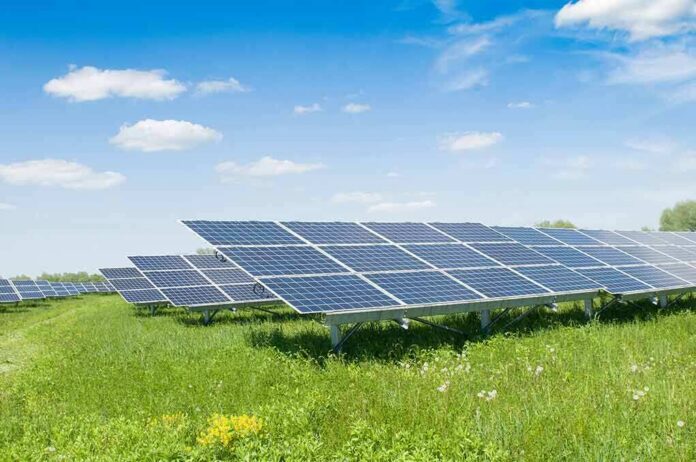
Conflicts over utility‑scale solar on Western rangelands are not really about a single lease or a single rancher; they are about how a state manages a perpetual trust to fund public beneficiaries while existing land users bear the immediate, localized costs of that fiduciary mission.
The Short Version
- Arizona’s State Land Department (ASLD) says it does not prioritize solar over other uses and that any Ørsted proposal remains in early evaluation, not approval.
- Leasing state trust land for solar follows a defined, auction‑based process aimed at maximizing long‑term value for beneficiaries, chiefly K‑12 schools.
- Rancher Casey Murph argues the targeted state grazing allotment is essential winter range and that solar should go on disturbed sites instead of productive rangeland.
- This dispute sits inside a broader pattern: technoeconomic siting steers renewables to large, open, lightly developed tracts—often the same places working ranches depend on.
What the state says it is doing, and why that matters
Arizona manages more than nine million acres of state trust land as an endowment; the agency’s legal duty is fiduciary, not regulatory. In practice, that means any change in use is evaluated on whether it increases the trust’s long‑term value for beneficiaries, chiefly K‑12 schools. ASLD has stated publicly that it has no policy prioritizing solar over other uses and that a proposed Ørsted solar project is in a very early evaluation phase rather than approved. That stance is more than rhetoric: the department’s own guidance shows that large‑scale solar access to trust land occurs through long‑term commercial leases offered and bid at public auction, with site evaluation, internal assessment, and board approvals preceding any award.
Two implications follow. First, the existence of an application or preliminary review does not equal a displacement decision; the legal trigger is an awarded lease. Second, because auction and appraisal mechanics are designed to surface the highest trust value, grazing—an annual, revocable use—will be outcompeted when a commercial energy lease can credibly deliver more revenue over decades. That is not favoritism toward solar; it is the predictable result of fiduciary optimization inside the trust model.
How the solar leasing process actually works
For solar, ASLD uses a structured path: developers identify candidate tracts, the department screens them, stakeholders (including existing lessees) are consulted to address improvements, water, and cattle movement patterns, and—if the project advances—the department seeks board approval to take it to public auction. Bidders compete on lease terms, and the high bid that meets the department’s conditions wins the right to execute the lease. Even after auction, the agency can condition access, require mitigation plans, and formalize coexistence or relocation measures in the lease instrument. None of that occurs automatically; it flows from a fiduciary evaluation, appraisal inputs, and the bid package specifics.
Because auctions monetize future income streams, solar leases often outperform grazing fees on a net‑present‑value basis, especially when interconnection and resource quality align. That economic gradient explains why renewables target large, contiguous, lightly developed state tracts: strong insolation, lower transaction costs, and simpler title compared with private checkerboards. Academic and policy analyses of siting repeatedly find technoeconomic factors—resource quality, interconnection, buildable area—drive location decisions more than abstract “preference,” which is why conflicts concentrate where working landscapes are still intact.
The rancher’s case and the on‑the‑ground stakes
Casey Murph’s argument is concrete and local. He says the proposed project lies on state trust sections that form his winter range—ground he leases and depends on to keep his operation viable—and not on his deeded land. He further contends that productive grazing country should not be converted to industrial solar when brownfields, parking lots, and already disturbed sites exist. He has also said that ASLD told him the project has not been approved, a point that aligns with the department’s process‑based posture.
From an operations standpoint, winter range loss is not a marginal inconvenience; it can force costly feed substitution, off‑ranch leasing at market scarcity prices, herd reduction, or exit. Unlike wind, where cattle can often graze among turbines, dense solar arrays typically fence out livestock, sever travel corridors, and reconfigure water access. Murph’s view—site solar where it does not displace productive use—is a siting principle that many jurisdictions now try to encode, though it competes with grid realties and land assembly costs.
Where the real disagreement lies
The parties do not disagree about whether a lease has been awarded; by both accounts, it has not. The dispute is over trajectory and priorities. Critics read gubernatorial support for renewable siting frameworks and mapping as a de facto preference for solar on trust lands likely to displace ranchers, even if no rule says “solar first.” ASLD’s statements, by contrast, emphasize process and fiduciary duty—every application is evaluated case by case, and auctions are designed to maximize trust value, not to favor a technology class.
This is the crux: a neutral fiduciary test can still produce systematically similar outcomes—more solar leases, fewer viable grazing allotments—because the economic signal points that way. To a rancher, “we don’t prioritize solar” rings hollow if the result is repeated conversion of critical range. To an agency trustee, forgoing a higher‑value lease to preserve a lower‑value use could breach duty unless statutory policy or adopted siting criteria justify it. Both positions are internally coherent; the collision happens because the trust’s beneficiaries are diffuse while the costs land on identifiable operators now.
What credible resolution would require
Three elements separate grievance from grounded adjudication. First, a spatially explicit impact analysis: exact lease boundaries, infrastructure footprints, access roads, and fencing, compared to the grazing allotment’s water, forage, and herd movement patterns. Agencies can and sometimes do redesign arrays, reserve stock trails, relocate waters, or sequence construction to preserve functional range; without maps and exhibits, that conversation is abstract.
Second, a transparent valuation record: appraisals, revenue projections, and auction terms that show the trust benefit delta versus continued grazing. If the trust premium is material, the legal case for conversion strengthens; if modest, targeted coexistence or alternate sites may clear the fiduciary bar with less disruption. Third, mitigation and compensation terms: transition timelines, offset acreage, or buy‑outs that reflect real operating losses rather than nominal payments. ASLD’s process contemplates coordination with grazing lessees; turning that intent into enforceable lease conditions is what prevents “process” from reading as evasion.
How to lower the temperature while honoring the trust
States that have reduced conflict tend to do a few things well. They adopt siting screens that steer solar first to disturbed or low‑conflict lands—retired ag fields near transmission, mine lands, or true brownfields—before greenlighting conversion of intact working range. They require early, not late, disclosure of footprint‑level designs to incumbent lessees. And they put coexistence and mitigation in the bid package so developers compete on community and operational performance, not just rent. None of this nullifies the fiduciary duty; it operationalizes it with fewer externalities by internalizing foreseeable costs into the lease economics.
The bottom line
On the record available, there is no awarded lease and no completed agency decision to displace a grazing operation; ASLD says plainly the proposal is still in early review and that it does not prioritize solar over other uses. Murph’s concerns are nonetheless rational given how trust‑land economics intersect with utility‑scale solar siting: when auctions seek to maximize value, high‑revenue leases will often supplant low‑revenue ones. The way through is not in slogans about favoritism or, conversely, in process bromides; it is in disciplined siting, transparent valuation, and binding mitigation that respect both the trust and the people who make a living on its land.
WATCH: Arizona Rancher Tells Trump That Dem Gov Katie Hobbs Wants to Evict Him From Family Land to Build Foreign Company's Solar Energy Plant https://t.co/H6JUQL0qmT #gatewaypundit via @gatewaypundit
— Woodrow Williams (@Woodrow17165268) September 6, 2026
Sources:
newsnationnow.com, arizonadailyindependent.com, youtube.com, land.az.gov, azcapitoltimes.com