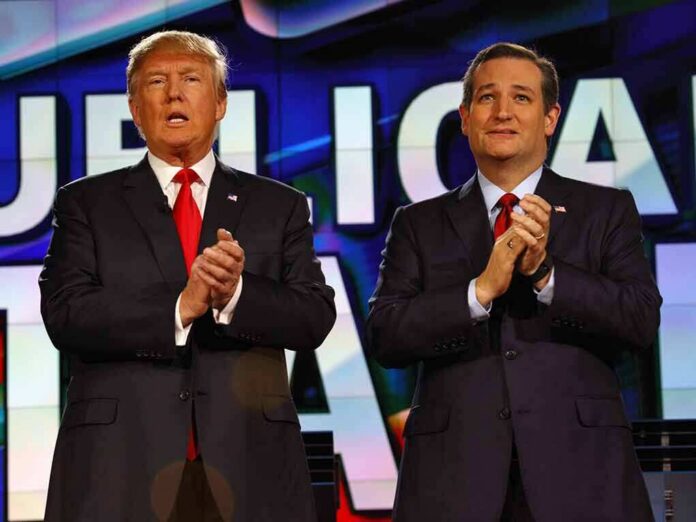
Republican senators privately warned that Donald Trump’s late endorsement of Ken Paxton over incumbent John Cornyn could hand Democrats a path to retake the Senate, exposing a party split that many voters see as elite power games over public service.
Story Snapshot
- Donald Trump endorsed Ken Paxton in the Texas Republican Senate runoff over incumbent John Cornyn [2][4].
- Cornyn allies fear Paxton is less electable statewide, risking the GOP’s Senate majority [3].
- Polling before the endorsement showed a close race with Paxton slightly ahead and stronger in rural counties [3].
- Trump delayed for weeks before weighing in, signaling internal party pressure and hesitation [1].
What Trump Did And Why It Matters
Donald Trump endorsed Texas Attorney General Ken Paxton one week before the May 26 runoff, praising him as a “true MAGA warrior” and criticizing Senator John Cornyn for insufficient loyalty during difficult periods [2][4]. The timing intersected with early voting, increasing the likelihood that the message reached Republicans who had not yet cast ballots [2]. Trump’s move fit a yearslong pattern in which endorsements function as loyalty tests inside the Republican Party, shaping media attention and donor behavior even when fundamentals remain competitive [2].
Trump’s choice followed weeks of public ambiguity after he previously said he would endorse “soon” but stayed out of the race through early April [1]. Reports indicated Senate Republican leaders encouraged Trump to back Cornyn, underscoring a divide between party leadership and Trump’s political brand [2]. That split amplifies voter frustration across the spectrum: conservatives see establishment maneuvering, and liberals view personality-driven politics overshadowing policy. Either way, the endorsement centers loyalty over governance, reinforcing concerns that insiders prioritize power over public outcomes [2][1].
The State Of The Race Before The Endorsement
Coverage summarizing polling averages between mid-March and early May showed Paxton narrowly leading Cornyn, 45.5 percent to 42.3 percent, with Paxton outperforming in rural counties and Cornyn stronger in the state’s largest urban areas [3]. That geographic pattern matters for November math: Republicans typically need durable suburban and metro margins to lock down statewide wins, but they also rely on overwhelming rural turnout [3]. The underlying data suggested a live contest, with Paxton’s base intensity and Cornyn’s metro reach pointing to different general-election pathways [3].
Fundraising and spending pointed to Cornyn’s institutional strength, with reports indicating Cornyn outspent Paxton roughly four-to-one during the runoff, a sign of donor confidence and organizational capacity [3]. Strategists who worry about losing the Senate see those assets as critical in a high-stakes cycle. However, spending advantages can be blunted when a dominant party figure reshapes the narrative in the final week. Trump’s endorsement gave Paxton free media, simplified cues for undecided Republicans, and potentially redirected small-dollar energy [2][3].
Republican Anxiety And The Electability Debate
Republican lawmakers and operatives expressed concern that Paxton’s controversies, including his impeachment and acquittal, could complicate a general-election campaign, while Cornyn’s long statewide record might play better in metro counties and among independents [4][3]. Those arguments rest on recognizable risk factors but lack publicly available, post-endorsement head-to-head polling against Democrat James Talarico in the supplied research, limiting hard conclusions about November viability [3]. Absent fresh data, the electability case remains a strategic judgment rather than a verified measurement.
Trump endorses Ken Paxton over incumbent John Cornyn in Texas Senate primary runoff
Trump endorsed TX Attorney General over incumbent senator in the Texas GOP runoff for U.S. Senate, one week before voting ends in the contentious and expensive primary. https://t.co/MEXhaywEK1
— $mokecheddathaassgetta (@Latino69Heat69) May 20, 2026
The unresolved evidence problem cuts both ways. Supporters of Paxton point to Trump’s loyalty criteria and Paxton’s early edge as proof of momentum, but the materials do not include precinct-level turnout shifts after the endorsement or verified changes in voter intent [2][3]. Cornyn allies cite stronger spending and urban performance, yet the record here does not produce primary-source crosstabs showing a clear advantage after Trump weighed in [3]. Voters frustrated with political theater will see professionals arguing from inference while withholding or lacking ground-truth numbers.
What To Watch Next In Texas And Washington
Texas Republicans now face a binary test: whether party identity is defined by demonstrated loyalty to Trump or by perceived general-election strength in populous regions. If Paxton wins the runoff on the back of late-breaking enthusiasm, attention will immediately shift to whether he consolidates metro Republicans without depressing suburban turnout. If Cornyn survives, analysts will measure whether institutional muscle and urban coalitions can overcome a high-salience loyalty signal in a polarized primary environment [2][3].
In Washington, the stakes are national. A Paxton nomination that underperforms in November could threaten the Republican Senate margin, inviting a policy swing on judges, spending, and border legislation. A Cornyn nomination that alienates parts of the base could suppress turnout and produce similar risks from the opposite direction. Either path illustrates the broader frustration many Americans share: leaders appear more focused on factional advantage and career security than on delivering concrete results on inflation, border integrity, energy costs, and public safety.
Sources:
[1] Web – Trump stays out of Texas Senate runoff after vowing endorsement
[2] YouTube – Trump Just Changed EVERYTHING in the Texas Senate Race
[3] YouTube – Donald Trump holds key endorsement as John Cornyn …
[4] YouTube – Trump says he may endorse in the Texas U.S. Senate race