
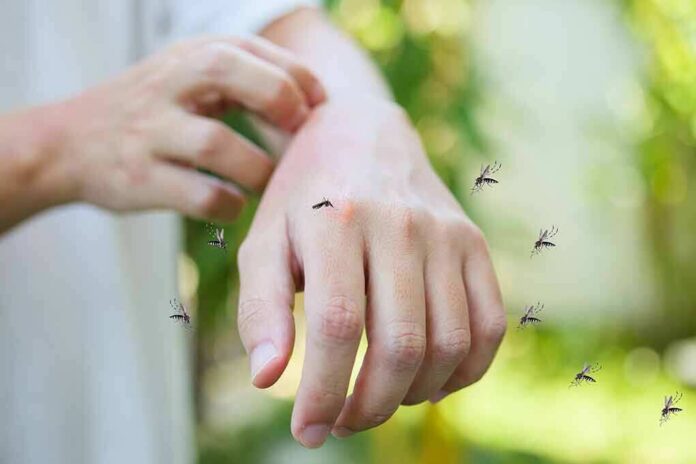
When dengue begins transmitting locally, the window for suppressing infectious mosquitoes is measured in days, not months; that is why Hillsborough County turned to low-altitude helicopter spraying as a rapid, targeted layer in an integrated response rather than as a silver bullet.
The Short Version
- Local transmission of dengue in Tampa triggered a formal health advisory and a coordinated mosquito-control surge that included helicopter-based ultra–low-volume (ULV) spraying in defined neighborhoods.
- Authorities repeated aerial missions as case counts climbed, using traps and lab testing to determine where and when to fly, and applying roughly an ounce per acre from about 150 feet.
- ULV spraying targets adult mosquitoes for immediate risk reduction and is deployed alongside larval source reduction and public guidance; it is a stopgap, not a stand-alone fix.
- Community concern focuses on product safety; EPA guidance for naled includes short-term precautions after spraying even as long-term wildlife risks are not expected.
What triggered the helicopters: confirmed local dengue and a rapid-response playbook
Florida health officials don’t activate aerial spraying because a single traveler returned with a fever; they do it when transmission is happening on the ground. In June 2024, the Florida Department of Health in Hillsborough County issued a mosquito-borne illness advisory tied to a confirmed locally acquired dengue infection and explicitly linked the response to coordinated surveillance and aerial spraying with county mosquito control. As the year progressed, the department reported multiple locally acquired dengue cases in the county and reiterated that aerial spraying was part of the ongoing prevention effort—evidence that the flights were operational, not performative. State arbovirus surveillance bulletins placed Hillsborough among the Florida counties with locally acquired dengue through 2024, underscoring why officials moved to suppress adult vectors quickly while advising residents on bite prevention and standing-water removal.
Helicopter missions are designed for speed and coverage when traps and case investigation suggest infectious mosquitoes are flying. Hillsborough’s public notices lay out clear parameters: low-altitude passes around 150 feet, roughly one ounce of product per acre, and explicitly bounded neighborhoods rather than blanket countywide application. That specificity matters operationally—it concentrates adulticide where Aedes aegypti is abundant and where human-mosquito contact is occurring now, not where it might occur next season.
How ULV spraying fits: mechanism, timing, and limits
A ULV adulticide application atomizes a small volume of insecticide into microscopic droplets that drift through the air column at night or dawn to contact and kill flying adult mosquitoes; the dose is tiny, but the exposure is high because the droplets traverse the same airspace mosquitoes occupy. In outbreak response, adulticiding buys time: by knocking down infectious adults fast, it can cut near-term transmission risk while larval control and source reduction work on the next generation. County reporting and local coverage describe exactly that layered approach—trap-driven decisions, adulticiding by helicopter or truck in hotspots, larviciding where water holds eggs and pupae, and community guidance on tipping containers and covering skin. Florida’s own vector-management guidance is blunt about expectations: adulticiding is never 100 percent effective, performs best when repeated quickly under suitable conditions, and belongs inside an integrated program, not as a substitute for it.
Operational details from Tampa-area coverage are consistent with a modern, data-led program. Inspectors deploy 24-hour traps, sort captured mosquitoes, and route female specimens for testing; positive findings inform whether to send trucks, helicopters, or both, and whether to emphasize larvicide or adulticide based on the entomological picture on the ground. Treatment boundaries—Ybor City, Hyde Park, South Tampa, and other defined blocks during periods of heightened activity—reflect the biology of an urban mosquito that often lives close to people and breeds in small containers rather than swamps or marshes.
The evidence base: why officials act decisively even when research certainty is mixed
Readers who track dengue control literature will recognize a tension. Systematic reviews spanning more than a decade have concluded that space spraying’s stand-alone impact on dengue transmission is mixed and low-certainty, with heterogeneous study designs that make definitive meta-analysis difficult. Some field experiences—such as integrated aerial campaigns combining larval control with adult knockdown—have reported sharp reductions in vector populations and halted transmission windows, while other evaluations have found inadequate or transient effects when operations were delayed or poorly matched to local conditions. Florida’s own guidance internalizes that nuance: expect meaningful but incomplete reductions, repeat rapidly, and embed adulticiding within surveillance, larval control, and community action.
Against that backdrop, the Tampa program’s logic is straightforward. Locally acquired dengue is present; Aedes aegypti is abundant in urban containers; adulticiding can reduce infectious bites in the near term; and larval control, property inspections, and resident behaviors must carry the medium-term load. State surveillance confirmed Hillsborough’s local cases during 2024, providing the epidemiological predicate for urgent adult suppression while other measures take effect.
What was actually sprayed, and what about safety?
Local briefings described an ultra–low-volume adulticide applied at less than an ounce per acre and asserted the formulations used in Tampa missions are safe for people, pets, and non-target wildlife when applied as directed. That messaging tracks standard public-health risk communication for EPA-registered products used in wide-area mosquito control, but residents reasonably ask which active ingredient was deployed and what precautions are warranted. EPA’s fact sheet on naled—a common adulticide for aerial mosquito control—acknowledges short-term human and invertebrate risks immediately after application and recommends keeping children indoors for four hours following spraying; at the same time, it concludes long-term wildlife effects are not expected under label-compliant operations.
Precision matters. Different missions can use different products—adulticides for flying mosquitoes, bacterial larvicides such as Bacillus thuringiensis israelensis (Bti) for waterborne larvae—and helicopters are used for both, depending on the operational target. County materials stress that low-altitude flying ensures larvicides reach water-holding containers; separate notices describe ULV adulticide passes for active transmission zones. Those are distinct tactics with different exposure profiles. The responsible path for agencies is transparent disclosure: product name and EPA registration number, label and dose, application polygons and dates, and any post-application monitoring or complaint logs. That documentation turns assurances into verifiable claims.
Helicopters are spraying Tampa neighborhoods to combat increasing Dengue fever cases. #DengueFever #GarysGotAnswers https://t.co/0NByUjWcjR
— Gary Schaaf (@TampaBizLitAtty) September 7, 2026
Where the real debate belongs: outcomes, thresholds, and comparators
Two questions decide whether helicopter spraying is a proportionate public-health tool: did it measurably reduce infectious mosquitoes or interrupt case growth in the treated zones, and was it the most effective option available at the time? The public record to date describes missions and case counts but does not publish before-and-after trap densities, droplet verification, resistance profiles, or neighborhood-level epidemiologic curves tied to flight dates. Those are solvable gaps. A routine after-action package—trap-count spreadsheets, treatment polygons and timestamps, product labels and calibration logs, and geocoded case data with appropriate privacy protections—would allow a quasi-experimental assessment of impact and clarify threshold criteria for choosing air over ground. Florida districts already emphasize that aerial adulticiding is rarely sufficient alone; showing how it performed alongside larviciding, inspections, and resident source reduction would strengthen public confidence and sharpen future decision-making.
Practical guidance for residents in treated neighborhoods
During active spraying periods, the most protective actions are the simple ones that compound with agency work. Drain containers, change pet water, and cover rain barrels; wear repellent with DEET, picaridin, or oil of lemon eucalyptus; and use loose, ankle-covering clothing—the vector prefers biting low. If aerial adulticiding with naled is scheduled, follow EPA’s short-term advice: keep children indoors for four hours post-application and rinse outdoor toys and surfaces before use. Those steps reduce bite risk and minimize exposure while the county executes time-sensitive flights.
Bottom line
Hillsborough County’s helicopter missions are best understood as a targeted, time-bound knockdown tactic nested inside a broader dengue control program triggered by documented local transmission. The science neither promises miracles nor counsels inaction; it argues for speed, integration, transparency, and iteration. Publish the operational data, keep the neighborhoods engaged, and treat each flight as one necessary move in a larger campaign to deny Aedes aegypti the urban habitats and timing it exploits.
Sources:
baynews9.com, hcfl.gov, hillsborough.floridahealth.gov, floridahealth.gov, heraldtribune.com, cdc.gov, wtsp.com, fox13news.com, pubmed.ncbi.nlm.nih.gov