
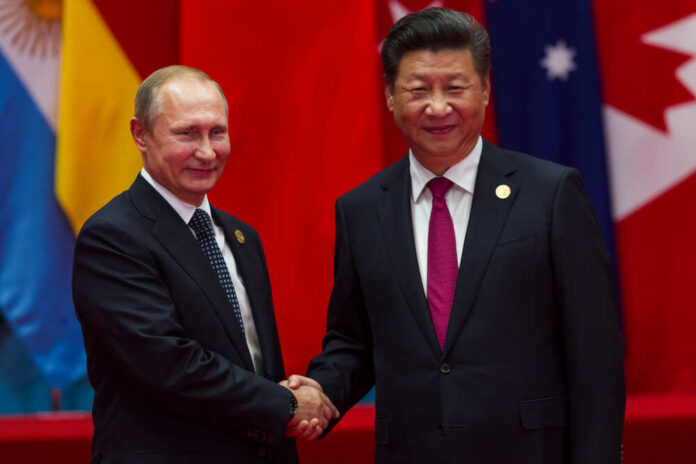
As Vladimir Putin and Xi Jinping deepen their cooperation in Beijing, China and Russia are reinforcing a partnership that directly challenges American influence and tests President Donald Trump’s effort to reassert U.S. leadership on the global stage.
Story Snapshot
- Russian President Vladimir Putin received a full state welcome in Beijing, including military honors and a formal ceremony hosted by Chinese President Xi Jinping at the Great Hall of the People.[1][2][3]
- The visit comes less than a week after President Donald Trump’s own high-profile trip to China, placing Beijing at the center of a rapidly intensifying competition between major world powers.[2][4][5]
- China and Russia agreed to further extend their long-standing Treaty of Good-Neighborliness and Friendly Cooperation, reinforcing a strategic partnership first formalized in 2001.[1][3][6]
- Carefully staged ceremonies, public messaging, and new agreements were widely interpreted as an effort by Beijing and Moscow to project unity and counterbalance U.S. global influence.[1][2][4]
Carefully Choreographed Welcome Puts U.S. On Notice
Chinese state media and international reporting confirm that Vladimir Putin arrived in Beijing on May 19 for a two-day state visit marked by a formal red-carpet reception, military honors, and a greeting from Chinese Foreign Minister Wang Yi.[1][2][5]
Video footage and photographs released by Chinese and international outlets show a highly choreographed sequence that included an airport reception, ceremonial honor guard, military band performances, and an official welcome hosted personally by Xi Jinping at the Great Hall of the People.[2][3][4]
Reporting from Euronews and the Associated Press noted that crowds waving Chinese and Russian flags greeted Putin’s arrival while uniformed honor guards and synchronized ceremonies emphasized the symbolic importance of the visit.[2][4] The imagery was difficult to miss: Beijing clearly intended to present Russia not as an isolated state weakened by Western sanctions, but as a central strategic partner standing beside China on the global stage.[1][3][6]
Xi and Putin Use Ceremony and Treaties to Signal Long-Term Alignment
Following the welcome ceremony, Xi and Putin held bilateral talks and oversaw the signing of multiple cooperation agreements covering trade, energy, diplomacy, and strategic coordination.[3][4][6] Chinese state media confirmed that both leaders agreed to further extend the China-Russia Treaty of Good-Neighborliness and Friendly Cooperation, originally signed in 2001.[1][6] The treaty has served for decades as the foundation for expanding economic, military, and diplomatic cooperation between Beijing and Moscow.
Xi described the partnership as part of a broader effort to create a “more just and reasonable” international order, while Putin praised what he called the “unprecedented” strength of relations between the two countries.[6][7] International reporting also highlighted discussions surrounding energy cooperation, including ongoing negotiations tied to the Power of Siberia 2 pipeline project and broader efforts to deepen trade using local currencies instead of the U.S. dollar.[5][6] Although full transcripts of the meetings and agreements have not yet been publicly released, analysts say the combination of treaty extensions, strategic messaging, and ceremonial symbolism signals that both governments are preparing for a long-term geopolitical alignment rather than a temporary tactical partnership.[1][5][6]
Summit Timed Days After Trump’s Trip Raises Strategic Stakes
The timing of Putin’s visit drew immediate international attention because it came only days after President Donald Trump concluded his own visit to Beijing.[2][4][5] Reuters, the Associated Press, and other international outlets noted that Beijing effectively hosted the leaders of the United States and Russia within the span of a single week — a diplomatic sequence widely interpreted as a demonstration of China’s growing influence as a global power broker.[4][5]
The Kremlin also emphasized that this marked Putin’s 25th visit to China, highlighting the unusually close and long-running personal relationship between Xi and Putin.[1][5] Analysts following the summit noted that Beijing is attempting to balance stable economic ties with Washington while simultaneously deepening strategic coordination with Moscow.[4][5][6]
For American policymakers, that balancing act matters significantly. A stronger China-Russia partnership could help both countries reduce exposure to Western sanctions, coordinate positions at the United Nations, and expand financial systems that bypass U.S. dominance in global trade and banking.[5][6] Every highly produced ceremony and public declaration during the visit carried a broader geopolitical message: Beijing intends to maintain strategic flexibility while strengthening partnerships capable of countering American influence abroad.[1][3][5]
Why This Matters For Americans Watching From Home
For many Americans concerned about growing geopolitical competition, the summit served as another reminder that rival powers are actively building long-term alliances designed to challenge U.S. influence economically, diplomatically, and militarily. The red-carpet welcome, treaty extensions, and joint statements were more than symbolic pageantry. Together, they projected the image of two authoritarian powers aligning around shared strategic interests at a moment when global power balances are shifting rapidly.[1][3][6]
Xi Holds Welcome Ceremony for Putin
Chinese President Xi Jinping held a welcome ceremony for Russian President Vladimir Putin on the morning of May 20 outside the Great Hall of the People in central Beijing.#China #Russia #Xijinping #ChinesePresident #Putin… pic.twitter.com/MZvwspsrpY
— CCTV+ (@CCTV_Plus) May 20, 2026
At the same time, many details surrounding the agreements remain unclear. Much of the publicly available information comes from Chinese state media releases, carefully edited video footage, and short official statements rather than complete transcripts or detailed policy disclosures.[1][3][6] That lack of transparency has fueled concern among analysts who argue that citizens and governments alike cannot fully evaluate the long-term implications of the agreements without greater visibility into what was discussed behind closed doors.
Whether the summit ultimately reshapes global power dynamics remains uncertain. But the imagery from Beijing — military honors, synchronized ceremonies, and treaty renewals between Xi and Putin just days after Trump’s visit — sent a clear signal that China intends to position itself at the center of an increasingly competitive international order.
Sources
[1] Xinhua – Putin Arrives in Beijing for State Visit
[2] Euronews – Putin Arrives in China for Talks With Xi Jinping
[3] Associated Press – Xi and Putin Highlight Friendship and Cooperation
[4] Associated Press / GPB – Xi and Putin Meet Days After Trump Visit
[5] Reuters – Xi Hosts “Old Friend” Putin After Trump Visit
[6] Xinhua – Xi Holds Talks With Putin in Beijing
[7] BBC News – Putin Hails “Unprecedented” Ties With China