

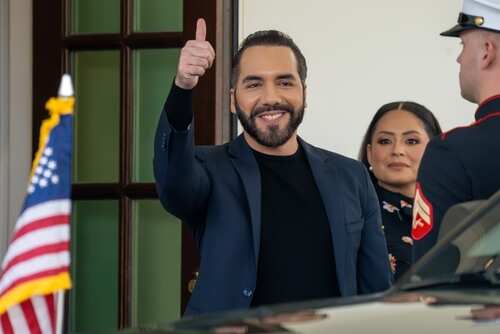
When Hillary Clinton blasted El Salvador’s mega‑prison as “brutal,” President Nayib Bukele fired back with a dare that exposed years of elite double standards on crime, borders, and human rights.
Story Snapshot
- Bukele responded to Clinton’s criticism of his CECOT mega‑prison by offering to hand over every inmate to any country willing to take them.
- The clash highlights long‑running hypocrisy from Western elites who fueled gang violence through bad policies, then condemned tough crackdowns from afar.
- CECOT sits at the intersection of Trump‑era deportation policy, Salvadoran anti‑gang measures, and aggressive human‑rights criticism.
- Human‑rights groups warn of abuses and deaths in custody, while Bukele’s supporters point to major drops in gang violence.
Bukele’s Public Dare to Clinton and Western Critics
On December 22, 2025, Hillary Clinton promoted a PBS Frontline documentary on social media, calling El Salvador’s Terrorism Confinement Center, known as CECOT, “brutal” and amplifying deportees’ claims that they were wrongly branded as gang members and abused inside the prison. The following day, President Nayib Bukele answered publicly, defending his flagship mega‑prison and offering to transfer every inmate to any foreign government willing to accept them, a move widely described as a sardonic dare.
Bukele’s message was pointed and specific: if international critics truly believe CECOT is a torture center, El Salvador is “ready to cooperate fully” by releasing its entire prison population into their custody. He added one firm condition: any accepting country must take everyone, including top gang leaders and those activists label “political prisoners.” By framing his response this way, Bukele challenged Clinton and allied NGOs to shoulder direct responsibility for the very inmates they defend rhetorically.
“We are willing to release our entire prison population … to any country willing to receive them.”
El Salvador President Nayib Bukele fires back at Hillary Clinton’s criticism of CECOT, daring other nations to take in the country's inmates.https://t.co/8L724Hu406
— Fox News (@FoxNews) December 24, 2025
How El Salvador Reached the Mega‑Prison Moment
El Salvador’s path to CECOT runs through decades of gang violence tied in part to U.S. deportation policies dating back to the 1990s and 2000s, when American authorities expelled thousands of Salvadoran gang members who then entrenched MS‑13 and Barrio 18 back home. Successive “mano dura” crackdowns, built on mass arrests and overcrowded prisons, only deepened the problem, turning facilities into command centers where gangs consolidated power, recruited members, and terrorized communities with little effective state resistance.
When Bukele took office in 2019, he promised to restore security in a country exhausted by homicides, extortion, and fear, even if that meant bending traditional civil‑liberties norms. After a state of exception was declared in March 2022, security forces gained authority to carry out warrantless arrests, extend pretrial detention, and suspend several due‑process protections. Over time, more than ninety thousand people—roughly 1.7 percent of the population—were detained on suspected gang ties, with about eight thousand later released after courts or prosecutors found insufficient evidence.
Inside CECOT: Security Gains Versus Human‑Rights Alarms
CECOT, officially the Terrorism Confinement Center, was built as the physical centerpiece of Bukele’s anti‑gang strategy, a sprawling maximum‑security complex designed to hold tens of thousands of alleged gang members under strict control. The president has showcased the facility as “the best in the world,” presenting it as the place where gangs finally lose their grip on neighborhoods and prison yards alike. For many Salvadorans tired of living under criminal rule, the images of tattooed gang bosses shackled and silent have become symbols of long‑overdue order.
Human‑rights organizations and former detainees describe a radically different reality inside the walls, alleging extreme overcrowding, filthy conditions, and a system that discards due process. Reports from groups such as Human Rights Watch detail prisoners sleeping on floors or even standing, outbreaks of tuberculosis and other infections, limited or no medical care, and virtually no access to lawyers or independent review. A local legal aid organization has documented hundreds of deaths in Salvadoran prisons since the crackdown began, raising concern that aggressive security measures are crossing into systemic abuse.
Trump‑Era Deportations and U.S. Legal Fallout
CECOT is not just a Salvadoran story; it has been deeply entangled with U.S. border and deportation policy. During Donald Trump’s first term, American authorities deported hundreds of Venezuelan and other migrants who ultimately ended up in CECOT, even after a U.S. judge ordered that those individuals be returned to the United States. That conflict between executive enforcement and judicial oversight has since become the basis of a major legal battle over the government’s authority to offload migrants into foreign prison systems.
Salvadoran officials, confronted with planeloads of deportees, frequently presumed criminal involvement, which in practice meant some migrants were swept into the same dragnet as local gang suspects. Rights advocates warn that this exposed non‑Salvadoran deportees to arbitrary detention, torture, and potential disappearances in a system already strained by mass arrests. They have also criticized Bukele’s broader openness to taking U.S. deportees of any nationality, including American citizens with convictions, arguing that such arrangements export public‑safety problems without adequate safeguards.
Sources:
El Salvador defends mega-prison key to Trump deportations
60 Minutes postpones segment on migrant deportations and El Salvador prison
El Salvador’s Prisons Are No Place for US Deportees
Bukele offers sardonic response to Hillary Clinton over CECOT criticism