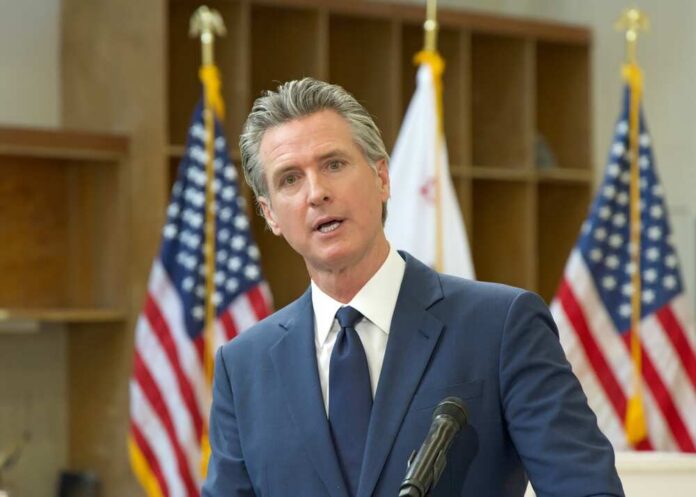
When a governor only seems to find the will to clear a homeless camp once it lands outside a wealthy ally’s front door, it feeds the growing belief that the system works fast for the connected and slow for everyone else.
Story Snapshot
- Gavin Newsom has made clearing homeless encampments a high-visibility priority, personally joining sweeps in Los Angeles.
- Social media claims say a recent cleanup near a rich, connected friend’s home shows favoritism, but hard proof is still missing.
- State policy now ties funding, model ordinances, and a task force to faster encampment removals across California.
- Advocates warn that “sweep first” politics punishes unhoused people while elites and officials avoid real accountability.
Newsom’s Encampment Crackdown Meets Elite-Privilege Accusations
California Governor Gavin Newsom has spent the past two years turning homeless encampment removal into a signature, made-for-camera policy push, personally appearing alongside road crews in Los Angeles as camps were dismantled under freeway overpasses.[1][2] His administration framed these actions as carrying out an executive order that told state agencies to “urgently address” dangerous encampments, stressing urgency, visibility, and “dignity and compassion” while emphasizing that he wanted results on the ground, not just data or reports.[1][2][6]
That very visibility is now fueling a viral accusation: that Newsom finally moved quickly to clean up one encampment because it sat outside the home of a rich, politically connected friend. The charge taps into a bipartisan frustration that the powerful enjoy special treatment while ordinary neighborhoods live with crime, filth, and tent cities for years. The available public record, however, does not identify the alleged donor, the property address, or documentation showing this specific site was chosen because of personal ties rather than routine enforcement.
What We Can Prove About Newsom’s Encampment Policy
Official statements show Newsom has deliberately tied his political brand to aggressive encampment removal statewide. In 2024, his office highlighted that he helped clean up multiple Los Angeles sites through the Clean California initiative, explicitly connecting his executive order to on-the-ground sweeps.[1] Around the same time, he publicly warned cities and counties to “clean up homeless encampments now or lose out on state funding next year,” pledging to redirect money beginning in January if local governments did not act fast enough to clear camps and move people into shelter or services.[2][3]
Following the United States Supreme Court’s Grants Pass decision, which gave cities broader power to ban camping in public spaces, Newsom doubled down by promoting a state “model ordinance” for cities and counties to crack down on “dangerous and unhealthy encampments.” His administration then launched a State Action for Facilitation on Encampments Task Force that brought together the California Highway Patrol, Office of Emergency Services, housing and health agencies, the Interagency Council on Homelessness, and the Department of Transportation to coordinate removals and service connections.[4] These steps show an institutionalized statewide strategy, not a one-off response to a single upscale block.
Critics Say Sweeps Serve Optics More Than Solutions
Homelessness advocates have blasted this approach as “sweep first, housing later” politics. The National Low Income Housing Coalition condemned Newsom’s executive order, arguing it urges communities to sweep homeless encampments without providing immediate, safe housing alternatives and warning that “political expediency will harm unhoused people and worsen homelessness.”[5] Their critique reflects a broader concern shared by many on the right and left: politicians love photo-ready crackdowns that make streets look cleaner for housed voters but rarely deliver permanent exits from homelessness.
CalMatters reporting describes the task force and related measures as the latest in a series of efforts to push encampments out of sight, while still leaving large gaps between the number of people on the street and available shelter beds.[4] For conservatives skeptical of big-government spending, Newsom’s claim that the state has poured tens of billions into homelessness while tents remain everywhere looks like proof of bureaucratic failure. For liberals focused on inequality, sweeps that displace people without guaranteeing housing reinforce the perception that public order for businesses and affluent neighborhoods matters more than long-term solutions for the poorest residents.
What We Do Not Know About the “Rich Friend” Cleanup
The social-media narrative about a cleanup outside a wealthy ally’s home resonates because it fits a pattern people recognize: rapid, disciplined government action appears only when elites are inconvenienced. Yet based on available documents and reporting, there is no named donor, no address, no inspection report, and no internal memo tying Newsom’s decision-making to one friend’s property.[1][2][3][4] There is also no comparative data showing that similar encampments elsewhere were left alone while this one jumped the line.
Supporters of the governor point to the broad encampment policy, funding threats, and task force as evidence that any high-profile cleanup reflects a standing strategy, not special treatment.[1][3][4] Skeptics respond that the absence of a transparent, site-specific paper trail about why that location was prioritized invites suspicion in a low-trust era. That gap in the record could be closed with basic disclosures: complaint logs, hazard assessments, site-selection criteria, and communications between the Governor’s Office, transportation officials, and any politically connected residents.
Why This Story Hits a Nerve Across the Political Spectrum
Whether or not a particular rich friend received preferential treatment, the episode underscores a deeper reality many Americans now agree on: government response often tracks political risk more than human need. California’s homelessness crisis has persisted despite large spending commitments and elaborate programs, while both conservatives and liberals watch leaders stage visible crackdowns that satisfy television cameras but do little to restore public safety, reduce addiction, or make housing attainable.[1][4] The perception that elites can summon swift action while average citizens are told to wait fuels anger at a system seen as protecting itself first.
For readers across the spectrum, the takeaway is not to accept either partisan spin at face value, but to demand evidence. If a donor’s influence shaped this cleanup, public records should eventually show it. If it was simply one more stop in a statewide enforcement campaign, agencies should be able to prove that through consistent criteria applied to wealthy and poor neighborhoods alike. In a time when both parties in Washington and Sacramento seem more focused on optics than outcomes, insisting on transparent, documentable decision-making is one concrete way citizens can push back against a government that feels captured by the well-connected.
Sources:
[1] Web – Governor Newsom cleans up homeless encampments in Los Angeles
[2] YouTube – Watch Cali. Gov. Gavin Newsom clean up homeless encampments
[3] Web – Newsom Vows to Take Away Funding From Cities and Counties for …
[4] Web – Newsom launches task force to clear CA homeless encampments
[5] Web – NLIHC Releases Statement on Governor Newsom’s Executive Order …
[6] YouTube – Newsom directs California cities to remove homeless encampments