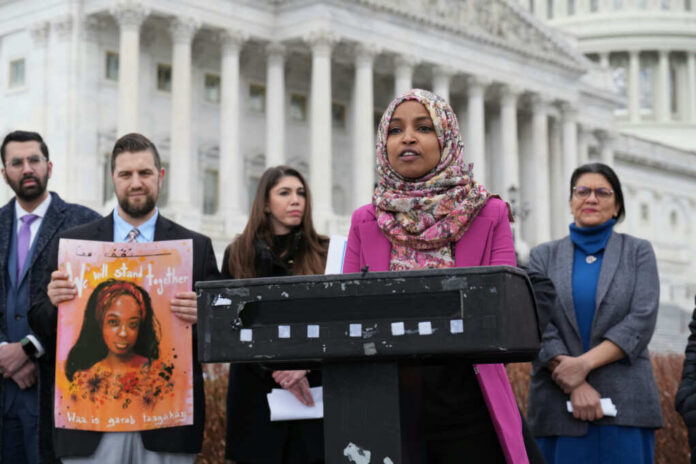
The recent votes to restrict U.S. military aid and arms sales to Israel did not change policy, but they did reveal something decisive: the Democratic Party’s center of gravity on Israel has shifted from reflexive support to a contested, increasingly skeptical stance driven by its base.
Key Points
- Over 100 House Democrats and roughly three-quarters of Senate Democrats backed measures to cut or block military aid and weapons sales to Israel, a level of dissent unprecedented in modern party history.
- These votes failed, but they exposed a structural realignment: the party’s rank-and-file and activist wing now largely favors conditioning or cutting aid, while leadership remains committed to longstanding security guarantees.
- Public opinion among Democratic voters has moved sharply against unconditional support for Israel, reshaping incentives for ambitious politicians and committee chairs alike.
- The emerging Democratic consensus is not “whether” Israel policy must change, but “how” to change it without abandoning U.S. regional strategy or domestic political coalitions.
From Quiet Consensus to Open Revolt: What the Votes Actually Did
For half a century, Democratic politics on Israel were defined less by debate than by habit. Military aid, co-production agreements, and diplomatic cover at the United Nations moved through Congress with minimal internal drama. The recent series of votes to block or cut aid did not break that pattern legislatively — every resolution failed — yet they demolished the illusion of consensus.
In the House, the Massie amendment to eliminate $3.3 billion in annual military assistance to Israel drew support from 103 Democrats, with 98 opposed and 10 voting present; only a single Republican backed it, and the measure lost 104–314. Two years earlier, a similar effort drew just 37 Democratic votes. In the Senate, resolutions led by Bernie Sanders to block specific arms sales — roughly $295 million in armored bulldozers and $151 million in 1,000‑pound bombs — garnered 40 and 36 Democratic votes respectively, with the bulldozer measure failing 59–40 and the bomb measure 63–36. Those numbers mark the largest intra-party revolt on Israel-related arms transfers since the modern aid architecture took shape after the 1970s.
It is critical to be precise about what these votes did and did not accomplish. They did not cut off aid; the underlying 10‑year memorandum of understanding providing $3.8 billion per year in assistance remains intact. Leadership framed the efforts as “symbolic” and maintained the traditional policy line. But the symbolism cuts both ways. When nearly half of House Democrats and over three-quarters of Senate Democrats register a formal vote against specific aid packages in the middle of an ongoing conflict, they are not merely sending a message to Netanyahu; they are announcing that the base of their own party has moved and they intend to follow.
Who Really Speaks for the Party? Leadership, Rank and File, and the New Center of Gravity
The central question these votes raise is not whether Democrats are “for” or “against” Israel. It is who now defines the party’s position — the leadership class steeped in the older bipartisan framework, or the rank-and-file legislators and activists shaped by Gaza, Lebanon, and Iran.
On one side stands the leadership bloc: House Minority Leader Hakeem Jeffries, key committee chairs, and veteran Senate figures such as Chuck Schumer and Chris Coons. Jeffries publicly pledged to vote against the Massie amendment and urged colleagues to protect the Obama-era memorandum of understanding that locks in $3.8 billion in annual aid through 2028. Senior Democrats on Foreign Affairs and Armed Services echoed that line, arguing that unilateral cuts would undercut U.S. credibility and destabilize a core security relationship. In the Senate bulldozer vote, seven Democrats — including Schumer and other foreign policy stalwarts — broke with the majority of their caucus to uphold the sale.
Opposite them is an increasingly broad coalition that, not long ago, would have been dismissed as the “fringe”: progressives like Sanders, Van Hollen, and Merkley, but also a growing contingent of centrist Democrats who now support conditioning offensive weapons or pausing particular transfers. Analysts tracking the April 2026 Senate votes noted that thirteen centrist Democrats flipped from previous pro-aid positions to support at least one of Sanders’ disapproval resolutions, explicitly citing the unpopular U.S.-Israel war on Iran and concerns about civilian harm.
What these votes show is not a tidy ideological split but a shifting center of gravity. Once-fringe positions — blocking bulldozers used in house demolitions, rejecting 1,000‑pound bomb sales tied to urban bombardment — have migrated into the mainstream of Democratic decision-making. Leadership still controls the formal party line, but it can no longer claim to speak for “the party” in any meaningful sociological sense. The party’s elected coalition is now divided, and its voting base has moved decisively away from the old posture of unconditional support.
The Voter Base Has Moved Faster Than the Politicians
Legislative rebellion rarely appears without prior movement in public opinion. On Israel, that movement has been rapid and stark. Polling over the past several years shows a collapse in Democratic voter support for unconditional aid and a broader decline in the warmth with which Democrats view Israel.
Surveys cited by Al Jazeera, the New York Times/Siena poll, and other outlets indicate that nearly three-quarters of Democratic voters now oppose military assistance to Israel, up from roughly 45 percent just three years earlier. A separate public opinion study found Democrats’ average “feeling thermometer” rating of Israel falling from 52 to 41 on a 100‑point scale, the first time in decades that Democratic sentiment has dropped below the neutral midline. Research summarized by foreign policy institutes describes the change as a move “from bipartisan consensus to generational fracture,” with younger and progressive voters particularly hostile to additional aid in the face of alleged human rights abuses.
Against that backdrop, the House and Senate votes look less like isolated acts of conscience and more like belated recognition of where the party’s voters already are. Sanders himself framed the Senate arms votes by noting that “over 80% of the Democratic caucus aligned with the American public” in opposing offensive weapons sales to Netanyahu’s government. Whether that percentage is exact or rhetorical, the underlying dynamic is clear: members who expect to face primaries, build national profiles, or compete in future presidential contests now have a strong electoral incentive to distance themselves from the old Israel line.
Leadership’s insistence on honoring long-term agreements and protecting strategic relationships reflects a different calculus: institutional memory, donor networks, and long-standing alliances. But factions that treat public opinion as the primary constraint on policy now hold enough seats to force visible, recorded votes that leadership cannot easily bury.
Why the Votes Failed — and Why That Matters Anyway
The failure of every aid-cutting or arms-blocking measure is not incidental. It highlights the limits of this realignment and the structures that still constrain it.
Procedurally, the Sanders resolutions and the Massie amendment were always heavy lifts. Arms sales disapproval measures require majorities in both chambers; the House amendment sought to strip core funding embedded in a broader national security package. Republicans, almost uniformly opposed to restrictions, voted against each effort, ensuring defeat. In the Senate, the bulldozer and bomb resolutions failed 59–40 and 63–36, respectively, even with overwhelming Democratic support, because Republican votes were nearly monolithic. In the House, only one Republican backed the Massie measure, again sealing its fate.
Substantively, leadership framed these proposals as destabilizing and short-sighted. They stressed the obligations of the existing memorandum of understanding and argued that abrupt cuts would signal unreliability to allies beyond Israel. That argument resonated enough with a critical minority of Democrats — especially those in leadership and committee roles — to keep formal policy intact. The votes were, in the narrow legislative sense, “symbolic.” They did not change the flow of weapons or aid.
But symbolism in politics is not mere theater; it is how coalitions test boundaries and signal future intent. By forcing roll-call votes with triple-digit Democratic support in the House and supermajority support in the Senate, opponents of unconditional aid compelled every member to choose a side in plain view of activists, donors, and primary challengers. Those tallies now exist as a durable record. Ambitious Democrats considering national runs will study them the way prior generations examined Iraq War votes or same-sex marriage positions. Shifts that begin as symbolic tests often end as substantive policy a few cycles later, once it becomes clear that the sky does not fall when the taboo is broken.
Mechanism of Realignment: War, Human Rights, and the Iran Factor
To understand why this rupture happened now, one has to look beyond Gaza and into the broader pattern of U.S.-Israel military cooperation, especially the intertwined conflicts in Lebanon and Iran.
The Sanders resolutions and related Senate debates explicitly linked bulldozer and bomb sales not only to civilian casualties in Gaza and the West Bank, but also to Israel’s role in the U.S.-Israel war on Iran — a conflict criticized by senators as unauthorized and strategically incoherent. In parallel, House and Senate efforts to constrain the president’s military options in Lebanon and Iran drew growing Democratic support each time they came to the floor. One House vote on limiting Lebanon operations, for example, saw Democratic support for restriction rise from 91 to 187 members within a month, more than doubling as the war dragged on.
In other words, opposition to Israel aid is no longer solely framed as a human rights issue, though that remains central. It is framed as a question of U.S. sovereignty, war powers, and the wisdom of entangling American forces in conflicts that voters increasingly view as someone else’s project. Evidence of large-scale civilian harm, urban destruction, and alleged violations of international law gives moral weight to that argument. But the mechanism of realignment is broader: a perception that the old Israel policy has become a vector for unwanted wars and economic shocks rather than a stabilizing alliance.
The leadership’s counter-argument — that honoring commitments and sustaining deterrence outweigh these costs — has not yet been backed by detailed public evidence on end-use compliance or civilian harm mitigation. Calls from within the party for Pentagon and State Department transparency on how U.S.-supplied weapons have been used have so far yielded little visible data. That leaves the moral and strategic case for continued aid thinner than it once was, especially among voters primed by Iraq and Afghanistan to distrust optimistic war rationales.
What It Means Going Forward: Control, Donors, and Future Coalitions
So who “controls” the Democratic Party on Israel now? Formally, leadership still does. It controls committee agendas, messaging, and, crucially, the ability to block binding changes to core aid commitments. The 10‑year memorandum remains untouched; the Pentagon’s cooperation with Israeli forces continues. On paper, that looks like continuity.
Informally, however, the coalition that can block new forms of integration and force public votes — on bulldozers, bombs, war powers, and National Defense Authorization Act provisions that deepen U.S.-Israel military fusion — now sits squarely in the Democratic caucus. A party whose base opposes additional aid by large margins, whose younger voters rate Israel coldly, and whose rising politicians have built careers on skepticism of foreign entanglements will not indefinitely sustain the old model.
Donor influence and organized lobbying — whether from AIPAC, J Street, or newer groups — will shape the pace and form of change. So will media framing; major outlets have been quick to label the recent votes “symbolic” and emphasize their failure, which can blunt their immediate impact but cannot erase the numbers. Over time, the structural fact remains: once nearly half of House Democrats and three-quarters of Senate Democrats vote to restrict aid, the burden of justification shifts. Maintaining the status quo becomes the position that requires explanation, not the move to change it.
For readers watching this unfold from the outside, the important thing is not the procedural outcome of any single vote, but the deeper pattern it reveals. A long-stable foreign policy consensus has fractured. The party’s base has moved; its elected officials, though constrained, are beginning to follow. And the next generation of Democratic leaders will have to build a coherent Israel policy in a world where unconditional support is no longer the default, but one contested option among several.
🌍 𝗕𝗥𝗘𝗔𝗞𝗜𝗡𝗚: President Trump will meet Darline Graham at the White House today. Darline Graham was sworn in to temporarily fill the Senate seat after the death of her brother, Lindsey Graham. Separately, 103 House Democrats voted to cut military aid to Israel. #USPolitics… pic.twitter.com/uIa4hCP4Ng
— News 24/7 (@Xpress_24_7) July 16, 2026
Who Controls the Party?
In practice, control is now shared — and contested. Institutional leaders still write the formal line, but the emerging coalition of skeptical lawmakers, backed by a changed electorate, controls whether that line can still be enacted without visible resistance. The failed votes against aid to Israel revealed that split more clearly than any speech could. They showed that the old guard can delay change, but it can no longer deny that it is coming.
Sources:
pjmedia.com, huffpost.com, washingtonpost.com, independent.co.uk, jewishinsider.com, jns.org, thehill.com, time.com, nytimes.com