The defining reality of the Iran war for U.S. planners has not been territory or headlines, but the speed at which America has burned through some of its rarest long‑range precision missiles—and the years it will take to rebuild that magazine.
Key Points
- Multiple independent reports say the U.S. Army has used virtually all of its ATACMS and Precision Strike Missiles in the five‑month war with Iran, leaving only marginal reserves for other contingencies.
- Defensive interceptors such as Patriot and THAAD have also been heavily expended, with CSIS estimates suggesting roughly two‑thirds of Patriot and more than one‑third of THAAD inventories consumed.
- Analyses of Pentagon data and industrial capacity point to multi‑year timelines—often into 2029—to restore prewar missile inventories, even with increased funding and production.
- The drawdown raises hard questions about U.S. readiness for a simultaneous crisis with China or another major adversary, and exposes longstanding weaknesses in the American munitions industrial base.
How the Iran War Burned Through America’s Long‑Range Arsenal
From the opening days of the Iran campaign, U.S. strategy leaned heavily on long‑range, precision‑guided missiles. These weapons—principally the Army Tactical Missile System (ATACMS) and its successor, the Precision Strike Missile (PrSM)—allow U.S. forces to hit fixed and relocatable targets hundreds of miles away without exposing pilots and aircraft to dense Iranian air defenses. Reuters, citing three people familiar with internal Pentagon data, reports that over five months of operations the Army has used “virtually all” of these surface‑to‑surface missiles. CBS News, relying on two sources with direct knowledge, independently echoes this assessment, stating that the U.S. has used nearly all of its global stockpile of long‑range precision missiles, specifically ATACMS and PrSM.
These are not mass‑production artillery rockets. ATACMS has been in service for decades, but inventories were never vast; PrSM, a newer system with deliveries beginning in 2023, entered the war with a relatively small initial stock. CSIS analysis, informed by Pentagon briefings, notes that an Army official described the “entire inventory of PrSM” as expended during the war, while other officials argue some remain—a disagreement that illustrates how tight the numbers have become. Even where ATACMS stocks are not formally at zero, estimates suggest only several hundred shorter‑range variants remain, much of the high‑end capability having been fired.
Nor has the depletion been confined to ground‑launched weapons. At least one Reuters source says the U.S. has burned through a little less than half of its global Tomahawk cruise missile inventory since the Iran campaign began. Other reporting, including Fortune and regional outlets summarizing CSIS work, points to heavy expenditure of air‑launched JASSM‑ER and similar standoff weapons, with large fractions of those inventories consumed in the first weeks of the war. The cumulative effect is a broad thinning of the precision‑strike toolkit on which U.S. war plans rely.
Defensive Interceptors: Patriot and THAAD Under Strain
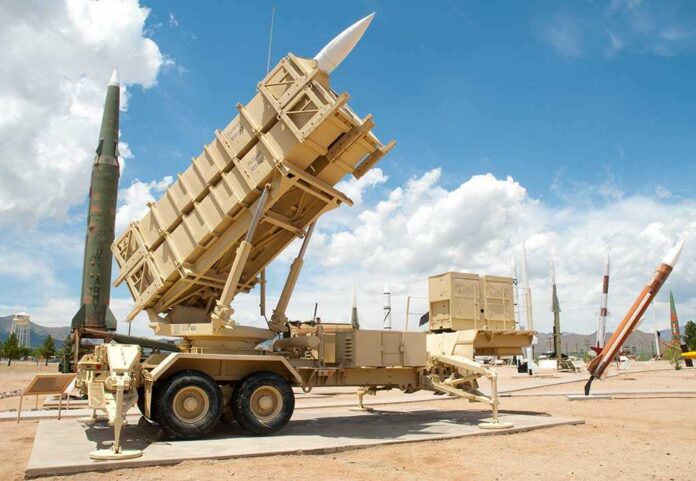
The depletion story extends to the defensive side of the ledger. Iran and its partners have used ballistic missiles, cruise missiles, and drones to strike U.S. forces and allied infrastructure, forcing sustained use of Patriot and Terminal High Altitude Area Defense (THAAD) interceptors. A July CSIS report, cited by CBS News, estimates that the U.S. entered the war with about 2,330 Patriot interceptors and, by late July, was down to between 759 and 827—roughly a two‑thirds drawdown. THAAD inventories fell from an estimated 452 interceptors prewar to between 234 and 278, a loss of at least 38%.
Military Times, summarizing the same CSIS work, underscores that this Patriot depletion “could create readiness challenges if another major conflict breaks out,” particularly given Patriot’s central role in defending U.S. bases and allies against ballistic threats. CNN’s earlier reporting on internal Defense Department assessments described a “near‑term risk” of running low on ammunition for future engagements within the next few years, after the Pentagon used about half of its Patriot and THAAD stocks in the first seven weeks of operations.
Unlike bullets or unguided rockets, each Patriot or THAAD interceptor is a sophisticated system with complex electronics, guidance, and propulsion components. As analysts emphasize, those parts have long lead times, and production lines were sized for peacetime demand rather than the extraordinary consumption rates of a high‑intensity regional war. The result is that every battery that stays forward in theater comes at the cost of shrinking the strategic reserve.
Rebuilding the Magazine: Why Restocking Takes Years
One of the most consequential findings across CSIS, CNN, and Fortune reporting is the projected time required to return missile inventories to prewar levels. CSIS estimates, cited by CBS, suggest it could take until at least mid‑2029 to rebuild Patriot and THAAD to their pre‑Iran war numbers. In a broader assessment of seven major munitions—including PrSM, ATACMS, Patriot, THAAD, Tomahawk, and others—CSIS concluded that refilling stocks will take between one and four years as missiles already under contract are delivered and new orders move through the pipeline.
These timelines are not driven primarily by budget constraints. Congress and the administration have moved to increase funding for missile procurement; some reporting even references trillion‑dollar defense toplines framed partly around replenishment. The limiting factors are industrial: the availability of solid rocket motor production capacity, warhead fill plants, advanced seekers and electronics, and test‑range throughput for certifying new missiles. Analysts who have tracked U.S. munitions production since the Cold War point out that the system was optimized for relatively small, predictable orders—supporting counterterrorism campaigns and limited strikes—not for rapid replacement of thousands of high‑end weapons consumed in months.
That mismatch between expenditure and production sits at the center of current readiness anxiety. Even if every plant runs at surge capacity, many of the components needed for ATACMS, PrSM, Tomahawk, and Patriot cannot simply be bought off the shelf. They require specialized fabrication, quality assurance, and government oversight that cannot be expanded overnight. This is why expert estimates, across several outlets, converge on multi‑year rebuild periods rather than quick fixes.
Readiness Beyond Iran: China, Allies, and Deterrence
What worries strategists most is not that the U.S. will run out of missiles for the ongoing Iran war itself. CSIS’s ceasefire‑phase assessment stresses that, even after heavy expenditure, “the United States has enough missiles to continue fighting this war under any plausible scenario.” The concern is the opportunity cost: every PrSM, ATACMS, Patriot, or THAAD interceptor fired in the Gulf is one less available for a crisis in the Western Pacific or on NATO’s eastern flank.
CNN’s reporting frames the problem explicitly in terms of a “near‑term risk” if another large war emerges while inventories are still recovering. Analysts and former officials quoted across CBS, Fortune, and think‑tank commentary repeatedly tie missile depletion to the scenario most feared in Pentagon planning—a Chinese attempt to coerce or invade Taiwan. High‑end standoff missiles and air defenses are central to U.S. concepts for blunting such an attack at range. If those magazines are thin, any administration faces a harder deterrence problem and fewer options that keep U.S. forces out of enemy missile envelopes.
Allies have noticed. Joe Kent, commenting on Reuters’ reporting about missile depletion, argues that Gulf states are reevaluating their dependence on U.S. protection as they watch Patriot and THAAD stocks fall and Iranian capabilities survive the campaign. While his broader claims about regional politics go beyond the core inventory data, the logic is straightforward: visible strain on U.S. munitions stocks can erode confidence in American security guarantees, particularly for partners who live under constant missile threat.
Adversaries, too, may adjust their calculus. Public narratives emphasizing that the U.S. has used “virtually all” of its long‑range precision missiles, amplified across Reuters, CBS, and social platforms, risk encouraging the belief that Washington’s ability to sustain another major fight is limited in the short term. Even if the classified reality is more nuanced, perception shapes deterrence. That is why senior officials often respond with broad assurances that “America’s military is the most powerful in the world and has everything it needs,” even when anonymous sources are warning of scarcity.
Meanwhile according to an exclusive report from Reuters, the U-S Army has reportedly used up most of its stockpile of long-range missiles
NewsNation's Robert Sherman: “Saying that US stockpiles of long-range precision missiles have virtually all been utilized in recent weeks.… pic.twitter.com/NSN35SGjDj— Worldwide News Network (@WorldwideNNX) August 5, 2026
What We Know—and What Remains Opaque
Despite the consistency across major outlets, it is important to be clear about the basis of the numbers. Exact missile inventories are classified; the public estimates come from a mix of anonymous officials, internal Defense Department assessments, and think‑tank modeling. Reuters and CBS both rely on unnamed sources “familiar with the data,” and explicitly note that those sources declined to say how many missiles remain. CSIS, whose spreadsheets underpin much of the secondary reporting, builds its figures from procurement histories, open‑source launch counts, and off‑the‑record consultations, not from audited government tables.
That structure creates room for reasonable uncertainty at the margins. Different reports sometimes refer to “global stockpiles,” “deployable inventories,” or “prewar levels” without standardizing definitions, and they occasionally mix offensive missiles with defensive interceptors under the single heading of “missile depletion.” Numbers can differ somewhat between publications, particularly on Tomahawk and JASSM‑ER. Yet the broad picture is remarkably consistent: several categories of high‑end missiles have been drawn down by half or more, with the Army’s key long‑range precision systems close to fully expended.
For serious observers, the way forward is not to dispute that reality but to illuminate it. The most useful next steps would be greater transparency about missile production and delivery schedules; clearer public distinctions between offensive standoff weapons and defensive interceptors; and more systematic reporting on how munitions usage is integrated into war planning. CSIS has already begun to disaggregate inventories by weapon type and project rebuild timelines; congressional oversight and independent audits can deepen that work and push Pentagon planners to align strategy with industrial base capacity.
The Iran war has thus exposed a structural vulnerability that was long discussed in abstract terms: the United States can consume advanced munitions faster than it can replace them. The immediate campaign appears sustainable. The question that will preoccupy defense professionals for years is whether the same can be said of the next war—and whether policymakers are willing to invest not just in missiles, but in the factories, workers, and logistics systems that keep the magazines full.
Sources:
cbsnews.com, aljazeera.com, reuters.com, cnn.com, youtube.com, foxnews.com, facebook.com