

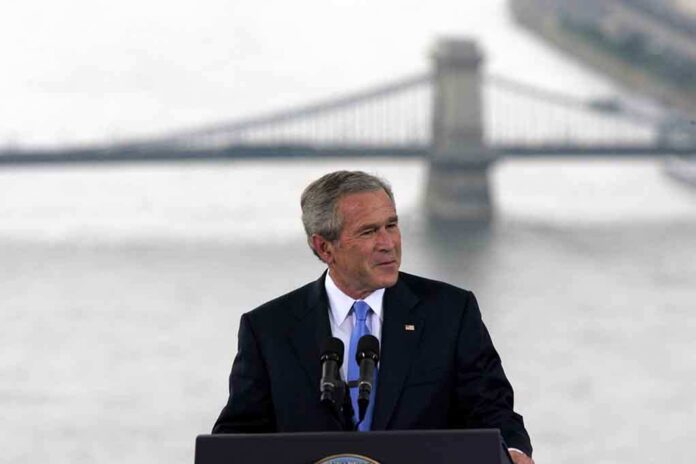
The most effective post-crisis leadership draws a hard line on enemies while drawing a wide circle around citizens; in the weeks after 9/11, President George W. Bush chose that second move with unusual clarity, separating Islam from terrorism as a matter of national purpose.
The Short Version
- Bush’s early post-9/11 messaging explicitly distinguished Islam from the attackers and instructed Americans to reject anti-Muslim bigotry.
- The White House paired this rhetoric with visible symbolism—an Islamic Center visit, meetings with Muslim leaders, and religious-outreach events.
- Archival texts show a consistent ideological frame: the United States opposed a terrorist network, not a religion.
- Claims that this “appeasement” damaged security lack documentary support in the available record; the evidence is rhetorical, not causal.
What Bush Actually Said—and Why It Mattered
Six days after the attacks, Bush stood at the Islamic Center of Washington and told the country, without hedging: “Islam is peace.” He condemned harassment of Muslim Americans and insisted that those who mistreated Muslims “should be ashamed.” The point was not atmospherics; it was to define the conflict and the community—who was the enemy and who plainly was not. In his September 20 address to Congress, he sharpened the distinction further: “The enemy of America is not our many Muslim friends; it is not our many Arab friends. Our enemy is a radical network of terrorists.” The line was categorical, intended to steer public anger away from collective blame and toward a specific adversary.
That posture was not a one-off. White House releases over the following months curated the same theme: America respects Islam; terrorists are traitors to their own faith; religious freedom is part of what was attacked and what would be defended. The State Department’s contemporaneous summary of the first 100 days after 9/11 explicitly highlights steps to protect Muslim Americans and describes outreach initiatives—a first-ever White House iftar, an Eid event, and education programs—to reinforce the message that Muslims are part of the national “we,” not suspects at large.
Mechanism: Messaging, Community Trust, and Counterterrorism
Counterterrorism is not only a matter of force and surveillance; it depends on tips, trust, and cooperation from communities who might otherwise withdraw if they feel collectively targeted. Post-9/11, federal investigators relied on information sharing across neighborhoods, mosques, and civic networks while racing to map a diffuse transnational threat. Public reassurance from the president served a concrete operational aim: it signaled that Muslim Americans were citizens to engage, not a population to be feared. Bush himself later framed his mosque visit in strategic terms—an ideological struggle in which America’s defense of free worship was a core part of what separated the United States from its enemies.
That design sat alongside a darker social reality: hate incidents spiked dramatically in the aftermath. Studies and official tallies document the surge in anti-Muslim and anti-Arab offenses in late 2001, with counts rising from a few dozen to several hundred in a single year—an increase on the order of fifteen-fold in some datasets. Those data points underscore the stakes of presidential framing. When violence tilts toward collective blame, leadership that narrows the target set to actual perpetrators is not an indulgence; it is a guardrail.
Symbolism With Policy Adjacency
The choreography of the first month mattered. The presidential stop at the Islamic Center—flanked by Muslim leaders, Qur’anic citations, and language that located Muslims firmly within the American civic story—was engineered to be seen. So were subsequent meetings with Muslim leaders at the White House and explicit presidential statements that the war was against terror and evil, not Muslims. In crisis communications, that kind of symbolism often does the heavy lifting: it gives agencies cover to act accordingly, makes it easier for local law enforcement to credibly protect targeted communities, and creates a rhetorical baseline that restrains the worst public impulses.
Official materials show the administration reinforcing that baseline across venues. The “Backgrounder: The President’s Quotes on Islam” aggregated the message into a single reference point, and the State Department’s timeline placed protection of Muslim Americans in the first tranche of post-attack actions. You can disagree with policy downstream—the contours of the Afghanistan and Iraq wars, surveillance architecture, or detention policy—without mischaracterizing this specific element of Bush’s leadership. On Islam and American Muslims, the archival record is strikingly consistent.
The Appeasement Charge and the Evidence Gap
The claim that Bush’s Muslim outreach “appeased” an adversary or degraded national security is a thesis in search of documentation in the public record at hand. The available sources show what the president said, where he said it, and how the administration promulgated the distinction between Islam and terrorism. What they do not show are internal memoranda, threat assessments, or operational reports tying that messaging to measurable security failures or intelligence complacency. No FOIA’d briefings, no NSC after-action notes, no DOJ guidance walking back investigative rigor appear in this package; the charge rests on inference rather than documented cause and effect.
By contrast, there is documented policy intent and continuity: repeated instructions against anti-Muslim bigotry, clear statements to allies and domestic audiences that the fight was with al-Qaeda and associated networks, and structured outreach to Muslim communities. That is not appeasement; it is coalition maintenance at home and abroad. If future research surfaced internal documents showing trade-offs that blunted vigilance, the debate would shift; until then, the archival footing favors the straightforward reading of the record.
Historical Context: The Triple Tension After Terror
In every mass-casualty attack linked to Islamist extremism, leaders navigate a three-way tension: reassure civil rights, signal security resolve, and modulate the media’s amplification of threat. In September 2001, the reassurance move was unusually visible because the ambient risk of backlash was high—and borne out in the hate-crime spike documented by federal statistics and independent researchers. The security signaling, however, was also unmistakable: Congress authorized force; NATO invoked Article 5; the United States fought in Afghanistan within weeks. The idea that inclusive rhetoric displaced resolve is not borne out by action.
This balance—condemn the guilty, protect the innocent—is not moral preening. It is a strategic throughline that helps sustain legitimacy for hard power, preserves community cooperation for domestic security, and upholds a constitutional identity adversaries claim to despise. Bush’s language at the mosque and from the rostrum put that throughline into the open, where it could anchor policy and constrain passions.
Post 9/11, America invaded or bombed every Muslim country it could, and Americans do not understand Shia and Sunni. It's a famous Bush moment when he blamed Iran for al-Qaeda.
— PANEX13 (@PA71A2) September 21, 2026
What Endures
The durable lesson is not that words alone defeat terrorists. It is that a superpower’s first sentences after catastrophe set the boundaries for everything that follows: who belongs, who does not, and what values are nonnegotiable even under maximum stress. On this axis, the contemporaneous record is clear: Bush separated Islam from terrorism, instructed Americans to reject bigotry, and embedded that stance in the administration’s public doctrine. The burden of proof therefore lies with anyone alleging that reassurance was appeasement with harmful consequences to produce more than conjecture—namely, specific, attributable documents or data that connect rhetoric to degraded security outcomes. Absent that, the evidence supports a different, simpler reading: a president defined the enemy correctly and kept the civic circle intact while the country went to war.
Sources:
usinfo.org, gilderlehrman.org, en.wikipedia.org, georgewbush-whitehouse.archives.gov, theguardian.com, bostonglobe.com