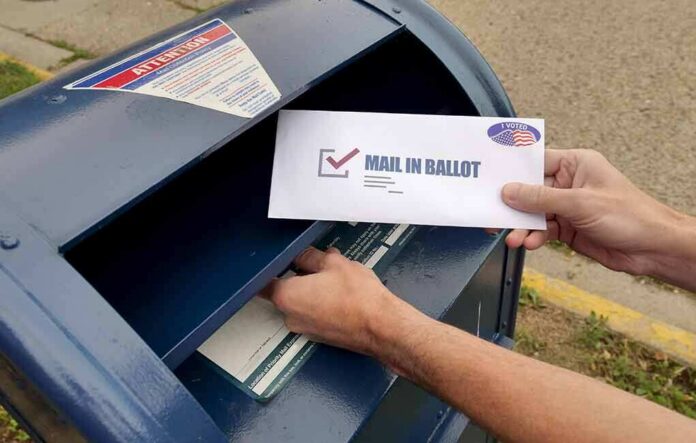
Federal prosecutors say a Utah letter carrier tossed more than 300 mail ballots into a dumpster, and the details should make every voter sit up.
Story Snapshot
- Justice Department unsealed an indictment alleging a postal worker trashed about 300 Utah ballots.
- Ballots were for the June primary; officials say none on that route got delivered that day.
- The worker told investigators he had no political motive and acted out of “laziness”.
- Postal inspectors traced the missing ballots, and a grand jury returned charges.
What prosecutors say happened and why it matters
The Department of Justice announced a grand jury indictment of a former United States Postal Service carrier who allegedly discarded hundreds of pieces of mail, including about 300 ballots meant for registered voters in Utah County ahead of the June primary. The indictment charges unlawful secretion, destruction, and delay of mail. Prosecutors framed the act as stripping voters of their ballots. The U.S. Attorney in Utah said the carrier set the ballots aside early in his shift and delivered none from that stack.
Federal investigators opened the case after election officials reported clusters of voters who never received ballots. The United States Postal Service Office of Inspector General worked with local officials to map the route and locate the missing election mail. That process led to a church parking lot dumpster, where the mail had been thrown away, according to coverage that cites government filings. A grand jury then issued a single count tied to destroying and delaying mail, which covers election pieces.
What the accused says and what the facts can support
The carrier told investigators he had no political agenda and acted out of frustration with workload. He described his conduct as “laziness” and said he thought he was getting rid of advertisements to lighten the load, according to court documents cited by national outlets. That explanation, if true, would not erase the charge; the law protects election mail regardless of motive. Intent to aid a party is not required to make the conduct criminal under federal mail laws.
Prosecutors counter that actions show awareness. They say the carrier separated ballots within about 90 minutes of starting work and did not deliver a single one from that batch. That timeline, if proven, undermines the “junk mail” claim. Election mail has distinct markings, and postal training addresses special handling. On a common-sense reading, a person handling a large stack of ballot envelopes would likely notice. A jury will weigh his words against the paper trail and recovered mail.
Election integrity lens: real risk, fast response, narrow scope
Mail voting depends on layers: design by local officials, transport by the Postal Service, and checks by election offices. When a single person breaks the chain, hundreds of voters can be harmed. That is why postal inspectors and prosecutors move fast. The Postal Service’s inspector general reports on-time processing rates above 97 percent for election mail during primaries, yet also flags training gaps and spot failures that need fixes. Both can be true: strong performance overall, with rare but serious breakdowns.
Mail voting depends on a simple promise: the ballot sent to a voter will actually reach the voter.
Federal prosecutors say former Utah postal worker Damon Matai Seei threw away mail assigned for delivery on June 3, including about 300 ballots for Eagle Mountain residents before… pic.twitter.com/fMPD58nZJF
— Dan Holbrook (@DanHolbrook) September 23, 2026
Conservative principles call for equal rules, tough enforcement, and systems that make wrongdoing hard and short-lived. This case fits that playbook. The accused faces a federal felony. Inspectors traced the problem, and election officials identified who missed ballots. That mix—clear consequences, visible oversight, and verifiable tracking—builds trust. It also argues for tighter route audits during ballot windows, clearer envelope designs, and refresher training that marks election mail as “do not discard” in plain terms.
What comes next for voters, officials, and the courts
The case now moves to court, where the government must prove the charge beyond a reasonable doubt. The defendant has pleaded not guilty and is entitled to a full defense. Voters in the affected area should have been contacted by local officials and offered replacements or in-person options. Going forward, election offices and the Postal Service can lean on simple, proven steps: barcoding routes for ballot trays, daily reconciliation of election mail counts, and rapid alerts from the Postal Service Office of Inspector General hotline when clusters go missing.
Sources:
justice.gov, foxnews.com, washingtonexaminer.com, lawcommentary.com