
When artists intervene in iconic public landmarks, the debate that follows is not about whether the act is “art” or “crime” so much as how a single gesture can be both—conceptually legible as performance while, in legal terms, almost certainly trespass.
The Short Version
- Sabine Tautou’s Hollywood Sign action was presented as a site-specific performance about fame and erased identity, not random hooliganism.
- Police detained Tautou and cited her for trespass—consistent with how authorities handle unpermitted landmark interventions.
- America has a long pattern here: expressive claim versus access law; the latter usually wins in court while the former wins in headlines.
- Prior Hollywood Sign incidents show the same split-screen outcome: cultural notoriety alongside misdemeanor enforcement.
What actually happened—and why intent does not neutralize trespass
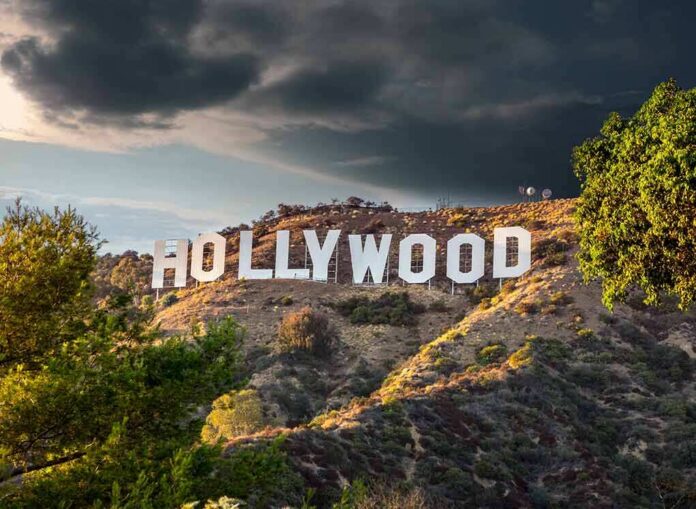
According to contemporaneous reporting, artist Sabine Tautou executed a brief performance at the Hollywood Sign—roughly a 25-minute window beginning around 10 a.m.—in which a nearly naked man was bound in a “mummified” wrap against the landmark’s structure, a piece Tautou titled “Public Figure, 2026.” Police detained the artist and cited her for trespassing. The artist’s press framing emphasized a conceptual juxtaposition: the sign as a global emblem of aspiration and celebrity, the “mummification” as a constraint that “restricts movement and erases identity.” That is a coherent thesis in the language of public art; it is not a legal defense to unauthorized access on restricted property.
In the American system, trespass turns on permission and scope, not motive. A performance that relies on entering a controlled zone or attaching materials to another’s property without consent lands within ordinary access and property rules. Courts have been consistent that expressive purpose does not create a free-speech right to occupy or alter property where entry is prohibited or conditioned; the forum is closed, and the analysis ends there. Prior Hollywood Sign episodes—when letters were masked to read “HOLLYWeeD” in 2017, and when a large image was hung over the sign in 2021—drew misdemeanor trespass treatment rather than any imprimatur of protected expression.
How these stunts function as art—site, symbol, and the body as medium
Uncommissioned urban interventions often seek leverage through location: the site is not a backdrop but the subject. The Hollywood Sign is one of the world’s most saturated symbols of self-invention; to physically confront that symbol—whether by wrapping a body to it, hanging objects from it, or remasking its planes—is to dispute the story it tells about access, status, and visibility. In Tautou’s own description, the bound body stands in deliberate tension with fame’s promise, suggesting that the very pursuit of iconicity imposes constraint. You don’t have to admire the tactic to acknowledge the grammar: juxtaposition, duration, and high-visibility framing are the working parts of the piece.
Historically, artists have used similar compositional devices at monuments and buildings precisely because a landmark compresses meaning: audiences bring prior associations, so the intervention needs little text to read. Danny Finegood’s 1976 “Hollyweed” alteration achieved this with simple tarps; decades later, digital culture accelerates that effect. The mechanism is as old as conceptual art: change the context, change the meaning. The gamble is that the emotional and symbolic payoff outweighs the legal risk.
Why the law remains unmoved: closed forums, property rules, and risk
Municipalities and custodial nonprofits treat landmarks like controlled work sites. Fences, signage, and posted rules establish a closed forum; once an actor crosses the line, even momentarily, the legal inquiry is uncomplicated. The Hollywood Sign’s stewards and local law enforcement have consistently enforced on that basis: if there is no damage, the matter is typically investigated and charged—if at all—as misdemeanor trespass, not vandalism. That pattern held after the 2017 alteration, which authorities expressly framed as a trespass because the structure was not impaired.
The doctrinal backdrop is not idiosyncratic Los Angeles policy but standard property and access law. Use beyond permission is trespass; expressive motive does not alter the status of the forum. Scholarship on uncommissioned public art catalogs the same tension: site-specific critique collides with the baseline rule that you cannot appropriate access to someone else’s property to make your point. The result is predictable—cultural conversation, legal citation.
The media economy of landmark interventions
If the legal script is so consistent, why do artists keep doing it? Because the cultural script is equally consistent: an unpermitted act at a recognizable landmark all but guarantees rapid distribution. The image is instantly legible at thumbnail size; the controversy supplies its own narrative—audacity, speed, and a named place. That visibility is the currency of conceptual public performance. Newsrooms know the template from past Hollywood Sign episodes; coverage predictably toggles between the artist’s statement and the enforcement response, giving the piece more oxygen than any white-wall gallery could. The artist pays in citations and reputational risk; the payoff is an audience measured in millions, not hundreds.
This is why even short-duration actions—Tautou’s lasted approximately 25 minutes—are calibrated for maximum capture: cameras rolling, statements prewritten, exit route planned. The brevity reduces risk without diluting the photographic punch. In a mediated environment, documentation is the art object.
Where reasonable disagreement actually lives
There is little serious dispute that such acts are unauthorized; the fulcrum of disagreement is over legitimacy, not legality. Advocates argue that landmarks absorb public meaning and thus invite public critique, particularly when the critique concerns who gets to be visible and why. Custodians counter that preservation, safety, and trademark stewardship are public obligations too—obligations that vanish if the structure becomes a canvas for any motivated actor. Both positions are coherent; only one controls what officers do at the fence line.
Another line of debate is proportionality. Should a non-damaging, time-limited intervention trigger criminal process? Practice in Los Angeles suggests a calibrated response: warnings or citations when there is no damage; trespass arrests primarily to deter escalation; vandalism charges reserved for harm requiring remediation. That approach is visible across incidents at the sign over decades and reflects a pragmatic calculus: protect the structure and disincentivize repetition without over-criminalizing symbolic speech.
Takeaways for artists, institutions, and the public
Artists who plan site-specific interventions at controlled landmarks should assume two truths: their expressive rationale may persuade audiences, but it will not supply legal permission; and the more legible the symbol they borrow, the more likely the result is notoriety paired with misdemeanor exposure. Institutions, for their part, have learned that clear perimeters, surveillance, and steady misdemeanor enforcement are sufficient to protect the asset without handing provocateurs martyrdom. The public gets both stories at once: the conceptual point the artist staged, and the civic boundary the law reaffirmed.
Sources:
nypost.com, x.com, tmz.com, news.artnet.com, dw.com