
The shortest-serving White House press secretary on record did not exit a vacuum; Katie Zacharia’s five-day tenure distilled how presidential communications roles turn on trust, optics, and tempo—and how quickly those forces can collapse a high-profile appointment.
At a Glance
- Katie Zacharia was named White House press secretary and publicly called the role “the honor of a lifetime,” praising President Trump’s leadership.
- Within five days, the White House confirmed she was “transitioning out,” following intense scrutiny and a rocky start to briefings.
- President Trump characterized Zacharia as a loyal supporter at appointment and later advised she reconsider remaining in the job.
- Her stint is widely reported as the briefest for a press secretary, underscoring the volatility of modern White House communications posts.
What happened: an appointment praised, a departure accelerated
On October 9, 2026, President Trump announced Katie Zacharia would succeed Karoline Leavitt as White House press secretary and lauded her as “a loyal and brilliant supporter, right from the beginning.” Zacharia responded in public with equal warmth, calling the appointment “the honor of a lifetime” and describing Trump’s leadership as “a blessing to this country.” Those reciprocal statements—president and appointee affirming loyalty and purpose—set the tone for what, in ordinary times, would be a honeymoon phase of message-setting and staff integration.
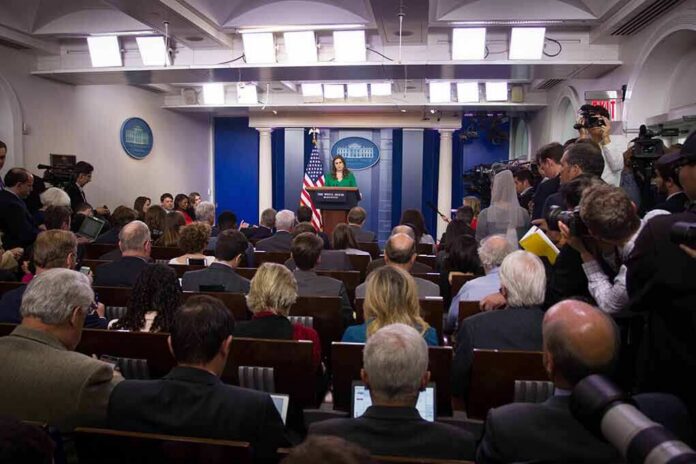
Instead, the arc compressed into a single workweek. By Friday of her first week behind the lectern, senior officials confirmed Zacharia was “transitioning out,” even as the president said he had urged her to reconsider remaining in the role. Major outlets reported the whiplash sequence: a Tuesday debut briefing that proved bumpy, mounting questions about her credentials and preparation, presidential remarks suggesting the choice to step aside would be hers, and, finally, confirmation that she would depart the post.
Mechanism: why this job breaks faster than most
The White House press secretary sits at the intersection of presidential preference, institutional process, and ceaseless media scrutiny. Success demands more than fluency with policy; it requires alignment with the president’s voice, stamina under hostile questioning, and instant credibility with reporters who traffic in detail. That credibility is cumulative and fragile. In Zacharia’s case, the White House continued to voice confidence—communications director Steven Cheung called her “uniquely qualified and whip smart”—but the same week saw public debate over her professional background and demonstrations of uneven podium control, conditions that can swamp even a supportive internal assessment.
The speed of the reversal matters because it signals how sensitive the role is to perceived missteps. In modern administrations, the political cost of an off-note at the podium is immediate; feedback loops involving broadcast clips, digital platforms, and partisan ecosystems penalize ambiguity or overreach within hours. Presidents, acutely aware that the briefing room projects their brand of competence, will cut losses quickly to protect the message. In this context, Zacharia’s initial expressions of loyalty and the White House’s defense of her capability were genuine but not dispositive once the narrative turned.
History and comparison: the briefest tenure, in a long-running pressure cooker
At roughly five days, Zacharia’s tenure is widely reported as the shortest for a White House press secretary—shorter than Jerald terHorst’s month under President Ford and Jonathan Daniels’s 48 days under President Truman, and more abrupt than other modern short stints that nonetheless cleared a month or more. The only close contemporary analogue—though a different job—remains Anthony Scaramucci’s 11-day run as communications director in 2017, which became a shorthand for velocity and volatility in presidential messaging operations.
In aggregate, press secretaries typically serve near three years; turnover at five days is therefore not an incremental deviation but an outlier that crystallizes broader forces shaping the post. Political science literature on presidential appointments has long argued that presidents juggle loyalty and perceived competence in senior picks, rarely securing both in abundance. Communications roles, because they are performative and public, expose that trade-off faster and more ruthlessly than policy posts shielded by process and time.
The week itself: public praise, scrutiny, and a controlled landing
From the outset, Zacharia emphasized alignment with Trump’s agenda, opening with language that framed her service as privilege and the president’s leadership as a national boon. Her first briefing featured ambitious claims across economics, energy, and national security—an effort to plant a flag for the administration’s narrative. But the same debut introduced friction points. Questions about her legal credentials and preparation for sustained exchanges fueled coverage that overshadowed message wins. By Friday, President Trump publicly suggested she should reconsider remaining in the role; the White House, through officials not authorized to speak on the record, confirmed she was transitioning out, softening the edges of a departure that might otherwise read as a firing.
The White House’s insistence on her abilities, paired with a departure framed as a transition, reflects a familiar institutional impulse: preserve the dignity of the spokesperson role and the individual occupying it, even amid decisive personnel changes. It also maintains the option for reassignment, an approach several administrations have used to retain talent while resetting the face at the podium. In Zacharia’s case, published reporting at the time did not include a public, post-decision farewell statement from her, leaving her own closing rationale unstated in the record.
White House has said its press secretary Katie Zacharia is leaving the role after less than a week on the job amid strong media criticism.
Zacharia’s departure was confirmed by US President Donald Trump, who told reporters on Friday that he had told Zacharia to "reconsider" her… pic.twitter.com/vCVgCuobXQ
— GAROWE ONLINE (@GaroweOnline) October 17, 2026
What it means: lessons for staffing the microphone
Three durable lessons emerge. First, presidential communications is a craft, not a résumé line; mastery requires rehearsal under fire, command of detail, and the humility to avoid outrunning the facts. Second, loyalty is necessary but insufficient. A president can and will praise a spokesperson’s allegiance—and mean it—yet still move quickly if the daily briefing becomes a liability. Third, process discipline matters. Vetting, message calibration, and early-briefing choreography are not bureaucratic niceties; they are the air cover that prevents a spokesperson’s first week from turning into a referendum on their credibility.
Why it endures as an instructive episode
Zacharia’s five-day tenure is not just a curiosity in the record book; it is a case study in how quickly the gravitational forces of the modern presidency can invert a promising appointment. The appointment itself, and the language surrounding it, show the premium the Trump White House placed on loyalty and alignment. The outcome shows that in the compressed half-life of present-day political media, even a loyal messenger’s standing depends on immediate performance and the perception of unassailable command at the podium. That combination—alignment with the principal and unflappable public craft—remains the gold standard, and the rarest find, for any administration.
Sources:
facebook.com, apnews.com, inquirer.com, stlpr.org, cnbc.com, bbc.com, abc6onyourside.com