When a domestic assault spills into a barricade incident, the facts that matter most are the victim’s account, the charges that follow, and the police decisions that bring it to an end; in Sevier County, Tennessee, those elements align into a clear, grave narrative of violence and a methodical SWAT resolution.
At a Glance
- Court records attribute to the injured woman a detailed account: she was doused in gasoline and her face was ignited during a domestic assault.
- Police tracked the suspect to a Smokies Motel room, where he barricaded himself, prompting a multi-hour SWAT and negotiator response.
- Tactical teams used specialized tools and ultimately arrested the suspect without further injury after breaching the room.
- Charges include aggravated domestic assault and especially aggravated kidnapping; jail records reflected a substantial bond.
A violent domestic assault followed by a barricade
According to contemporaneous court records, the woman told responding officers that Mark A. Harden poured gasoline on her, forced her onto a couch, grabbed a lighter, and set her face on fire. She described how she extinguished the flames—accounts summarized in separate outlets mention using running sink water or a kitchen bowl—and reported burns that required transport to the University of Tennessee Medical Center. The specificity of ignitable liquid, ignition source, and extinguishing method is atypical of vague accusations; it reads like a victim reliving a discrete sequence under acute stress, which is how most credible first reports arrive to police. Local outlets obtained and summarized the affidavit and related filings contemporaneously, anchoring the allegation in the language of sworn complaint rather than rumor.
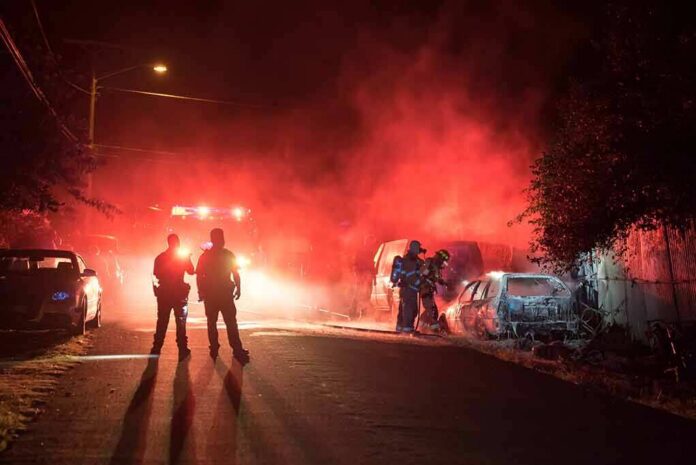
Deputies and Sevierville police then moved to locate Harden. Just after midnight, officers found him at the Smokies Motel, where he refused commands and barricaded himself in a room, according to the department’s public information officer. Given the severity of the alleged assault and the prospect he could be armed, Sevierville deployed its SWAT unit, crisis negotiators, and a police K-9. That escalation is standard: an alleged violent felony combined with a barricaded subject meets the operational threshold for specialized teams focused on containment, communication, and controlled entry.
How the SWAT response unfolded
Multiple reports independently track the same sequence: negotiators sought voluntary surrender while tactical officers maintained a perimeter and used tools designed for standoffs—among them a small drone for situational awareness and, later, chemical agents to disrupt the barricade. When there was no safe path to compliance, officers breached and conducted a deliberate search, ultimately finding the suspect concealed beneath a mattress and clothing. He was taken into custody at the close of a roughly three-hour operation. The cadence—contain, communicate, escalate tools, then breach if necessary—reflects best practice in reducing risk to officers, bystanders, and the subject, and it is exactly what you see in well-run barricade resolutions across agencies.
What happens after the door comes down tends to be prosaic but important. Officers secure and search the subject for weapons, clear adjoining spaces, and then begin the slow paperwork gravity of a serious felony case: transport, booking, initial appearance, and bond determination. In Sevier County, local jail records and charging documents reported a suite of offenses that track the narrative prosecutors expect to prove—aggravated domestic assault for the alleged burning, especially aggravated kidnapping tied to restraint when the victim tried to flee, and additional counts linked to the incident chronology. Bond was set in the hundreds of thousands of dollars, a figure that signals judicial recognition of both risk and the seriousness of the alleged conduct.
What the charges and records tell us
When multiple, independent local outlets summarize the same affidavit language and quote police on-record about the standoff, you have the backbone of a fact pattern: a specific allegation of gasoline and ignition, immediate treatment for first- and second-degree burns, and a barricade that ends with an arrest. The legal posture is pretrial—charges and warrants, not a conviction—but that does not make the account nebulous. Rather, it means the narrative is rooted in a sworn victim statement and an arrest process robust enough to justify specialized police deployment and significant bond. The Mountain Press, WVLT, and WATE all converged on those core points.
The woman’s description of how she put out the flames varies slightly across summaries—sink water versus a bowl. That discrepancy is minor against the totality of the account and typical of early paraphrase from different documents or interviews. What does not vary is the central mechanism: gasoline applied to the victim’s body, a lighter used as an ignition source, and resultant burns documented by transport to a regional medical center. Those are the details that matter to both a prosecutor’s theory and a fire investigator’s lens; they are also the details that justify the “especially aggravated” label attached to a kidnapping charge when restraint follows severe bodily injury.
Why police procedure looked the way it did
Domestic violence cases that escalate into barricades are among the highest-risk calls in patrol work. Officers are balancing three imperatives in real time: preserve life, protect the public, and apprehend a suspect reasonably believed to have just committed a violent felony. The decision to call SWAT is not an indulgence; it is a risk-management choice when a suspect’s refusal to exit a confined space turns the geometry of entry into a hazard for officers and any unseen third parties. Drones, chemical agents, K-9s, and negotiators are not theatrics; they are tools sized to regain information and initiative when a subject has both. In this case, those tools produced an arrest without reported additional injury and preserved an evidentiary scene for later analysis.
The charges filed and the reported bond amount add a layer of procedural corroboration. Courts do not set six-figure bonds in a vacuum; they do so on the strength of probable cause articulated in sworn filings, the nature of the injuries described, and an assessment of danger and flight risk. Multiple outlets cited the specific charges and bond, drawing from court and jail records that exist precisely to mark the transition from allegation-at-scene to a case in the criminal docket.
Black Man charged after setting a woman on fire and leading SWAT on a 3-hour standoff in Sevier County.
Mark Harden, 33, is facing charges including especially aggravated kidnapping, aggravated domestic assault, and vehicle theft following a violent incident on Mutton Hollow… https://t.co/cAnNTmh3OM— Ravious101 🦅🇺🇸 (@Ravious101) October 21, 2026
The broader lens: extreme violence and media attention
The gasoline-and-ignition allegation is horrific, and it will attract headlines. That tendency is well-documented: studies of domestic-violence coverage consistently find that the most extreme physical cases crowd out attention to the far more common but less spectacular forms of abuse—coercive control, threats, and harassment. Sensational framing can draw eyes but often strips context. The responsible frame here is straightforward: a detailed victim statement, an acute injury response, a tactical barricade resolution, and felony charges now in the court system. Coverage that keeps those pillars in view—rather than hyperbole—helps the public understand both the gravity of the alleged conduct and the mechanics of how such cases move from scene to courtroom.
Sources:
thegatewaypundit.com, wvlt.tv, wate.com, hindustantimes.com