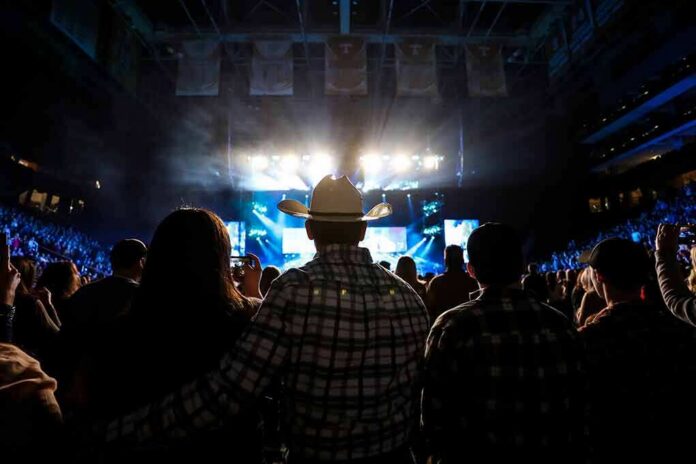
In country music, political candor is never just about policy; it is a stress test of identity, loyalty, and brand. Jelly Roll’s week guest-hosting Jimmy Kimmel Live! crystallized that truth, and John Rich’s assessment—that an artist can speak his mind but should expect a price—tracks with how this genre has long converted political talk into reputational stakes.
At a Glance
- Jelly Roll publicly framed himself as politically “down the middle” after making Trump jokes on a national late-night stage, acknowledging the blowback and rejecting partisan labels.
- John Rich defended the right to speak while warning that country artists who wade into politics often alienate a portion of their audience—sometimes a large one.
- The strongest claims here are attitudinal, not numerical; there is no credible measure that Jelly Roll “lost half his fans,” but the backlash dynamic is real.
- Country’s audience history makes this predictable: the genre routinely treats political comments as authenticity tests that can trigger swift punitive reactions.
What Happened And Why It Landed So Hard
Jelly Roll closed out a high-visibility guest-host run on Jimmy Kimmel Live! with a monologue that mixed Trump jokes and an attempt to define his own political bearings. The humor drew immediate blowback from a subset of conservative-leaning country fans; in the days after, he rejected the idea that a late-night booking equates to adopting the host’s politics and described himself as “pretty down the middle,” a self-portrait that listed faith, rural roots, and bowhunting alongside his profession. The content matters less than the venue and the audience priors: a country star on a show often framed as antagonistic to President Trump is, to many listeners, not neutral ground, and satire can read as betrayal rather than bit. Jelly Roll’s post-show framing aimed to de-escalate the partisan reading without disowning what he said.
Enter John Rich, who has been consistent on one point: artists should tell the truth as they see it, and they should also understand the consequences. In multiple outlets, Rich cast Jelly Roll’s posture as authentic and unsurprising, and stressed that country’s consumer culture often punishes perceived deviation—sometimes severely. His rhetoric that an artist could lose “half” an audience in these moments dramatizes the risk, but it is not backed by quantified fan-behavior data in the public record; it functions as a warning, not a measurement.
Mechanism: How Backlash Takes Shape In Country Music
Country’s reaction cycle is unusually efficient because identity signaling is embedded in the genre’s institutions. Radio programmers, legacy press, and fan networks have long encoded expectations about what a country star represents—patriotism, small-town rootedness, and a wary stance toward elite lecturing—so when an artist appears to cross those signals, the response moves quickly from disagreement to adjudication of authenticity. The pattern is old: artists who step into overt politics—on either side—often trigger immediate audience discipline, from boycotts to radio reluctance. The Dixie Chicks saga remains the canonical case study, but the mechanism extends beyond that episode and has been described repeatedly in industry and academic analyses as a structural feature of the format rather than an episodic flare-up.
Late-night television adds a multiplier. The comedic frame licenses sharper jabs, but the platform’s perceived ideological tilt ensures those jabs are read as partisan even when the performer, like Jelly Roll, claims a centrist identity. For a subset of country consumers, the venue itself is a provocation; for commentators, it is proof of alignment. This is the interpretive trap: an artist tries to use the stage to widen how he is understood, and the audience narrows him to a single axis—team red or team blue—based on where the jokes landed.
What The Record Supports—and What It Doesn’t
Two claims carry strong evidentiary support. First, Jelly Roll explicitly said he anticipated the conversation and would not be slotted neatly into a partisan box; his “down the middle” statement and refusal to equate a TV gig with adopting the host’s politics are on-record. Second, Rich has been unambiguous about his principle—speak honestly, accept the price—and his view that Jelly Roll’s Kimmel persona reflected the real person rather than a calculated pivot.
Two other claims are weaker. The idea that Jelly Roll privately gamed out losing “half” his fans before the show lacks primary documentation in the public materials. And while reports describe boycotts and fans announcing they’d stop listening, no reputable analysis has surfaced that quantifies a durable collapse in streams, ticket sales, or radio spins attributable to the monologue. Put simply: a backlash happened; its scale is contested. Treat Rich’s “half” as rhetoric, not data.
Why Country Treats Politics As A Loyalty Test
Country music is a community as much as a market, and communities police boundaries. Sociologically, the genre’s postwar consolidation—regional radio, touring circuits, and Nashville’s label system—rewarded conformity to shared codes that signaled “our people.” In such systems, politics becomes shorthand for membership; the stakes are not who you voted for, but whether you are still “us.” This helps explain why the same comments that read as mainstream satire outside the format can feel like disloyalty within it, and why even centrist positioning draws crossfire. Analysts and historians have documented cycles of retaliation against overt political stands; the lesson artists learn is to either keep politics oblique or accept the risk when they don’t.
The modern twist is algorithmic. Outrage clips travel farther than nuance, so a single sharp line on a late-night set can define an artist’s politics for audiences who never watch the longer monologue where he claims the middle. Aggregators then frame the moment as conversion or betrayal, flattening motive and context into a binary story that pays in clicks. Once that frame hardens, walk-backs, clarifications, and good-faith self-descriptions compete uphill against the first impression.
Jelly Roll Addresses Political Affiliation Amid Backlash Over Trump Jokes https://t.co/f4vMYCBhl5
— Bradenton Herald (@bradentonherald) September 3, 2026
Practical Implications For Artists—and Fans
For artists, the Jelly Roll episode underlines three durable rules. First, clarity about identity before a polarizing stage can blunt a portion of the blow; if you plan to flex into political comedy on a venue your base distrusts, define your own priors early and often in channels they trust. Second, if you choose candor, do it without the crutch of invented numbers; let the work and the courage speak. Third, assume that tone matters as much as content: satire aimed at a political figure will be heard by some as disdain for the audience that supports that figure.
For fans, the same episode is a reminder that authenticity cuts both ways. If you prize an artist’s honesty about addiction, faith, and failure, you cannot demand strategic silence on politics without converting “authenticity” into a one-way mirror. Country’s greatest performers have always smuggled complicated truths through simple forms; the genre is strong enough to survive a monologue. The market will render its verdict over months, not hours—on songs, not sound bites.
Sources:
facebook.com, whiskeyriff.com, newsnow.com, wideopencountry.com, ibtimes.co.uk, pagesix.com, people.com, yahoo.com, breitbart.com