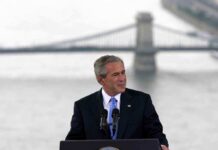

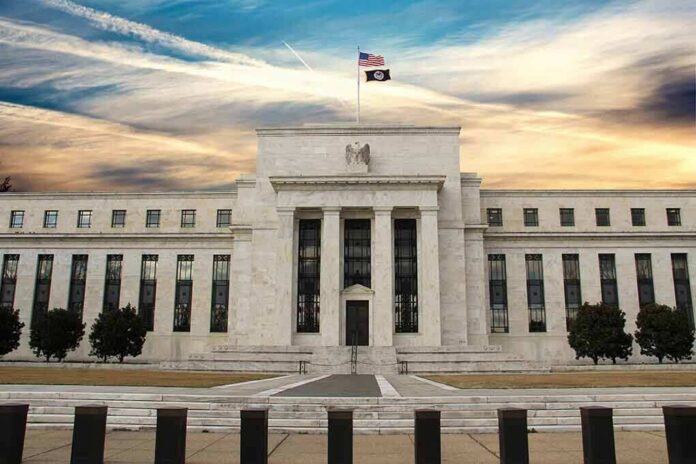
The death of Alan Greenspan at 100 closes the book on a Federal Reserve era that brought both booming prosperity and the seeds of the 2008 crash.
Story Snapshot
- Alan Greenspan, Federal Reserve chairman from 1987 to 2006 under four presidents, has died at 100.
- His tenure lined up with a decade-long boom, low inflation, and the so‑called “Great Moderation.”
- Critics say his easy‑money, Wall Street‑friendly approach helped inflate bubbles and worsen the 2008 crisis.
- His legacy is a warning about how much unchecked power an unelected central bank can hold over our lives.
Greenspan’s Long Reign Over America’s Money
Alan Greenspan served as chairman of the Federal Reserve from 1987 until early 2006, making him one of the longest-serving central bank chiefs in American history and earning the nickname “maestro” from Wall Street and the media.[8] He was first appointed by President Ronald Reagan and then reappointed by presidents from both parties, ultimately serving five terms under four different presidents during nearly nineteen years at the helm of the nation’s money supply.[13]
During Greenspan’s time in charge, the economy experienced what many called the “Great Moderation,” a stretch from the mid‑1980s into the 2000s marked by more stable growth, lower inflation, and fewer recessions than earlier decades.[6] Supporters credit him with helping to guide the country through Black Monday in 1987, the early‑1990s downturn, the Asian and Russian financial scares, the dot‑com bust, and the shock after the September 11 terrorist attacks without a complete economic collapse.[4]
Record Expansion, Rock‑Star Status, and the “Maestro” Myth
From 1991 to 2001, the United States enjoyed an uninterrupted decade of growth, then the longest expansion on record, and Greenspan sat at the center of that story.[1] Mainstream outlets praise him for letting the economy “run hot” in the late 1990s, even as many experts urged rate hikes, while inflation stayed modest and unemployment fell to levels not seen in thirty years, giving him huge clout in Washington and almost celebrity status in financial circles.[11]
Media and global elites often painted Greenspan as a near‑genius manager of capitalism, claiming his decisions helped bring global prosperity and stability in the 1990s.[11] But those same glowing stories rarely stressed that he built on the hard anti‑inflation work of his predecessor Paul Volcker or that the internet boom, the peace dividend after the Soviet Union fell, and other forces outside the Federal Reserve also drove the surge, raising questions about how much credit one unelected official really deserved.[11]
From “Great Moderation” to Great Crisis
Only two years after Greenspan left office, the United States was hit by the worst financial crisis since the Great Depression, and many analysts now argue his policies helped load the system with risk.[10] Critics point to his low‑interest‑rate stance and his light‑touch approach to financial regulation as key factors that fed both the stock bubble of the late 1990s and the massive housing bubble that exploded in 2008, turning the “maestro” label into a punchline for families who lost homes and savings.[10]
Academic and policy critics say Greenspan supported a financial system that became more fragile over time by refusing to keep strong tools of oversight in place, even as complex products spread across Wall Street.[8] Others note that during the so‑called “Greenspan put,” markets grew used to the idea that the Federal Reserve would step in with easy money whenever stocks fell sharply, which rewarded big risk‑taking and left everyday savers bearing the cost when the party finally ended.[3]
What His Legacy Means for Conservatives Today
Alan Greenspan’s story is a clear example of the built‑in conflict that comes when one central bank is both a powerful regulator and the operator of key pieces of the financial system.[18] Research shows that this dual role can push the Federal Reserve to protect its own turf and its preferred tools, even if that means delaying needed reforms or ignoring warning signs, which is the exact opposite of limited, accountable government rooted in the Constitution and responsive to the people.[18]
🇺🇸BREAKING: Alan Greenspan, the former Federal Reserve chairman, has died at the age of 100 from complications of Parkinson's disease.
Greenspan led the Fed from 1987 to 2006 under four presidents, presiding over the longest economic expansion in US history and coining the… pic.twitter.com/ssj7JuIMIn
— Crypto Jargon (@Crypto_Jargon) June 22, 2026
For conservatives who have watched decades of inflation, bailouts, and Washington debt, Greenspan’s mixed record is a reminder that “experts” are not always on the side of working families. He oversaw years of stability, but he also left behind an over‑mighty Federal Reserve, a more globalized, bubble‑prone economy, and a class of financial insiders who learned that the central bank would often shield them from the full cost of their own bad bets.[6]
Sources:
[1] Web – Alan Greenspan, Fed chair under 4 U.S. presidents, dies at age 100
[3] Web – Alan Greenspan – Wikipedia
[4] Web – The Fed, the Stock Market, and the “Greenspan Put”
[6] Web – Was Alan Greenspan a good chairman of the Fed or did he … – Reddit
[8] Web – Is there life after Greenspan? – Bruegel
[10] Web – How Alan Greenspan set the course for our modern financial …
[11] Web – Alan Greenspan, long-time US Federal Reserve, chairman dies at 100
[13] Web – Alan Greenspan, longtime US Federal Reserve chairman, dies aged 100
[18] Web – Alan Greenspan, former Fed chairman, dies at 100