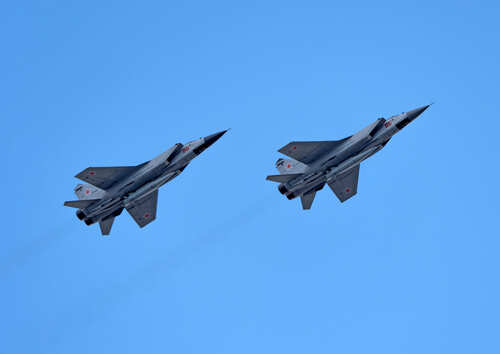
Russia is marketing a “Mach 5 space fighter” to spook the West—but the MiG-41 still looks like a paper tiger with no confirmed prototype in the air.
Story Snapshot
- Russian outlets and defense commentators have renewed hype around the MiG-41 (PAK DP) as a successor to the MiG-31, with extreme speed and near-space ambitions.
- Multiple reports emphasize the program remains pre-prototype, with no public evidence of a flying MiG-41 as of late 2025.
- Claims include Mach 4+ to Mach 5 performance, very high altitude operations, and even anti-satellite or hypersonic-intercept roles—but these remain unverified.
- Analysts point to familiar constraints: sanctions, wartime strain, and Russia’s mixed track record with advanced aircraft timelines.
Russia’s MiG-41 “Revival” Meets a Hard Reality: No Jet Yet
Russian messaging has again pushed the MiG-41, also known as the PAK DP program, as a next-generation interceptor meant to replace the aging MiG-31 fleet. Reports tied to late-2025 commentary describe an “external design” as complete and suggest a prototype flight could happen “in coming years.” Western coverage, however, stresses the key fact voters should focus on: there is still no confirmed prototype publicly visible, let alone flight testing.
That gap matters because the most dramatic claims—near-space performance, “sixth-generation” features, and hypersonic speed—depend on proving real hardware. Until a prototype appears and is independently observed, the program remains an aspirational deterrence story. For Americans watching how adversaries posture, it’s a reminder that propaganda and capability are not the same thing, especially when budgets, supply chains, and industrial capacity are under stress.
What Russia Says the MiG-41 Will Do
The advertised concept centers on extreme interception: very high speed, very high altitude, and long reach—essentially a Cold War mission set updated for modern threats. Russian statements and reporting around the program have described objectives such as countering stealth aircraft, tracking or intercepting hypersonic weapons, and potentially engaging targets in near-space, including satellites. Some publicly circulated specifications also describe a large aircraft with ambitious range and altitude claims, but the figures vary by source.
Russia’s own program narrative also ties MiG-41 to prestige competition with U.S. sixth-generation efforts—sometimes framed in headlines as an answer to America’s future air dominance plans. For conservative readers, the practical takeaway is straightforward: adversaries will broadcast best-case numbers to shape perceptions. The more relevant signal is whether a nation can actually design, build, test, and field the platform at scale—something Russia has struggled with on other advanced projects.
Timeline Claims Versus Development Signals
Most reporting converges on a long-running development arc: preliminary work described as starting around the early 2010s, official recognition of the need later in the decade, design milestone claims by 2019, and a development-phase description by 2021. Even with those milestones, the program is still widely described as pre-prototype. Several sources also describe shifting expectations for first flight and service entry, with timelines slipping as the program moves from announcements to engineering reality.
That pattern is familiar in defense procurement: early design and wind-tunnel testing can happen years before a demonstrator aircraft ever flies. If Russia can’t stabilize engine development, avionics supply, and materials needed for high-speed airframes, “coming years” can stretch into a decade. Reports explicitly raise those constraints, including the impact of sanctions and wartime demands. Those are not talking points; they are measurable pressures on any aerospace industrial base.
Engines, Materials, and the “On Paper” Problem
Multiple accounts highlight that the MiG-41’s biggest promises hinge on technology that is difficult even for wealthy, stable economies to mature quickly: propulsion for sustained high speed, thermal management for high-altitude flight, advanced sensors, and signatures control. Some reporting ties the concept to engines associated with other Russian fighter development efforts, which themselves have faced delays. Without a mature engine and production-ready subsystems, speed and altitude targets remain aspirational rather than operational.
Western skepticism in the cited coverage focuses less on whether Russia can draw a fast interceptor and more on whether it can deliver a working “sixth-generation” system under economic and supply constraints. That skepticism does not mean the U.S. should dismiss the concept; it means Washington should base posture on verifiable capability. Under President Trump, prioritizing sober threat assessment—without buying the hype—helps keep defense planning grounded in reality and taxpayer dollars focused on systems that actually work.
What U.S. Readers Should Watch Next
The next meaningful proof points are concrete and observable: a revealed prototype, credible flight-testing evidence, and signs of a supply chain capable of scaling production. If Russia produces a demonstrator aircraft and begins testing, the discussion changes from marketing to measurable performance. Until then, the MiG-41 story functions mainly as signaling—aimed at deterrence messaging, domestic prestige, and international headlines comparing it to future U.S. aircraft concepts.
Forget the F-47: Russia’s MiG-41 Could Be a Mach 5 ‘NGAD’ Space Stealth Fighterhttps://t.co/X1y7EUv4gU
— 19FortyFive (@19_forty_five) January 27, 2026
For Americans frustrated by years of mismanaged priorities at home, the lesson is also domestic: national strength isn’t built by slogans. It’s built by industrial capacity, disciplined budgets, and leadership that treats defense as readiness—not a political fashion statement. If the MiG-41 remains “only on paper,” it underscores how hard advanced aerospace is. If it becomes real, it will be because Russia solved the engineering and production problems that propaganda can’t solve.
Sources:
Russia revives MiG-41 to compete with US F-47 — but only on paper so far
Russia restarts MiG-41 program to intercept the American F-35 in coming years
Russia’s Mach 5 MiG-41 6th Generation ‘NGAD’ Fighter Is a Failure
Russia’s MiG-41 Mach 4 Fighter Could Smoke the F-35 (On Paper)