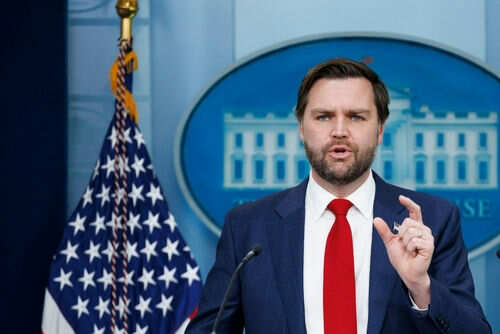
The Trump White House is trying to project strength in high-stakes Iran diplomacy—but mixed messages about whether Vice President JD Vance is “too risky” to send are fueling fresh doubts about who is steering the ship.
Quick Take
- The White House confirmed JD Vance will lead a second round of U.S.-Iran talks in Islamabad after President Trump publicly cited security concerns as a reason Vance would not attend.
- The talks come amid an Israel-Iran war and a fragile ceasefire, with no reported breakthrough from the first round on nuclear issues, sanctions, or the Strait of Hormuz.
- Iran is pressing for changes tied to the Hormuz situation before moving forward, raising the stakes for global energy markets and U.S. leverage.
- The episode highlights a familiar Washington problem: unclear public messaging during a crisis can weaken deterrence and invite political attacks at home.
Conflicting Signals on Vance’s Role Raise Questions
President Trump told ABC News on April 19 that Vice President JD Vance would not attend the second round of Iran talks in Pakistan, saying it was “only because of security” and adding, “JD’s great.” Within roughly a day, a White House official confirmed Vance would, in fact, lead the U.S. delegation in Islamabad alongside Jared Kushner and Middle East envoy Steve Witkoff. That contradiction quickly became the story itself.
The most important detail is what did not change: the location. These are not talks “in Iran,” but negotiations hosted by Pakistan in Islamabad, a neutral venue intended to reduce risk and keep lines open while tensions remain high. Still, when the commander in chief and the White House staff land on opposite public talking points, allies and adversaries both take notes—especially during an active regional war.
What Happened in the First Islamabad Talks
Reports on the April 11–12 meeting indicate the first round failed to produce a breakthrough on Iran’s nuclear program, U.S. sanctions, or the Strait of Hormuz. The same core U.S. lineup—Vance, Kushner, and Witkoff—was tied to that earlier effort, which helps explain why Washington is keeping continuity for round two. Continuity can signal seriousness, but it also means the administration now owns the results more directly.
Iran’s side for the second round is reportedly led by Mohammad Bagher Ghalibaf, the parliamentary speaker, underscoring that Tehran is elevating the political weight of the discussions. Even with senior names involved, the available reporting does not describe concrete agreements from round one, and it remains unclear what, if anything, Iran is prepared to concede. Limited public detail is normal for sensitive diplomacy, but it also leaves Americans guessing.
The Strait of Hormuz and the Energy Pressure Point
The Strait of Hormuz remains the pressure point hovering over every sentence in these negotiations. Reporting indicates Iran has demanded an end to the Hormuz blockade before proceeding, tying diplomatic progress to control of a critical maritime corridor. Any extended disruption in Hormuz can threaten global oil flows, which quickly translates into higher costs for consumers and businesses. In a post-inflation era, that vulnerability is not theoretical for U.S. households.
For conservatives who prioritize energy affordability and national strength, the administration’s challenge is to de-escalate without rewarding coercive tactics that endanger global commerce. The research provided does not establish the exact terms being proposed or which parties would change their posture in Hormuz. Without those specifics, the key takeaway is strategic: Tehran appears to be linking diplomacy to leverage over a chokepoint that hits wallets worldwide.
Why the Messaging Matters at Home and Abroad
Mixed messaging—first excluding Vance for “security,” then confirming he leads—creates an opening for critics to claim confusion inside the federal government. Democrats can frame it as disorganization; Republicans can argue it reflects the realities of threat assessments changing hour to hour in a dangerous environment. The sourced reporting supports only one firm conclusion: the public narrative shifted fast, and the White House had to clarify the president’s comments.
That kind of turbulence also feeds broader public cynicism about Washington competence. Many voters across the spectrum already believe insiders care more about optics than outcomes, and foreign-policy whiplash reinforces that suspicion. The available sources do not prove any internal power struggle, but they do show how a single off-message interview can become a self-inflicted distraction while negotiators are trying to prevent a wider war.
What to Watch as Round Two Approaches
The immediate question is whether the second Islamabad round can stabilize the ceasefire and reduce the risk of escalation between Israel and Iran. The longer-term question is whether the talks shift U.S.-Iran relations on sanctions and nuclear constraints, or simply buy time while tensions persist. No source in the provided research offers a clear timeline for the next session or a definitive Iranian response to the Hormuz-related demand.
VP JD Vance to Lead U.S. Delegation to Iran Despite Security Concerns
— GuitarGuy (@JohnPalumb66174) April 19, 2026
For now, the best-read signal is personnel: Washington is sending a senior team, and the White House says Vance leads it. If progress is announced, expect the administration to highlight deterrence and deal-making; if talks stall, expect both parties to weaponize the confusion over who said what and when. Either way, the cost of unclear federal communication is real—because adversaries calibrate their next move off America’s public posture.
Sources:
Vance to Lead U.S. Delegation for Iran Talks in Pakistan Amid Ceasefire Tensions
Vice President JD Vance to Lead U.S. Delegation as Iran Remains…