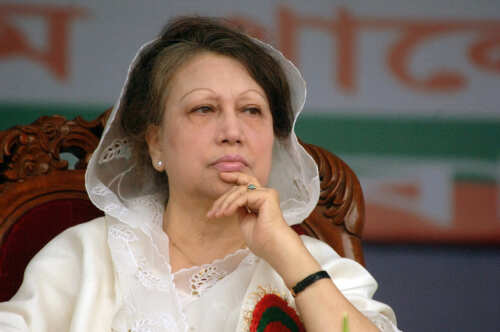
Bangladesh’s first female prime minister Khaleda Zia has died at age 80, ending a pioneering political career that shaped the nation’s democratic transition while leaving behind a complex legacy of both groundbreaking leadership and governance challenges.
Story Highlights
- Khaleda Zia died December 30, 2025, at Evercare Hospital Dhaka after 36 days of hospitalization
- Bangladesh’s first female PM served two terms (1991-1996, 2001-2006) and was second female PM in the Muslim world
- Her death comes just before crucial February 2026 elections, creating political uncertainty for the Bangladesh Nationalist Party
- Son Tarique Rahman returned from 17-year exile just days before her death, raising succession questions
End of a Political Era
Khaleda Zia passed away at 6:00 a.m. local time on December 30, 2025, following prolonged illness including advanced cirrhosis, arthritis, diabetes, and heart complications. The 80-year-old Bangladesh Nationalist Party leader had been hospitalized since November 23, marking the conclusion of a remarkable political journey that began during Bangladesh’s transition from military rule. Her death removes a towering figure from the nation’s political landscape at a critical moment before February 2026 elections.
#WATCH | Dhaka, Bangladesh | Elite Force RAB (Rapid Action Battalion) deployed outside Evercare Hospital, Dhaka, where Bangladesh's first woman Prime Minister, Khaleda Zia, passed away earlier today, at the age of 80. pic.twitter.com/8x7vGQkRZE
— ANI (@ANI) December 30, 2025
Pioneering Female Leadership in the Muslim World
Zia first became prime minister in 1991 following the BNP’s electoral victory, establishing herself as Bangladesh’s first female leader and only the second female prime minister in the Muslim world after Pakistan’s Benazir Bhutto. Her groundbreaking role challenged traditional gender barriers in South Asian politics, paving the way for women’s political participation in the region. She served two terms, including a full tenure from 2001-2006, during which she navigated complex domestic and international challenges while maintaining her position as a dominant political force.
Governance Challenges and Controversies
Zia’s political legacy includes significant controversies, particularly during her 2001-2005 tenure when Bangladesh ranked as the world’s most corrupt country according to the Corruption Perceptions Index. Her administration faced criticism for governance failures and corruption allegations that later resulted in legal proceedings against her. Following her term’s end in 2006, she endured detention, house arrest, and prolonged legal battles until her acquittal on graft charges in November 2024, just months before her death.
Political Succession and Party Future
The timing of Zia’s death creates immediate challenges for the BNP as it approaches crucial elections scheduled for February 12, 2026. Her son Tarique Rahman’s return from 17 years of London exile just days before her passing raises questions about party leadership succession and electoral strategy. The BNP must now navigate leadership transition while maintaining organizational coherence during Bangladesh’s ongoing political restructuring following Sheikh Hasina’s 2024 ouster. This leadership vacuum threatens to disrupt the bipolar political structure that has defined Bangladeshi politics for decades.
International leaders including Indian Prime Minister Narendra Modi and Pakistani Prime Minister Shehbaz Sharif expressed condolences, while interim leader Muhammad Yunus declared three days of state mourning. Zia’s death marks the end of an era characterized by strong female political leadership in Bangladesh, with significant implications for women’s representation in future governance and the nation’s democratic development.
Sources:
Bangladesh declares 3-day mourning for former PM Khaleda Zia – Arab News