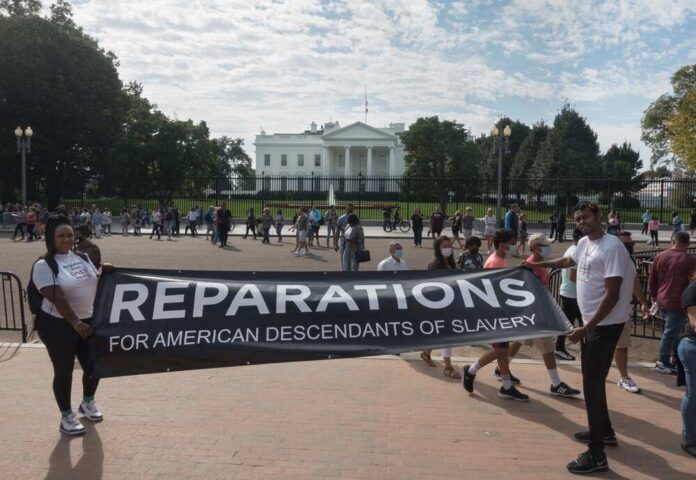
The loudest voice demanding reparations right now may also be writing Republicans’ favorite midterm ad.
Story Snapshot
- Ayanna Pressley is now the House point person on H.R. 40, the federal reparations commission bill.[2][4][7]
- Her public message goes far beyond a “study” and leans hard into language about debt, redress, and compensation.[1][2][5]
- The actual bill stops at creating a commission, with no payout formula, budget, or checks in the mail.[2][4][7]
- Conservatives can oppose bad policy design while still taking the history seriously and forcing a real numbers-based debate.
How Pressley Turned A Study Bill Into A Moral Debt Campaign
Representative Ayanna Pressley did not step to the microphone to talk about a quiet commission and some future hearings. She told the country, “This is not a movement or an appeal for benevolence or charity. This is a movement to demand redress, to write wrongs, to compensate, to compensate for the harm and loss that we have experienced.”[1][2] That language is not about drafting historians. It is about a moral debt she claims the federal government still owes.
On paper, though, her main vehicle is H.R. 40, the Commission to Study and Develop Reparation Proposals for African Americans Act.[2][4][7] The bill would set up a fifteen-member federal panel to examine the legacy of slavery, systemic racism, and economic discrimination, then recommend “reparative measures” to Congress.[2][4] The commission would hold hearings, gather stories, and produce a report. No formulas. No specific dollar amounts. No automatic programs. Just recommendations lawmakers could accept, shrink, or ignore.
What Her Reparations Agenda Really Does And Does Not Do
Pressley and her allies frame this as “a racial justice, economic justice, and moral imperative bill” that must be passed before America’s 250th birthday.[2][4][8] She links slavery to redlining, biased home appraisals, blocked access to G.I. Bill benefits, and other government failures over generations.[1][2][5] She also leans on the fact that the federal government has done targeted redress before, like for Japanese Americans interned during World War II. Her argument is clear: we have paid others; Black Americans were left out.[1][2]
The problem for her side is not passion. It is detail. None of the materials tied to this June 2026 reparative justice push show a concrete payout plan. There is no liability model, no eligibility test, no per-person estimate, and no total budget.[1][2][4][7] Even the broader network she works with, including the Civil Rights and Restorative Justice Project, is still cataloging cases and building a documentary record of specific killings and non-prosecutions.[7] That work may be serious, but it is still one or two bridges away from an actual check written by the Treasury.
Why Republicans Secretly Love This Fight In An Election Year
Democrats have a long habit of turning complex cultural issues into simple bumper stickers. Pressley is doing that for reparations. She says, “The United States government owes us a debt and we need reparations now.”[3][5] Yet the bill she leads is a study commission that promises years of hearings and reports. That gap makes easy work for conservative campaigns who want to ask swing voters one blunt question: “Do you want your tax dollars going to race-based payouts?”
Opponents do not even have to exaggerate much. The media has already cast her speeches as “fiery” demands that “reparations are long overdue.”[5] Her own office calls H.R. 40 a “historic reparations bill,” even as the fine print confirms it only “creates a federal commission to examine the lasting impact of slavery and explore reparative measures.”[4] Common-sense voters pick up that mismatch quickly. When the sales pitch is “we are owed,” and the product is “we will form a committee,” trust drops and skepticism rises.
How Conservatives Can Hit The Weak Spots Without Denying History
Smart conservatives do not need to pretend slavery and Jim Crow were anything but evil. The better move is to ask what, exactly, the federal government is being asked to do today, for whom, and at what cost. Pressley’s side has not done the hard math. There is no public damages model, no list of which agencies or time periods are on the hook, and no breakdown of how to distinguish eligible descendants from others.[1][2][4][7] For a policy this sweeping, that is a glaring hole.
That opens the door to a line of argument rooted in classic conservative values. Lawmakers can demand a full audit of past federal programs, a legal opinion on race-based compensation, and transparent economic modeling before any reparations scheme is even debated. They can remind voters that emotional language and moral guilt are not substitutes for clear law and sound budgeting. If Democrats choose to run on “reparations now” with only a study commission in hand, they are the ones taking the debt wish into November.
Sources:
[1] Web – Debt Wish: Dem Ayanna Pressley Wants Reparations and MAGA Is Begging …
[2] YouTube – Pressley, Advocates Call Congress to Advance Transformative …
[3] Web – VIDEO: Ahead of America’s 250th, Pressley, Advocates Call On …
[4] Web – Sen. Cory Booker, Rep. Ayanna Pressley, Rep. Summer Lee, Rep …
[5] Web – Press Release: Pressley and Advocates Urge Congress to Support …
[7] YouTube – Pressley, Advocates to Host Equity Week Press Conference on …
[8] Web – Congresswoman Ayanna Pressley Visits CRRJ, Kickstarts H.R. 40 …