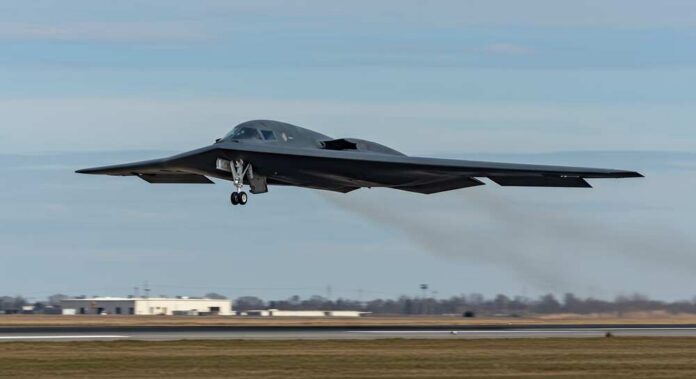
Air Force BOMBSHELL: The Jet That Never FlewAmerica’s airpower gap got a lot bigger when Washington let a fast, stealthy “interim bomber” built from the F-22 die quietly in the mid-2000s.
Story Snapshot
- Lockheed Martin studied turning the F-22 Raptor into the FB-22, a strike-focused, supersonic stealth bomber concept meant to modernize an aging bomber fleet.
- The plan emphasized reusing a large share of existing F-22 components while adding bigger wings, more range, and more internal strike capacity for contested airspace.
- Air Force leaders publicly discussed buying around 150 aircraft, but the concept faded by 2006 as costs, complexity, and shifting priorities took over.
- Analysts cite the same recurring tradeoff: quicker “good enough” capability now versus a clean-sheet long-range bomber later.
The FB-22 concept: a “regional bomber” built from the Raptor
Lockheed Martin’s FB-22 proposal grew out of early-2000s concerns that the Air Force’s bomber force was aging while air defenses were getting smarter and deadlier. The concept adapted the F-22’s stealth and speed into a strike-optimized aircraft, with design changes aimed at carrying more air-to-ground weapons, flying farther, and penetrating contested airspace. Supporters described it as an interim “regional bomber” that could arrive sooner than an all-new platform.
Technically, the idea was not a simple “bolt-on” upgrade. Reporting and historical summaries describe a widened or reshaped airframe, significantly larger wings for additional lift and fuel, and refinements intended to improve survivability on deep strike missions. Advocates argued that leveraging existing F-22 technology and production knowledge could control risk and shorten timelines, while still delivering a high-end aircraft able to strike inside heavily defended areas without relying on permissive skies.
The United States 🇺🇸 exports a wide range of advanced weapons, yet one system remains strictly off-limits: the F‑22 Raptor. As the world’s first fifth-generation fighter, the F‑22 can achieve supersonic flight without afterburners and incorporates technology so sensitive that… pic.twitter.com/I2VqBInXwP
— WAR (@warsurv) February 3, 2026
Why it appealed after 9/11-era reviews of bomber shortfalls
Post-Cold War force planning left the Air Force with bombers that were effective but increasingly stretched by time, maintenance burdens, and evolving threats. The 2001 Quadrennial Defense Review elevated concerns about penetrating advanced anti-access/area-denial environments, where non-stealth aircraft and vulnerable tanker support can become limiting factors. Within that context, an FB-22-style approach offered a politically attractive pitch: field credible stealth strike power faster, and at a fraction of the cost of developing a brand-new bomber from scratch.
That appeal fit a wider history of lawmakers and Pentagon leaders exploring F-22 “family” variants. Earlier concepts, including navalized or carrier-oriented ideas, collided with the hard realities of range requirements and cost. The FB-22 tried to solve the range and payload problem by changing the wing and internal volume while keeping core Raptor DNA. Even so, the same old procurement friction remained: modifications can look cheaper on paper, but they can become expensive once engineering, testing, and mission integration pile up.
What the aircraft was supposed to do—and what it still couldn’t fix
Accounts of the FB-22’s intended performance emphasize speed, stealth, and a larger strike load than the baseline F-22’s limited air-to-ground configuration. The F-22 can carry small precision weapons internally, but it was built first for air dominance. The FB-22, by contrast, was framed as a penetrator designed to hit time-sensitive targets in dangerous airspace. Lockheed representatives even argued the evolved design could be exceptionally survivable, aligning with the Air Force’s interest in “rapid long-range strike” options.
Critics and analysts, however, pointed back to physics and operational math. A fighter-derived platform can struggle to match true bomber persistence and unrefueled reach, especially when planners want deep strikes without leaning heavily on tanker aircraft. Other assessments note that making major changes—like new wing designs or structural revisions—can erase some of the “cheap and quick” advantages. These critiques don’t disprove the concept; they clarify the risk: an interim solution can become neither truly inexpensive nor truly long-legged.
Why it was shelved—and what that says about procurement priorities
By 2006, the FB-22 faded from serious discussion, and later years brought no active revival. The research record points to shifting priorities rather than a single dramatic cancellation moment: the Air Force and Pentagon focus moved toward longer-range bomber solutions, while broader tactical aviation investments centered on the F-35’s multirole promise. The result was a familiar Washington pattern—prioritizing an all-in “next big thing” while living with capability gaps in the meantime.
For Americans who prefer limited government and competent stewardship of taxpayer dollars, the key takeaway is procedural rather than partisan: defense acquisition repeatedly struggles to balance speed, affordability, and mission needs. The FB-22 story shows how the system can discard a near-term option that might have reduced risk in contested regions, even as future programs stretch into the next decade. The sources available don’t provide a definitive single cause for the decision, only a consistent picture of complexity and changing strategic emphasis.
Sources:
F-22 Raptor Stealth Fighter Could Have Been ‘Shape-Shifted’ Into a Bomber