Inside-the-room disruptions at party conventions work because they convert abstract grievances into a visceral, broadcastable moment—and because the response from the stage often defines the meaning more than the banner in a protester’s hands.
The Short Version
- A single outburst inside a tightly scripted convention changes the story arc, shifting focus from policy lines to identity, allegiance, and order.
- Video and on-the-record reports show a protester waving and throwing a Mexican flag during Vice President JD Vance’s Dallas address before being escorted out; Vance seized the moment to frame it as a test of national loyalty.
- Such interruptions sit at the fault line between protected dissent and disruption—legible to courts and campus codes alike as the difference between protest and a “shout-down”.
- Convention-week strategy is asymmetric: activists seek images; organizers seek control. The clash is old, but modern media amplifies its stakes.
What actually happened in the arena
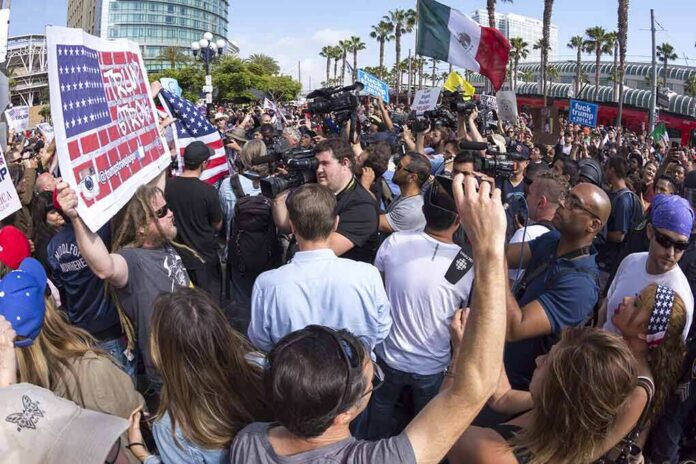
The core facts are straightforward and well documented. During Vice President JD Vance’s prime-time address at the Republican midterm convention in Dallas, a protester stood up inside the arena waving a Mexican flag and hurled it toward the stage area. Security removed the individual as Vance, pausing his prepared remarks, told him, “If you love Mexico so much, get your ass over there—I’ll buy you the plane ticket.” The exchange drew cheers and reset the room’s energy around a theme of national allegiance. Separate reporting noted confusion among some attendees about whether a second flag was Palestinian; the political valence, however, was set by Vance’s framing, not by the precise flag taxonomy.
Those are consequential details for two reasons. First, the act occurred inside the event, not outside in a designated protest area; in convention choreography, floor disruptions are qualitatively different from marches at the perimeter. Second, the thrown flag created a tidy visual for broadcast packages and social clips—an economy-of-image that favors organizers who can recast disorder as disrespect, and protesters who can puncture message discipline with a single, sticky symbol.
Why interruptions inside the room carry outsized leverage
Disruptive protest—what social movement scholars call “interruptive collective action”—works by suspending the expected flow of an event and forcing a reallocation of attention. The tactic compresses complicated grievances into a brief, affective shock that makes audiences feel a conflict before they parse it. That is not a bug; it is the mechanism. It converts the political economy of modern media—short clips, strong visuals, sharp contrasts—into leverage for those otherwise locked out of the microphone.
At party conventions specifically, the stagecraft is designed to eliminate surprises. That very predictability is why interruptions can dominate coverage. The historical record—from the 1960 pickets that remapped conventions as protest stages to the 1968 Chicago confrontations that turned streets into national spectacle—shows how a single breach in the script can overshadow days of messaging. In Dallas, the Mexican flag on the floor during a speech about national direction presented a near-perfect opportunity for the speaker to flip the script, and Vance did so with practiced clarity.
Free speech, disruption, and the line that matters
In First Amendment doctrine and campus speech norms alike, the crucial distinction is between expression and obstruction. The right to protest is robust; the right to shout down a speaker—what civil liberties advocates call “mob censorship” or the heckler’s veto—is not. The norm aims to protect both the dissenting speaker and the invited speaker from being silenced by the other’s volume or threat of disorder. That framework is why event organizers routinely designate protest zones and police routes: they create space for expressive activity without ceding control of the program. When a protest migrates inside the room and disrupts the proceeding, security removal is not a surprising outcome; it is the built-in remedy to preserve the event’s speech rights.
None of that answers whether the message—here, a critique tied to immigration and identity—holds merit. It explains why, as a matter of institutional design, interruption inside the venue triggers a different response than a march outside it. In Dallas, city and federal agencies publicly laid out perimeter controls, closures, and designated protest areas; activists organized counter-events and marches nearby. That architecture is how big-tent democratic politics balances robust protest with predictable proceedings.
Symbol, counter-symbol: how the meaning was set
Politics is saturated with symbols because they travel faster than paragraphs. A Mexican flag on the floor during a GOP vice president’s speech is a highly legible image; it invites viewers to read it as a challenge to the speaker’s immigration stance or as a repudiation of American primacy. Vance’s rejoinder—explicitly recasting the moment as a loyalty test and offering to “buy the plane ticket”—transmuted the symbol into a partisan proof-point about borders and belonging. The camera corroborates the moment; the language cements the frame.
This is the asymmetry at work. Protesters chase the image that punctures message discipline; speakers chase the counter-image that affirms theirs. In this case, the response prevailed in the room, as cheers on the video make plain. For audiences beyond the hall, the clip functions as a Rorschach: dissent made visible to sympathizers; disorder confirmed to opponents. Either way, the reaction—what the powerful said back—becomes the memory.
JD Vance Dallas Protest Disrupts GOP Convention Speech
Read more on…https://t.co/SDmSe4F41b#politicalprotest #vance2028 #republicans #NRIPage pic.twitter.com/xIe7NF22Cy
— NriPage (@NRIPage) September 11, 2026
The enduring pattern—and how to read the next one
Expect more of this, not less. National parties now stage mid-cycle conventions and marquee rallies that compress attention into tight windows; activists tune their tactics to land within those windows. Local governments and federal agencies will continue to build layered protest perimeters and security corridors around such events, precisely to keep interruption outside the room even as they acknowledge robust rights of expression nearby. Inside, organizers will rehearse the pivot—a one-liner that metabolizes disruption into advantage—because experience shows the counter-symbol often commands the clip.
For citizens trying to make sense of the next viral interruption, a simple diagnostic helps. First, separate the arena from the street; the same chant reads differently when it commandeers a podium. Second, look for verifiable anchors—video from inside, on-record quotes—to establish what occurred, then evaluate the framing that followed. Here, those anchors exist in abundance, and they converge on a clear sequence: a protester waved and threw a Mexican flag; security removed him; Vance used the moment to assert a nationalist frame, to strong applause. Disagreement about the politics is inevitable; disagreement about the facts is not.
Sources:
facebook.com, amgreatness.com, nypost.com, nytimes.com, thegatewaypundit.com, youtube.com, cbsnews.com, dallasnews.com