
Justice Sotomayor’s remarks on court reform stir debate over judicial independence.
Story Highlights
- Justice Sotomayor has voiced skepticism about the constitutionality of applying term limits to sitting justices.
- Her comments highlight internal diversity and institutional caution regarding court reform.
- The debate over court reform persists amid heightened political polarization and declining public trust in the Court.
- Her intervention emphasizes the importance of judicial independence over political pressure.
Justice Sotomayor’s Skepticism on Court Reform
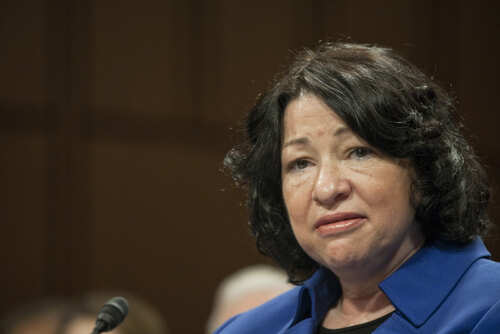
In a notable development, Justice Sonia Sotomayor, a key figure in the Supreme Court’s liberal wing, publicly expressed reservations about proposed court reforms, particularly the imposition of term limits on current justices. Her intervention challenges the assumption that all liberal justices uniformly support such reforms, highlighting internal diversity and institutional caution. This skepticism adds complexity to the ongoing debate over Supreme Court reform.
In a recently released audio recording of a July 2024 interview at the University of Zurich, Sotomayor stated, “The problem with a term limit is how will they institute it, because I am promised my job for life, and that can’t be taken away constitutionally — I don’t believe even with a constitutional amendment — because you cannot have a retroactive law changing something that you’ve earned.”
[Keith E. Whittington] Justice Sotomayor on Supreme Court Term Limits https://t.co/zMy2XzXuef
— Volokh Conspiracy (@VolokhC) August 9, 2025
The Historical Context of Court Reform
The push for Supreme Court reform has roots in the ideological shift that occurred when the Court moved to a 6-3 conservative majority following the appointments of Justices Gorsuch, Kavanaugh, and Barrett. This change sparked calls for reforms like court expansion and term limits, especially after contentious rulings on pivotal issues. These proposals, however, have yet to advance significantly in Congress, illustrating the ongoing tension between political advocacy and judicial independence.
Public trust in the Court has been declining, with both political parties accusing each other of undermining its legitimacy. This environment of heightened polarization makes the debate over reform even more contentious, as stakeholders grapple with the implications of potential changes to the Court’s structure and function.
Implications for the Reform Movement
Justice Sotomayor’s remarks have significant implications for the reform movement. In the short term, they may slow the momentum for change by underscoring the risks of politicizing the judiciary and dividing reform advocates. In the long term, her stance could set a precedent for judicial caution in public debates, influencing future reform efforts and shaping the Court’s relationship with Congress. For progressives, her intervention presents a new challenge in building consensus, while conservatives and institutionalists view it as a validation of their concerns about maintaining judicial independence.
The debate over Supreme Court reform remains a complex and contentious issue, with Justice Sotomayor’s intervention highlighting the nuanced perspectives within the Court. As the conversation continues, the importance of understanding the internal dynamics of the judiciary and the limits of external pressure becomes increasingly apparent.
Sources:
Empirical SCOTUS: The Real A.C.B.
SCOTUSblog: Supreme Court’s Most Conservative Justices Part Ways
SCOTUSblog: It is Not a 3-3-3 Supreme Court