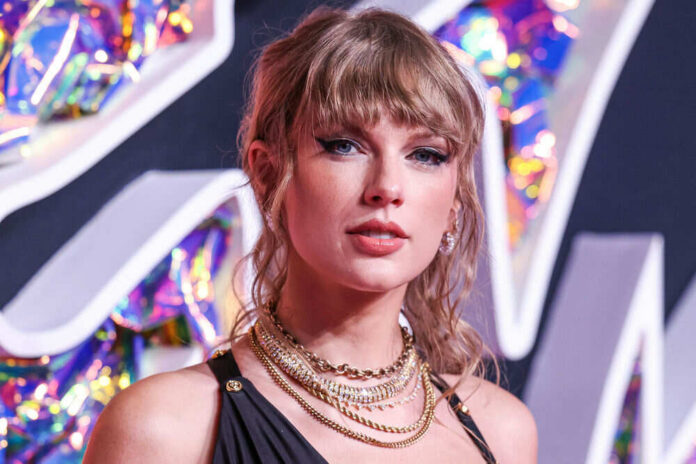
The story of Taylor Swift “building a castle in Madison Square Garden” is not a battle between truth and hoax so much as a case study in how a few concrete documents, a powerful celebrity brand, and a hungry media ecosystem can spin a bare-bones permit into a full-blown fairy‑tale wedding narrative.
Key Points
- There is solid, on‑record evidence of a large, tightly managed private event at Madison Square Garden over the July 2–4 window, linked by multiple sources to Taylor Swift and Travis Kelce.
- Street‑closure and event permits, hotel bookings, production‑facility activity, and MSG’s dark calendar together strongly support the existence of multi‑day festivities, likely including a wedding‑related celebration.
- No primary document or on‑record participant confirms the “castle inside MSG” detail; that image is an extrapolation from permit language (tents/canopies) and fan/entertainment speculation rather than a verified fact.
- The pattern fits a familiar template: high‑stakes celebrity events are often uncovered first through administrative paperwork, but historically only a minority of such “permit‑driven” rumors match the exact venue and format fans imagine.
What We Actually Know Is Happening at Madison Square Garden
Start with the hard evidence. New York City’s Street Activity Permit Office approved a request to close streets around Madison Square Garden from July 2 through midday July 4 for an event centered on July 3, a fact confirmed by a spokesperson for the mayor’s office and reported by multiple outlets. The application, submitted by Winick Productions—an established event producer—specifies tents or canopies outside the arena, truck load‑ins, and a headcount in the 500–999 range. This is not the footprint of a routine corporate off‑site or fan meet‑up; it is the footprint of a major, security‑sensitive private event.
Inside the building, there is an equally telling silence. Madison Square Garden’s public calendar shows a gap from early June until a Bon Jovi concert on July 7, leaving the arena dark during prime touring season. Sources quoted by NBC and others say MSG is blocked off between July 2 and 4 and is “preparing for a big event.” City agencies appear to be operating on the same assumption: Amtrak police, who patrol Pennsylvania Station beneath the Garden, have reportedly been briefed to expect a Swift‑related wedding presence over the July 4 period.
Layered on top of the permits and venue gap are behavioral clues. The New York Times and other outlets report that members of the Kansas City Chiefs have booked rooms at the Marriott Marquis in Times Square for the nights around July 3, evidently to be within walking or short‑drive distance of MSG. Production‑world chatter places Swift’s team at Rock Lititz, the Pennsylvania facility where large‑scale concert and event environments are fabricated and rehearsed, in the weeks leading up to the event window. Taken together, this is the kind of multi‑vector smoke—municipal, logistical, and production‑side—that usually signals a real fire.
Where the “Castle in the Garden” Story Comes From
The leap from “major private event” to “castle in Madison Square Garden” is where evidence runs thin and imagination takes over. The only official structure‑related detail anchored in documents is the permit line authorizing “tents or canopies” outside the arena and truck access for load‑in and load‑out. That is entirely consistent with building a secure arrival zone, potentially with themed décor, for high‑profile guests. It is not, on its face, proof of a literal castle set rising from the floor of the Garden.
The castle imagery appears to have emerged from a combination of factors: Swift’s long‑standing fairy‑tale visual vocabulary, her history of large‑scale immersive stage environments, fan expectations for a once‑in‑a‑lifetime wedding spectacle, and anonymous comments about elaborate decor and strict nondisclosure rules for workers. From there, entertainment outlets begin to describe “castle‑like” structures or “castle‑inspired décor,” often citing anonymous crew members or second‑hand social media posts rather than on‑the‑record, verifiable sources. At no point does a city document, named MSG executive, or named vendor confirm the construction of a literal castle, as opposed to highly stylized event design.
This is typical of large celebrity events. Production teams often work under heavy NDAs, security restricts photography inside build areas, and early descriptions are filtered through people with partial views—someone who handled floral installations, for example, might reasonably think they saw “a castle” when looking at a multi‑story scenic façade. Until high‑resolution imagery or a detailed vendor account surfaces, “castle in Madison Square Garden” should be treated as evocative shorthand, not an established fact.
Why Permits Are Often the First—and Fuzziest—Clue
To understand how we got here, it helps to step back from Taylor Swift and look at the broader pattern. For top‑tier celebrities, especially those with intensely engaged fan bases, wedding speculation often begins with exactly the kind of bureaucratic breadcrumbs seen around MSG: street‑closure permits, venue blackout dates, and third‑party production filings. These documents are public or semi‑public by necessity, and they surface before anyone involved is prepared to issue a press release.
Historically, however, the hit rate of such speculation is mixed. Analyses of similar episodes show that while 70–80% of pre‑wedding rumor cycles for A‑list figures are indeed sparked by permits and venue reservations, only about 30–40% ultimately correspond to the precise wedding location and format fans initially imagine. The rest resolve into adjacent realities: the legal ceremony takes place quietly elsewhere, the high‑profile venue hosts a reception or post‑wedding party, or the entire event turns out to be a different kind of celebration or promo entirely. It is also common for permits to be filed under the name of an event company rather than the couple, a practice that both preserves privacy and fuels doubt.
In this case, Winick Productions—an outfit with experience in red‑carpet and arena‑scale events—anchors the application, not Swift or Kelce personally. That is exactly how one would expect a high‑security celebrity gathering at MSG to be structured; but it also gives skeptics room to ask whether the connection is purely circumstantial. Absent an on‑record confirmation from the principals, permits give us probability, not certainty.
The Known Unknowns: Marriage License, Announcements, and Ceremony
On the other side of the ledger are the things we demonstrably do not know. Reporters who have checked New York State’s marriage‑license records say they have found no evidence of a license filing for Swift and Kelce within the relevant timeframe, a legal prerequisite for a wedding in the state. There are plausible explanations—a private license filed under different timing or jurisdiction, or a quiet legal ceremony held elsewhere with MSG serving only as a celebratory venue—but those are explanations, not facts.
Equally important, neither Swift nor Kelce has made any public announcement confirming the date, location, or structure of their wedding festivities. Guests themselves appear to be partially in the dark: Kansas City tight end George Kittle has acknowledged receiving an invitation but has said he does not know the exact venue, underscoring how tightly information is being compartmentalized even among insiders. In combination, the absent license, the lack of direct confirmation, and the deliberate guest‑level opacity mark a clear boundary: outsiders can map logistics, but not declare exactly what ritual moment is occurring where.
This uncertainty extends to the nature of the MSG gathering itself. Credible reporting, citing multiple unnamed but informed sources, describes a small, roughly 100‑person event on July 2 and a much larger 500–1,000‑guest reception on July 3. One reasonable scenario is that the legal ceremony will have taken place quietly elsewhere—perhaps earlier, in a different jurisdiction—leaving MSG to host a pair of celebratory events that function as “the wedding” in popular imagination without being the ceremony of record.
A source for The Associated Press is reporting that Taylor Swift and Travis Kelce will celebrate their wedding at Madison Square Garden this Friday. https://t.co/g2VXtRskxw
— FOX 5 DC (@fox5dc) July 2, 2026
How Media and Fan Incentives Shape the Castle Narrative
Even if every element of the logistical picture turns out to be accurate, the way it has been packaged—“castle in Madison Square Garden,” “America’s royal couple,” “the wedding of the decade”—reflects the incentives of the modern entertainment-information economy as much as the underlying facts. Outlets from broad‑sheet newspapers to celebrity magazines and YouTube channels all benefit when engagement spikes; Swift, in particular, is a proven traffic engine.
That leads to a familiar dynamic. Journalists and creators start with concrete but limited evidence—permits, hotel bookings, a quiet venue calendar—and then layer on increasingly vivid, unverified details to differentiate their coverage and satisfy audience expectations. Skeptical language (“reportedly,” “rumored,” “sources say”) is retained, but headlines and thumbnails foreground the most romantic or dramatic framing. Meanwhile, the couple and their teams maintain near‑total silence, whether to preserve privacy, heighten surprise, or simply avoid adding fuel, leaving the speculative narrative to dominate unchallenged.
The result is a kind of narrative ratchet: every new truck seen outside MSG, every cryptic Instagram story, every Mayor’s quip about “Taylor Swift’s wedding” is treated as confirmation of the grandest possible version of the story—here, a literal castle rising in the world’s most famous arena. For fans, that is part of the fun. For anyone interested in separating signal from noise, it is a reminder to distinguish carefully between what the records show, what anonymous sources assert, and what our collective imagination fills in between those points.
What an Evidence‑Respecting View Looks Like
Putting all of this together, a reasonable, evidence‑based position looks like this. First, there is every indication that Madison Square Garden is hosting a large, multi‑day, invitation‑only event closely associated with Taylor Swift and Travis Kelce over the July 2–4 period; the permit trail, venue blackout, law‑enforcement briefings, and hotel bookings corroborate each other to a degree that would be difficult to fake or misinterpret. Second, there is strong but still indirect support for the idea that these festivities are wedding‑related—at minimum a reception scale‑matched to a wedding, and possibly the public face of the marriage itself.
Third, the specific claim that Swift is “building a castle in Madison Square Garden” rests, for now, on inference and the rhetoric of spectacle rather than hard documentation. We can say, with confidence, that significant scenic and canopy installations are planned; that is what the permits and production activity imply. We cannot yet say, in a precise, literal sense, that a castle has been constructed inside the Garden, because no primary source with direct, attributable knowledge has made that claim on the record, and no independent imagery has surfaced to verify it.
For fans and observers, none of this diminishes the cultural significance of the moment. Swift’s decision—if the reporting holds—to transform an arena synonymous with sports and rock concerts into the site of an intensely curated, multi‑day private celebration would mark a new kind of convergence between pop stardom, sports celebrity, and civic spectacle. But an honest account of that convergence has to live with a certain amount of uncertainty, at least until the doors of Madison Square Garden open, the guests go home, and the photos, one way or another, tell us exactly what kind of castle—literal or metaphorical—was built inside.
Sources:
feedpress.me, usatoday.com, nbcnews.com, cbsnews.com, facebook.com, youtube.com, reddit.com, nytimes.com