

A jet-powered Russian drone drove straight through the roofline of a Tavria V supermarket in Mayaky, Odesa region, igniting a sweeping fire and injuring shoppers and staff—the kind of daylight strike on a plainly civilian site that has become a grim, recurrent feature of this war.
At a Glance
- A Russian jet-powered drone struck the Tavria V supermarket in Mayaky, Odesa region, causing a large fire and injuries.
- Regional authorities reported four people injured as emergency crews fought the blaze under repeated air-raid alerts.
- CCTV-style footage and regional emergency-service updates show a direct hit and extensive structural damage.
- The strike tracks with a broader pattern of drone attacks against civilian objects documented by human rights and UN reporting.
What happened in Mayaky: the confirmed core
Regional authorities and Ukrainian outlets converged quickly on the same core account: a Russian jet-powered drone slammed into the Tavria V supermarket in the village of Mayaky, Odesa region, sparking a major fire and injuring civilians. Odesa Regional Governor Oleh Kiper reported four people were wounded in the strike, an update that followed earlier three-injury tallies as responders moved through the site and hospitals received patients. A named spokesperson for the Odesa Regional Prosecutor’s Office, Inna Verba, separately described the casualties in early reports, citing a 34-year-old man hospitalized with a blast injury along with two women, aged 40 and 57.
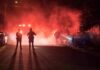
The physical scene—direct impact, structural destruction, and fire—is well-documented across local reporting and emergency-service communications. Regional emergency services posted material from inside the gutted store: scorched aisles, collapsed fixtures, and responders working through the smoke. The operation was not straightforward; firefighters were forced to pause repeatedly because air-raid alerts indicated renewed threat vectors overhead. Several outlets published or referenced security-camera video showing the moment of impact, which aligns with subsequent imagery from inside the building and street-level views of the façade and damaged vehicles.
Casualties, numbers, and why they move
Readers often seize on early casualty figures as definitive; veterans of conflict reporting know better. The Mayaky sequence—initially three injured, then four as Kiper’s update came through—fits the standard trajectory of an active incident: people self-evacuate, bystanders ferry the wounded to different facilities, triage priorities shift, and emergency crews, sometimes under renewed threat, must balance suppression, rescue, and documentation. Empirically, casualty counts in war tend to wobble in early hours across sources with different vantage points and incentives. A statistical study of conflict-loss reporting that integrated 4,609 multi-source claims from the Russia–Ukraine war underscores exactly this dynamic and the need to account for source biases rather than assume them away.
None of this negates the anchor facts in Mayaky. The site is identified, the strike mechanism is reported consistently, the injuries were real, and the building burned. The evolution from three to four wounded simply reflects the tempo of emergency medicine and the fog of an ongoing air campaign, not a contradiction in the underlying event description.
How “jet-powered drone” fits the battlefield pattern
Ukraine’s air-defense picture features a spectrum of Russian one-way attack drones, cruise missiles, and ballistic systems, with so-called “jet-powered” Shahed variants drawing attention for higher approach speeds and a distinct acoustic profile. Civilian-site impacts have been a documented pattern since the early phases of Russia’s full-scale invasion, with repeated legal and fact-finding bodies examining intent and effects. The UN Human Rights Council’s Independent International Commission of Inquiry on Ukraine has found that Russian forces committed crimes against humanity, including murder, and war crimes such as attacks on civilians, citing months-long drone barrages against civilian areas on the right bank of the Dnipro in Kherson. Human Rights Watch has separately detailed cases in which Russian drones targeted individual civilians and civilian property in Kherson, an approach squarely at odds with international humanitarian law’s principles of distinction and proportionality.
Those legal baselines matter here. Under the laws of war, civilians and civilian objects—including supermarkets—are protected; striking them deliberately, or striking in a way that is indiscriminate or expected to cause excessive civilian harm relative to any concrete and direct military advantage, violates international humanitarian law. UN officials have repeatedly stressed that attacks on civilian infrastructure, whether bridges, schools, hospitals, or shops, breach these rules and must stop. Even in contested spaces, the burden is on the attacker to distinguish and to minimize civilian harm in practice, not in post hoc narrative.
Emergency response under fire
Major urban fires triggered by explosive impact are complex to suppress even in peacetime; add recurring air-raid alerts and the operational calculus changes. The Odesa regional emergency service fielded more than 30 firefighters, according to local reporting, and had to pull teams back multiple times as sirens sounded—standard safety protocol when follow-on waves are plausible. Periodic withdrawals lengthen burn time, expand smoke damage, and complicate interior searches. They also slow the careful accounting of victims and responders that produces the definitive casualty and damage assessments that arrive days later rather than hours.
This is why daytime strikes on clearly civilian venues reverberate beyond the immediate blast radius. The damage propagates through delay: delayed rescues, delayed medical transfers, delayed documentation that courts will need. Civilian confidence in routine spaces—groceries, pharmacies, schools—erodes under that uncertainty. The enemy understands this; fear is an effect as real as shrapnel.
Why this incident will still matter months from now
Some events become legal test cases; others, emblematic episodes that illustrate a pattern. Mayaky risks being both. First, the fact pattern is clean: a direct hit on a named civilian supermarket, recorded on video, corroborated by multiple local outlets, with a public emergency response and identifiable victims. Second, it lands inside a larger evidentiary arc assembled by UN investigators and human rights researchers, who have documented systematic drone use against civilians and civilian objects in Ukraine’s south and east. Incidents like this are the atoms of future accountability: individually small, collectively dispositive.
There is also a hard-nosed military implication. Jet-powered one-way attack drones compress defenders’ reaction times, stress radar and optical cueing, and challenge point-defense systems around distributed civilian infrastructure. A supermarket seems tactically trivial; in practice, it is a soft node in the social fabric—one among thousands—that air defenders cannot ring-fence continuously without exorbitant cost. That asymmetry is precisely why international law restrains attackers rather than asking every civilian venue to harden.
A Russian jet-powered drone directly struck a Tavria V supermarket in Mayaky, in Ukraine’s Odesa region, on Thursday (October 15), sparking a major fire and causing extensive damage to the building.
Ukrainian authorities said at least four people were injured in the strike. pic.twitter.com/PItqkCTU4F
— Newswire Plus (@newswireplus) October 16, 2026
The line between tragedy and precedent
The strike on the Tavria V in Mayaky is not an anomaly so much as another data point in a documented pattern of drone attacks harming civilians in Ukraine. It injured four people, set a large commercial building ablaze, and forced firefighters to work under the threat of renewed strikes. The facts are straightforward and, for many Ukrainians, achingly familiar. As investigators, prosecutors, and international monitors continue to compile records, episodes like Mayaky will help determine not just the historical account of this war but the strength of the legal constraints meant to keep grocery shopping from requiring combat discipline.
Sources:
facebook.com, intent.press, unian.ua, bessarabiainform.com, unian.net