
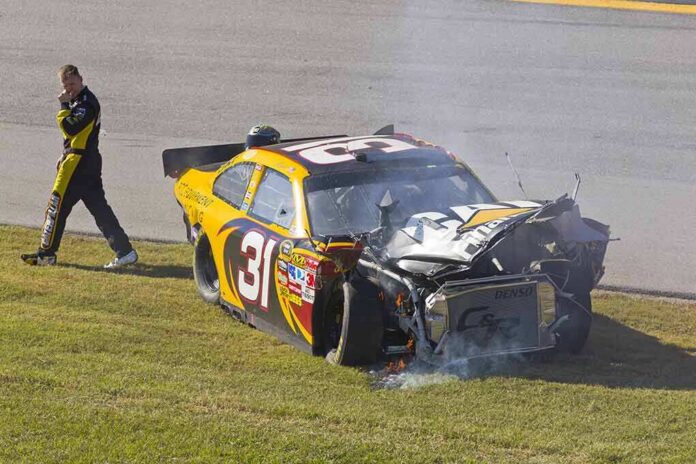
At Talladega, one driver’s small loss of control can ripple through a 190-mph pack and collect innocent bystanders; Tony Stewart’s early exit from the Truck Series race was a textbook case of that superspeedway logic, not a failure of his racecraft.
The Short Version
- The Lap 17 wreck began ahead of Stewart when Stewart Friesen’s truck wiggled in Turns 1–2, made contact, and veered into traffic, triggering a chain-reaction crash.
- Stewart was caught mid-pack with nowhere to escape; his No. 25 hit the outside wall, and he was evaluated and released.
- NASCAR’s official race reporting describes an eight-truck melee; other accounts varied on total truck count but agree on the upstream trigger.
- This was classic Talladega pack racing: compressed fields, tiny margins, and incident propagation that makes “fault” and “avoidability” separate questions.
What actually happened in the Lap 17 melee
The decisive facts are not ambiguous. Midway through Stage 1, the crash sequence started in front of Tony Stewart. NASCAR’s contemporaneous report places the initiating moment with Stewart Friesen’s truck: a wiggle in Turns 1 and 2, contact from behind by Andrés Pérez, and a leftward move into Kris Wright that set off a chain reaction across the lane structure. Stewart, running in the dense mid-pack where Talladega drafts compress gaps to feet rather than car-lengths, was in the middle and had no clean escape corridor as trucks slid and rebounded off the banking. The official account describes eight trucks involved and characterizes the wreck as a chain-reaction event beginning up the road from Stewart’s position.
Stewart’s own description conforms to that sequence. “Everyone started wrecking and they came across the track and got me,” he said post-incident, framing his retirement as the downstream cost of someone else’s instability rather than a self-induced error. On the radio he added a driver’s telltale post-impact assessment — “Knocked the wind out of me. I’m good.” — the sort of remark you hear when a hit is heavy enough to stun but not injure. Medical staff later evaluated and released him at the infield care center, and the focus turned quickly back to the race restart, as it always does in a Talladega afternoon balanced on the edge of physics and probability.
Why Talladega turns small mistakes into big wrecks
Talladega’s modern racing dynamic is engineered to be close. Decades ago, when speeds crept toward and beyond 200 mph, NASCAR imposed intake restrictions to cap horsepower and keep cars from threatening the catch fencing at terminal velocity. Over time the series moved from traditional restrictor plates to tapered spacers and a broader superspeedway package, but the net effect remained: the field compresses into large drafting packs, aerodynamic wakes matter more than raw engine, and closing rates between lines can surge and vanish in half a second. The benefit is riveting side-by-side competition; the cost is that a wiggle, a tire going soft, or a misjudged push doesn’t just rotate a single truck — it echoes through three lanes of traffic at once. NASCAR has iterated the package repeatedly in response to crash dynamics and safety learnings, including engine power reductions intended to temper run-ups and multi-truck impacts, but the pack-racing premise is intact by design.
In that context, “fault” is not a particularly useful everyday category. At Talladega, incident genesis and downstream involvement are distinct. A driver can do everything right in mirror management, line commitment, and throttle modulation and still be in a bad spot the instant a truck two rows up slides half a lane. That’s what the Lap 17 incident illustrated: the spark was ahead, the kinetic chain swung outward, and Stewart’s truck was simply in the geometry of consequence.
Reconciling the counts and the mechanics
Some outlets labeled the wreck as a nine-truck crash while NASCAR’s report lists eight trucks involved. Differences like this are common at superspeedways because “involved” can be counted several ways: direct contact, spin without wall impact, debris damage, or pit retirement during the caution. What matters materially is the sequence, and on that there is alignment: instability at Friesen’s truck, a veer into adjacent traffic, and a lateral chain reaction that caught Stewart’s entry and snapped it to the outside wall. The Associated Press rendering, which noted Friesen “lost control” and shot up the banking into Stewart, matches the race-control description in broad structure even as it compresses the details for a wire piece.
The initiating mechanical cause — wiggle from aero disturbance, push energy, or a cut tire — is not decisively resolved in public reporting, which is typical in the absence of a formal technical bulletin. That uncertainty, however, does not change the causal ladder. Whether the first input was rubber, aero, or contact, the chain reaction began upstream of Stewart and evolved too quickly for a mid-lane, mid-pack truck to invent an escape route that wasn’t there. Talladega’s SAFER barriers, modern seats, belts, and HANS devices did their job; Stewart walked away, winded but fine.
Stewart’s return, without the romance or the blame
Because Tony Stewart is a three-time Cup champion and a fixture in the sport’s imagination, any Talladega retirement triggers narrative reflex — the comeback that fizzled, the legend who can’t buy a clean race, the echo of prior superspeedway drama. Strip away the mythology and you’re left with a straightforward racing fact pattern: a veteran placed mid-pack in a superspeedway draft, tagged by a wreck that started ahead. That is not a referendum on his form; it is the tax Talladega levies randomly across a field, sometimes repeatedly. Indeed, NASCAR’s own report described a multi-truck melee and Stewart as a collected party, not a catalyst, and his comments mirrored that language precisely.
Fans craving causality often overfit lessons to singular results. Superspeedway proficiency does exist — the best pack racers manage energy, sight lines, and alliances with uncommon acuity — but even the masters carry Talladega scars. That dual truth is what makes judgment at these tracks so tricky: skill reduces exposure; it does not eliminate it. If Stewart’s next outing features the same speed and positioning but a different chain reaction, he could just as easily be the one threading through as the outside line clatters into the fence.
A part-timer just stole Talladega 🏁😱
Driving Spire Motorsports' No. 7 Chevy in a part-time return to the Truck Series, Sammy Smith used a run on the outside off the final turn to win today's Love's RV Stop 225 by 0.091 seconds over Tyler Ankrum. Austin Green, Ty Majeski and…
— mundanewizzard (@megasigler) October 23, 2026
What to watch going forward at superspeedways
Three things shape outcomes where the air matters as much as the asphalt. First, upstream stability: how pushers manage bumper alignment in the tri-oval and entry to Turn 1, where the surface transitions as the pack compresses. Second, tire integrity under sustained side-loads during multi-lap green runs — a single slow leak destabilizes an entire lane. Third, escape geography: drivers who leave micro-margins to the wall or the apron can sometimes step into a pocket when the accordion snaps, though those margins come at the cost of track position until the moment they are needed. For spectators, it looks like luck; for practitioners, it is probabilistic risk management at 190 mph.
Sources:
foxnews.com, nascar.com, sports.yahoo.com, racingnews.co, newsobserver.com