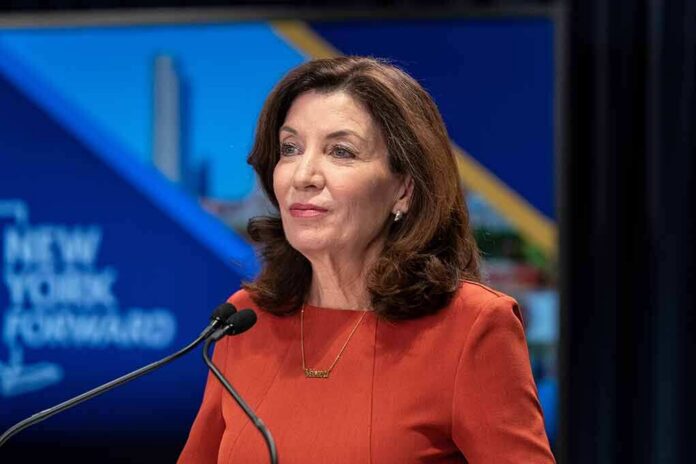
A sitting governor sharing a bar booth with the two most polarizing figures in her own party, two days before an election she was favored to win, is not an accident of scheduling — it is a calculated bet that the modern Democratic coalition is wide enough to hold a centrist executive and a democratic socialist mayor in the same frame without the picture backfiring.
Key Points
- Gov. Kathy Hochul watched the Buffalo Bills’ 36-10 win over the Baltimore Ravens alongside Mayor Zohran Mamdani and Rep. Alexandria Ocasio-Cortez at Murphy’s Sports Bar in Astoria, Queens, on November 1, 2026, two days before the gubernatorial election.
- Hochul framed the appearance as deliberate coalition-building, telling reporters the two progressive figures “want to be with me,” and arguing their support would not cost her moderate votes.
- The event doubled as a show of Democratic unity against President Trump, coming the same day Ocasio-Cortez and Mamdani publicly rebuked a fellow Democrat for endorsing a Republican in Michigan.
- Academic research on endorsements suggests such appearances rarely move large numbers of votes directly; their real function is signaling ideological alignment and consolidating a coalition’s base.
- The staging followed weeks of substantive policy collaboration between Hochul and Mamdani — on child care funding and data-center regulation — that gave the photo-op a governing record to point to, not just a gesture.
What Happened at Murphy’s Sports Bar
The gathering was unambiguous in its facts. Contemporaneous pool photography and wire reporting place Hochul, Mamdani, and Ocasio-Cortez together at Murphy’s Sports Bar in Astoria on Sunday, November 1, 2026, watching the Bills defeat the Ravens 36-10. The timing was not incidental: it fell on the final weekend before Tuesday’s gubernatorial election, and Hochul treated it as a campaign stop rather than a social outing, telling reporters on-site that the two progressive figures “want to be with me” and insisting their support wouldn’t alienate moderate voters she needed to win. The New York Times reported the three ate wings together and cast the moment explicitly as a display of unity against politicians aligned with President Trump.
That framing mattered because the same day, Ocasio-Cortez and Mamdani were publicly rebuking Michigan Rep. Haley Stevens for endorsing a Republican, with Senate Minority Leader Chuck Schumer calling her move a “despicable betrayal”. The Queens watch party and the Michigan rebuke were two expressions of the same message: Democratic officials who break ranks will be called out, and those who hold the line — including a governor willing to be seen with the party’s left flank — will be publicly embraced.
Why a Governor Courts the Left She Once Kept at Arm’s Length
Hochul entered the race with institutional advantages — a late-October poll showed her holding a 14-point lead over Republican challenger Bruce Blakeman — which made the choice to campaign visibly with Mamdani and Ocasio-Cortez a matter of strategy rather than desperation. A comfortable frontrunner does not need to manufacture enthusiasm; she needs turnout. New York City’s Democratic base, energized by Mamdani’s mayoralty and Ocasio-Cortez’s national profile, represents the single largest bloc of votes in any statewide race, and a governor who appears estranged from that base risks depressed turnout even while winning comfortably on paper.
The relationship was not purely transactional theater. In the preceding weeks, Mamdani had credited Hochul’s state-level support for expanding free child care access in New York City and for help closing a budget shortfall, while contrasting her record with Blakeman’s stated opposition to expanded Medicaid and his cooperative stance toward ICE. Ocasio-Cortez separately praised Hochul’s handling of a data-center moratorium. That groundwork gave the Bills-watching photo-op a policy spine: it wasn’t simply three Democrats posing together, it was three Democrats pointing to shared governing outcomes ahead of Election Day.
What Political Science Says About Endorsements Like This
The more durable question is whether any of this actually changes votes, and the research literature is fairly consistent: not by much, on average. A meta-analysis of 59 real-time randomized political-advertising experiments found the average effect of campaign messaging on vote choice was roughly 0.7 percentage points, with substantial variation depending on the message and the audience. Endorsements function less as persuasion tools and more as information shortcuts — cues that help voters infer where a candidate sits ideologically without requiring them to study a policy platform. A 2025 study using the Cooperative Election Study found that endorsements measurably shift how voters perceive a candidate’s ideology and, in turn, their willingness to support that candidate, particularly when the endorser carries a clear partisan or ideological signal.
That cuts both ways for Hochul. Standing beside Mamdani and Ocasio-Cortez can consolidate progressive and younger urban voters who might otherwise sit out a race they view as already decided. It simultaneously hands opponents a ready-made attack: Blakeman’s campaign repeatedly argued that Hochul’s alignment with “socialist” figures in New York City revealed her true governing instincts, tying her record on taxes and regulation to Mamdani’s more explicitly left-wing agenda. Whether that attack lands depends less on the photo than on whether voters already held firm views about Mamdani before the Bills game ever aired — which is precisely the limitation endorsement research consistently finds: these moments reinforce existing allegiances far more than they convert the undecided.
Mayor Mamdani and AOC are joining Gov. Kathy Hochul on the campaign trail at Astoria's Murphy's to catch the Bills vs the Ravens. Hochul and Mamdani visited the bar ahead of the mayoral election last year. pic.twitter.com/rIgDzKrk3H
— Shane O Brien (@ShaneOBrienNews) November 1, 2026
A Coalition Appearance, Not a Campaign Finance Event
Worth noting for anyone parsing the legality of three officeholders campaigning jointly: New York’s campaign finance framework explicitly permits candidates to appear together and even share costs for joint campaign activity, provided expenses are proportionally allocated, and it does not restrict candidates from appearing at events sponsored by unaffiliated third parties. The structure exists precisely because joint appearances like Murphy’s Sports Bar are common and unremarkable mechanically — what makes them newsworthy is political, not procedural. The bar tab was never the story; the optics of alignment were.
Sources:
nypost.com, mediaite.com, rutlandherald.com, nyccfb.info, cambridge.org