

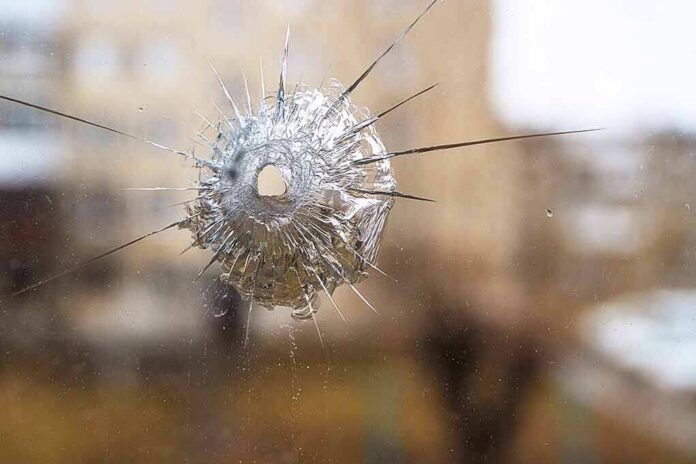
The most durable layer of home security is not a gadget by the door but the envelope of the house itself; in Fort Lauderdale, two masked suspects reportedly learned that the hard way when a hurricane-impact window absorbed repeated blows from a handgun and kept an occupied family inside separated from danger.
At a Glance
- Fort Lauderdale Police say two masked suspects attempted to force entry into an occupied home; video reportedly shows one striking an impact-rated window with a handgun without breaching it.
- The episode illustrates how laminated “hurricane” glazing resists forced entry by holding together even after shattering, buying crucial time for occupants to call 911.
- Under federal victimization definitions, attempted entries fall within the household-burglary category—failed does not mean trivial.
- Most household burglaries involve no violence; when residents are home and violence occurs, offenders are typically unarmed, but firearm-involved events do happen.
What Reportedly Happened: An Attempted Forced Entry, Stopped at the Glass
Fort Lauderdale Police maintain that on the early evening of October 19, 2026, two masked individuals approached an occupied residence and tried to break in. Surveillance footage, as described in contemporaneous coverage, shows one suspect in a dark hoodie and red pants repeatedly striking a window with a handgun as a striking tool. The glass cracked but did not give way, and the pair fled before gaining access. Detectives asked the public for tips to identify the suspects. That is the essential sequence: attempted forcible entry, an occupied home, a firearm brandished and used as an impactor, and a failure to breach because of the window’s construction.
Legally and practically, “attempted” is not a footnote. Under federal victimization standards, household burglary encompasses unlawful or forcible entry as well as attempted entry, whether or not property is stolen; the law and the data treat those events as serious incidents because intent, presence of residents, and use of force are what elevate risk—not just whether a theft was completed.
Why The Window Held: Laminated Impact Glass and Its Failure Mode
Impact-rated windows evolved for hurricanes, not burglars, but their physics makes them unusually resilient to forced entry. A typical unit is a laminated “sandwich”: two sheets of glass bonded to a tough interlayer—usually polyvinyl butyral (PVB) or a similar polymer—then anchored within a reinforced frame. When struck, the glass cracks and may even spiderweb dramatically; the interlayer, however, keeps the pane intact and anchored, preventing an opening large enough to squeeze through. In ordinary annealed glass, a single sharp blow can produce an aperture in seconds; with laminated impact glass, even repeated strikes tend to create cracks without a pass-through, buying time and making noise—the two things intruders dislike most.
The failure mode matters. Standard glazing fails brittlely: break, gap, entry. Laminated assemblies fail ductilely: fracture, adhere, resist. That distinction is why the Fort Lauderdale suspects reportedly could not convert visible damage into an entry point with ad hoc tool use—the side of a handgun—rather than a dedicated breaching implement. Well-installed units also distribute forces into robust frames and anchorage, raising the work needed from “quick smash” to “prolonged attack.”
How This Fits the Broader Pattern of Household Burglary Risk
Household burglary, not commercial burglary, is the dominant setting for break-ins. Bureau of Justice Statistics materials make two other points relevant here. First, attempted entries “count”—they show up in the data and in victims’ lives because the harm is rooted in the invasion of the home and the escalation potential, not just the loss of property. Second, violence during burglaries while residents are present is the exception rather than the rule; among those violent cases, the majority of offenders are unarmed, though a nontrivial fraction involve firearms. In that light, a window that forces delay and increases effort serves a protective function disproportionate to its simplicity: it short-circuits speed, which is often the intruder’s main advantage, and dampens escalation pressure inside the home.
The Fort Lauderdale video account also underscores a common offender pattern: improvisational tool use and a bias for quick entry. Opportunistic actors rarely bring the specialized breaching tools that would defeat well-installed laminates more efficiently. By forcing multiples of time, effort, and noise, hardened fenestration increases the likelihood of abandonment—precisely what appears to have happened here.
Mechanics of Deterrence: Time, Noise, and Visible Hardening
Security engineering reduces risk with three levers: raise the effort to attack, increase the time to complete it, and amplify exposure (noise, visibility) during the attempt. Laminated impact windows act on all three. They convert a seemingly vulnerable perimeter into a stubborn membrane; they ensure that each strike yields spectacle but not access; and they make success a matter of sustained, conspicuous effort. In everyday practice, that is often enough. Industry testing and storm research—originally aimed at windborne debris and building-envelope integrity—has documented how these assemblies absorb impacts without catastrophic opening; the same property frustrates would-be intruders.
While consumer marketing sometimes drifts into hyperbole, the core claim stands: compared with standard glass, properly specified and installed impact glazing is significantly more resistant to hurried forced entry. The Fort Lauderdale incident is a textbook demonstration of that principle in the real world.
Law and Language: Attempted Burglary Still Means Serious Crime
When police describe an “attempted residential burglary,” they are applying statutory concepts that hinge on intent and action, not just outcome. National definitions used in victimization surveys explicitly include attempts—unlawful or forcible entry tried but not completed—at residences, attached garages, or other structures on the property. This matters for homeowners and communities because policy, insurance, and policing strategies track those attempts as risk signals. A failed entry is not a nonevent; it is a near-miss in which target hardening and circumstance happened to win the day.
Data on violence during household burglaries also helps calibrate response. Most such crimes do not involve weapons; among those that do escalate to violence while residents are home, only a subset involve firearms. That is cold comfort during an incident but useful context for prevention: passive measures that slow entry and create decision points—locks, lighting, laminated glazing—tend to reduce exposure to direct confrontation in the moments when outcomes are most volatile.
Practical Takeaways for Homeowners: Building a Resilient Perimeter
The Fort Lauderdale attempt highlights a layered approach that does not require turning a home into a fortress. If you live in hurricane country, impact-rated windows and doors are already a sound investment for wind and debris; their resistance to opportunistic forced entry is a consequential bonus. Combine that with reinforced door hardware, solid-core exterior doors, and motion-activated lighting to create friction at every step. The goal is not absolute invulnerability but to shift the offense–defense balance: add minutes, add noise, reduce the intruder’s confidence. Surveillance helps after the fact and can aid police, but the decisive layer in this case was physical: the laminate held, and the suspects left.
Sources:
nypost.com, cityofevanston.org, publicapps.troopers.ny.gov, wsvn.com